Solar flares set the Sun quaking
April 18th, 2008 Solar flares set the Sun quaking

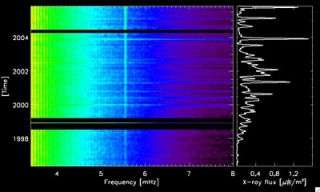
A frequency-time diagram of global oscillations in the Sun as measured by SOHO. The colour-coding represents the strength of the oscillations. The bright horizontal lines are strongly correlated with solar flares, represented by the solar X-ray flux in the right panel. These lines are most prominent in the high-frequency region of the spectrum. The vertical line at 5.55 mHz in the left panel is an instrumental artifact. Credits: SOHO/VIRGO (ESA & NASA)

Data from the ESA/NASA spacecraft SOHO shows clearly that powerful starquakes ripple around the Sun in the wake of mighty solar flares that explode above its surface. The observations give solar physicists new insight into a long-running solar mystery and may even provide a way of studying other stars.

The outermost quarter of the Sun’s interior is a constantly churning maelstrom of hot gas. Turbulence in this region causes ripples that criss-cross the solar surface, making it heave up and down in a patchwork pattern of peaks and troughs.

The joint ESA-NASA Solar and Heliospheric Observatory (SOHO) has proved to be an exceptional spacecraft for studying this phenomenon. Discovering how the ripples move around the Sun has provided valuable information about the Sun’s interior conditions. A class of oscillations called the 5-minute oscillations with a frequency of around 3 millihertz have proven particularly useful.

According to conventional thinking, the 5-minute oscillations can be thought of as the sound you would get from a bell sitting in the middle of the desert and constantly being touched by random sand grains, blown on the wind. But what Christoffer Karoff and Hans Kjeldsen, both at the University of Aarhus, Denmark, saw in the data, was very different.

“The signal we saw was like someone occasionally walking up to the bell and striking it, which told us that there was something missing from our understanding of how the Sun works,” Karoff says.

So they began looking for the culprit and discovered an unexpected correlation with solar flares. It seemed that when the number of solar flares went up, so did the strength of the 5-minute oscillations.

“The strength of the correlation was so strong that there can be no doubt about it,” says Karoff.

A similar phenomenon is known on Earth in the aftermath of large earthquakes. For example, after the 2004 Sumatra-Andaman Earthquake, the whole Earth rang with seismic waves like a vibrating bell for several weeks.

The correlation is not the end of the story. Now the researchers have to work to understand the mechanism by which the flares cause the oscillations. “We are not completely sure how the solar flares excite the global oscillations,” says Karoff.

In a broader context, the correlation suggests that, by looking for similar oscillations within other stars, astronomers can monitor them for flares. Already, Karoff has used high-technology instruments at major ground-based telescopes to look at other Sun-like stars. In several cases, he detected the tell-tale signs of oscillations that might originate from flares.

“Now we need to monitor these stars for hundreds of days,” he says. That will require dedicated spacecraft, such as the CNES mission with ESA participation, COROT. The hard work, it seems, is just starting.

Citation: ‘Evidence that solar flares drive global oscillations in the Sun’ by C. Karoff & H. Kjeldsen will be published in The Astrophysical Journal Letters on 1 May 2008.

Source: European Space Agency


print this article email this article download pdf blog this article bookmark this article     Digg this Stumble it share on Facebook share on Reddit add to delicious save to Yahoo! bookmarks
4.1/5 after 19 votes


April 18th, 2008 all stories
Space & Earth / Space Exploration

Comments: 0
Rank: 4.1/5 after 19 votes

  • Stumble this up

  • Digg this

  • Share it:
  • share on Facebook
  • share on MySpace
  • share on Slashdot
  • rss-newsfeed
  • share on Google
  • share on Reddit
  • add to delicious
  • save to Yahoo! bookmarks
  • share on Windows Live
  • Add to Mixx!
Rating: 4.1/5 after 19 votes

  • Related Stories

  • Giant pipe organ in the solar atmosphere
    created Apr 19, 2007 | popularity not rated yet | comments 0
  • Double Star And Cluster Observe First Evidence Of Crustal Cracking
    created Sep 22, 2005 | popularity not rated yet | comments 0
  • Ultra-fast Movies of the Sky
    created Jun 09, 2005 | popularity not rated yet | comments 0
  • VLBA locates superenergetic bursts near giant black hole
    created Jul 02, 2009 | popularity not rated yet | comments 0
  • Sunspots revealed in striking detail by supercomputers
    created Jun 18, 2009 | popularity not rated yet | comments 0

Tags


  • Physicists Demonstrate Quantum Memory with Matter Qubits
    Physicists Demonstrate Quantum Memory with Matter Qubits
    Physics / General Physics
    created Jul 03, 2009 | popularity 4.4 / 5 (17) | comments 1
  • 'Holey' Nanosheets for Wastewater Dye Removal
    Nanotechnology / Nanomaterials
    created Jul 01, 2009 | popularity 5 / 5 (5) | comments 1
  • Jellyfish Robot Swims Like its Biological Counterpart
    Jellyfish Robot Swims Like its Biological Counterpart
    Electronics / Robotics
    created Jun 26, 2009 | popularity 4.4 / 5 (8) | comments 1
  • Could Maxwell's Demon Exist in Nanoscale Systems?
    Could Maxwell's Demon Exist in Nanoscale Systems?
    Physics / General Physics
    created Jun 24, 2009 | popularity 4.4 / 5 (18) | comments 29
  • Living Safely with Robots, Beyond Asimov's Laws
    Living Safely with Robots, Beyond Asimov's Laws
    Electronics / Robotics
    created Jun 22, 2009 | popularity 4.6 / 5 (52) | comments 40
  • Other News

    Forty years ago man first walked on the moon

    Space & Earth / Space Exploration

    created 15 hours ago | popularity 5 / 5 (2) | comments 1

    Forty years ago on July 20, 1969, American astronaut Neil Armstrong realized the oldest dream of human civilizations when he became the first man to walk on the moon.


    The least sea ice in 800 years

    The least sea ice in 800 years

    Space & Earth / Earth Sciences

    created Jul 01, 2009 | popularity 4.2 / 5 (62) | comments 56

    New research, which reconstructs the extent of ice in the sea between Greenland and Svalbard from the 13th century to the present indicates that there has never been so little sea ice as there is now. The ...


    Gas around young galaxy

    Intense heat killed the Universe's would-be galaxies, researchers say

    Space & Earth / Astronomy

    created Jul 01, 2009 | popularity 3.4 / 5 (21) | comments 27

    (PhysOrg.com) -- Our Milky Way galaxy only survived because it was already immersed in a large clump of dark matter which trapped gases inside it, scientists led by Durham University's Institute for Computational ...


    Scientists' Drill Hits Magma: Only Third Time on Record

    Scientists' Drill Hits Magma: Only Third Time on Record

    Space & Earth / Earth Sciences

    created Jun 29, 2009 | popularity 4.7 / 5 (22) | comments 19

    (PhysOrg.com) -- Scientists drilling a borehole deep into Iceland’s rocky crust to explore new methods of using geothermal energy hit a major roadblock on Thursday: Their drill ran into molten rock at a depth ...


    NASA manager pitches a cheaper return-to-moon plan

    Space & Earth / Space Exploration

    created Jun 30, 2009 | popularity 4 / 5 (7) | comments 18

    (AP) -- Like a car salesman pushing a luxury vehicle that the customer no longer can afford, NASA has pulled out of its back pocket a deal for a cheaper ride to the moon.