The next step in robot development is child’s play
Teaching robots to understand enough about the real world to allow them act independently has proved to be much more difficult than first thought.
The team behind the iCub robot believes it, like children, will learn best from its own experiences.
The technologies developed on the iCub platform – such as grasping, locomotion, interaction, and even language-action association – are of great relevance to further advances in the field of industrial service robotics.
The EU-funded RobotCub project, which designed the iCub, will send one each to six European research labs. Each of the labs proposed winning projects to help train the robots to learn about their surroundings – just as a child would.
The six projects include one from Imperial College London that will explore how ‘mirror neurons’ found in the human brain can be translated into a digital application. ‘Mirror neurons’, discovered in the early 1990s, trigger memories of previous experiences when humans are trying to understand the physical actions of others. A separate team at UPF Barcelona will also work on iCub’s ‘cognitive architecture’.
At the same time, a team headquartered at UPMC in Paris will explore the dynamics needed to achieve full body control for iCub. Meanwhile, researchers at TUM Munich will work on the development of iCub’s manipulation skills. A project team from the University of Lyons will explore internal simulation techniques – something our brains do when planning actions or trying to understand the actions of others.
Over in Turkey, a team based at METU in Ankara will focus almost exclusively on language acquisition and the iCub’s ability to link objects with verbal utterances.
“The six winners had to show they could really use and maintain the robot, and secondly the project had to exploit the capabilities of the robot,” says Giorgio Metta. “Looking at the proposals from the winners, it was clear that if we gave them a robot we would get something in return.”
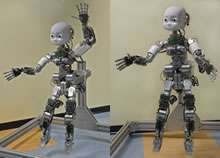
The iCub robots are about the size of three-year-old children, with highly dexterous hands and fully articulated heads and eyes. They have hearing and touch capabilities and are designed to be able to crawl on all fours and to sit up.
Humans develop their abilities to understand and interact with the world around them through their experiences. As small children, we learn by doing and we understand the actions of others by comparing their actions to our previous experience.
The developers of iCub want to develop their robots’ cognitive capabilities by mimicking that process. Researchers from the EU-funded Robotcub project designed the iCub’s hardware and software using a modular system. The design increases the efficiency of the robot, and also allows researcher to more easily update individual components. The modular design also allows large numbers of researchers to work independently on separate aspects of the robot.
iCub’s software coding, along with technical drawings, are free to anyone who wishes to download and use them.
“We really like the idea of being open as it is a way to build a community of many people working towards a common objective,” says Giorgio Metta, one of the developers of iCub. “We need a critical mass working on these types of problems. If you get 50 researchers, they can really layer knowledge and build a more complex system. Joining forces really makes economic sense for the European Commission that is funding these projects and it makes scientific sense.”
Built-in learning skills
While the iCub’s hardware and mechanical parts are not expected to change much over the next 18 months, researchers expect to develop the software further. To enable iCub to learn by doing, the Robotcub research team is trying to pre-fit it with certain innate skills.
These include the ability to track objects visually or by the sounds – with some element of prediction of where the tracked object will move to next. iCub should also be able to navigate based on landmarks and a sense of its own position.
But the first and key skill iCub needs for learning by doing is an ability to reach towards a fixed point. By October this year, the iCub developers plan to develop the robot so it is able to analyse the information it receives via its vision and feel ‘senses’. The robot will then be able to use this information to perform at least some crude grasping behaviour – reaching outwards and closing its fingers around an object.
“Grasping is the first step in developing cognition as it is required to learn how to use tools and to understand that if you interact with an object it has consequences,” says Giorgio Metta. “From there the robot can develop more complex behaviours as it learns that particular objects are best manipulated in certain ways.”
Once the assembly of the six robots for the research projects is completed, the developers plan to build more iCubs, creating between 15 and 20 in use around Europe.
The six project winners are:
-- Imperial College London: Embodied cognition using internal simulation and a global workspace;
-- Université Pierre et Marie Curie, Paris: Motor, affective and cognitive scaffolding for iCub;
-- Centre National de la Recherche Scientifique (CNRS)/Université Lumiere Lyon 2: Development of shared intentions and cooperation in a humanoid robot via situated simulation models;
-- Technischen Universität München, Munich: iCub development of kids' manipulation skills;
-- Universitat Pompeu Fabra, Barcelona: An integrated anthropomorphic neuromorphic cognitive architecture for the iCub; and,
-- Middle East Technical University, Ankara: Emergence of communication in iCub through sensorimotor and social interaction.
Source: ICT Results


