Black hole sheds light on a galaxy
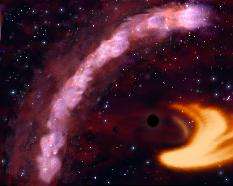
A light echo occurs when interstellar gas is heated by radiation and reacts by emission of light. An international team led by Stefanie Komossa from the Max Planck Institute for extraterrestrial Physics in Garching, Germany, has observed the light echo of an enormous X-ray flare, which was almost certainly produced when a single star was disrupted by a supermassive black hole.
For the first time, the light echo of such a rare and highly dramatic event could be observed in great detail. The light echo not only revealed the stellar disruption process, but it also provides a powerful new method for mapping galactic nuclei (Astrophysical Journal Letters, Mai 2008).
When a star is disrupted by a black hole in the nucleus of a galaxy, its debris is inevitably attracted and absorbed by the black hole. This sudden increase in the accretion rate causes an abrupt burst of ultraviolet and X-ray light because the gas from the disrupted star becomes very hot. As the high-energy radiation travels through the core of the galaxy it illuminates surrounding matter and so makes it possible to probe regions of the galaxy that would otherwise be unobservable.
"To study the core of a normal galaxy is like looking at the New York skyline at night during a power failure: You can't learn much about the buildings, roads and parks", says Stefanie Komossa. "The situation changes, for example, during a fireworks display. It's exactly the same when a sudden burst of high-energy radiation illuminates a galaxy." However the astronomers had to hurry up and look through the telescope at the right moment, because X-ray bursts don't last very long.
From the strength, the degree of ionization and the deduced velocities of the rapidly varying emission lines, the physicists can tell in which part of the galaxy they are emitted. The emission lines represent the "fingerprints" of the atoms in the hot gases heated by the flare. The galaxy with catalog name SDSSJ0952+2143 which was detected in December 2007 by Komossa and her team in the Sloan Digital Sky Survey archive caught their attention because of its superstrong iron lines: the strongest (relative to oxygen emission) that were ever observed in a galaxy. In them the authors see an evidence for a molecular torus which plays an important part in so-called unified models of active galaxies.
The unified model postulates that all active galaxies are made of identical components and that the perceived differences are just due to the different directions from which we view the galaxies. An important element of this model is the molecular torus, which surrounds the black hole and its accretion disk and covers them when viewed from certain directions. Also the breadth of the spectral lines which the scientists measure is influenced by the viewing direction and that means by the molecular torus.
Should the expectations of Komossa and her colleagues be confirmed, this will be the first time that scientists have seen such a strong time-variable signal from a molecular torus. From the light echo, the torus can be mapped and its geometry inferred, something which has not been possible up to now.
Along the same lines is the detection of variable emission in the infrared: It can be interpreted as the "last cry for help" of the heated dusty torus matter before the dust is destroyed by the flash.
In addition to the remarkably strong iron lines, the scientists also noticed a very peculiar shape of the hydrogen emission lines which had never been seen before. This line hints at activities of the disk of matter around the black hole, which consists mainly of hydrogen. "Probably we are seeing the debris of the disrupted star here which is just being accreted by the black hole", explains Hongyan Zhou from the MPE, co-author of the research paper.
The recently-discovered light echo still continues and is being traced with powerful telescopes. The burst itself has faded away. The first observations with the X-ray satellite Chandra show measurable but already faint X-ray light from the galactic nucleus.
"Reverberation-mapping of light echoes opens up new possibilities to study galaxies", concludes Komossa. The team now wants to use this method to explore the physical conditions in the circumnuclear material in active and non-active galaxies.
Original paper: arXiv:0804.2670v1 [astro-ph]
Source: Max Planck Institute for Astrophysics


