Seeing clearly despite the clouds
April 18, 2008
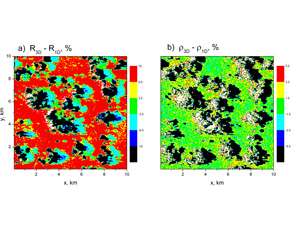
Clearly cloudy: Using the ratio method (right) clears up the satellite view (left) of a partly cloudy sky. Credit: PNNL
Satellites taking atmospheric measurements might now be able to see blue skies as clearly as optimists do. Researchers have found a way to reduce cloud-induced glare when satellites measure blue skies on cloudy days, by as much as ten-fold in some cases. The result might lead to more accurate estimates of the amount of sunlight penetrating the atmosphere. Because clouds represent one of the largest areas of uncertainty, eventually this could lead to improved climate models.
Sunlight bouncing off clouds blinds satellites trying to determine how much the blue sky between is actually reflecting. Researchers at the Department of Energy's Pacific Northwest National Laboratory have found that using an indirect measurement of that reflected light can bring the measurements of cloud-bordered blue skies to within about 10 percent of what other instruments indicate, the researchers report March 28 in Geophysical Research Letters.
"When researchers try to apply satellite technology originally developed for clear skies to partly cloudy conditions, they find additional light reflected from clouds," says PNNL atmospheric scientist Evgueni Kassianov. "We can't use the same technology we use for clear skies for complex cloudy skies."
Blue skies might seem empty, but they are full of naked-to-the-eye particles called aerosols, which are made up of water and bits of matter. These aerosols reflect sunlight. The more aerosols, the more sunlight is reflected back to the satellite. But on cloudy days, clouds bounce sunlight all around and make nearby aerosols seem brighter than they really are. Previous research has shown that clouds can brighten aerosols even up to three kilometers (almost two miles) away.
Atmospheric scientists convert the brightness of those aerosols into a value called the aerosol optical depth. This is roughly how far light can penetrate the air, sometimes thought of as visibility: skies with few aerosols appear clear and skies with many appear hazy. Previous work has shown that nearby clouds can increase the brightness of blue skies by 10 to 15 percent, underestimating the visibility by 140 percent.
To address the problem, Kassianov and his fellow PNNL researcher Mikhail Ovtchinnikov took advantage of the fact that clouds largely reflect the same amount of light regardless of the wavelength of light. Aerosols, on the other hand, reflect sunlight at different wavelengths to differing degrees. So, the two tested whether using ratios of sunlight reflectance at different wavelengths might allow the extra reflectance from clouds to drop out of their atmospheric images.
The idea worked. The researchers constructed two images of a patch of cloudy sky using cumbersome computational methods that can subtract out estimated cloud-induced glare. One was based on total reflected light, and the other was based on ratios of how much light was reflected at two different wavelengths. The ratio image provided a view of the cloudy sky with much better contrast than the reflected light one, indicating that ratios better delineate blue sky from cloud.
But a pretty picture won't help anyone recreate aerosols in a computer model. So the team devised an innovative way to convert the ratios back into aerosol optical depths. The team created a database that related wavelength ratios, particles sizes, number of particles and aerosol optical depth. From this database, two ratios would allow them to determine their aerosol properties of interest.
The two then determined the accuracy of the ratio method. They selected data from a typical summer day in the southern Great Plains, gathered via the DOE's Atmospheric Radiation Measurement Climate Research Facility (ACRF) in Oklahoma. Using the ratio method, they retrieved the aerosol optical depth at three wavelengths (470, 660 and 870 nanometers) and compared this to the original data. The ratio method estimated aerosol optical depth under partly cloudy conditions with an error of only about 10 percent.
If the results hold up with additional testing, Kassianov says this approach could be applied to data being collected by NASA's Earth Observing System in skies near clouds.
"Researchers use different models and try to incorporate aerosol effects. The models are so inaccurate that we don't know how much aerosols change cloud properties," he says. "This tool could potentially increase the accuracy of our climate models."
Source: Pacific Northwest National Laboratory
-
Geoengineering could save Earth -- or destroy it
Dec 02, 2011 |
5 / 5 (2) |
13
-
British team set to field test gigantic balloon and water hose geo-engineering experiment
Sep 02, 2011 |
2.8 / 5 (17) |
75
-
Scientists working on technique to use lasers to force rain
Sep 01, 2011 |
4.8 / 5 (4) |
3
-
For water researchers, an atmosphere full of questions
Jun 13, 2011 |
not rated yet |
0
-
Clouds' effect on sunlight energy at Earth's surface depends on the wavelength of light
May 09, 2011 |
4.8 / 5 (5) |
5
-
Engineers build first sub-10-nm carbon nanotube transistor
Feb 01, 2012 |
4.9 / 5 (33) |
30
-
Something old, something new: Evolution and the structural divergence of duplicate genes
Jan 31, 2012 |
4.6 / 5 (7) |
1
-
The hidden nanoworld of ice crystals: Revealing the dynamic behavior of quasi-liquid layers
Jan 30, 2012 |
5 / 5 (5) |
1
-
Stock market network reveals investor clustering
Jan 27, 2012 |
3.9 / 5 (23) |
8
-
Of microchemistry and molecules: Electronic microfluidic device synthesizes biocompatible probes
Jan 26, 2012 |
5 / 5 (2) |
0
-
Do some geologists actually act a lot like Randy Marsh?
Feb 11, 2012
-
Discrepancy between oxygen and carbon-dioxide levels
Feb 09, 2012
-
where gems are found in the world
Feb 09, 2012
-
Wind Waves in Reservoir ~ Wind run-up and Wind set-up
Feb 08, 2012
-
Balance of oxygen in the atmosphere
Feb 01, 2012
-
The case for a methanol-based economy
Jan 30, 2012
- More from Physics Forums - Earth
More news stories
Climate change causes harmful algal blooms in North Atlantic: study
Warming oceans and increases in windiness could be causing of an abundance of harmful algal blooms in the North Atlantic Ocean and North Sea, according to new research.
2 hours ago |
not rated yet |
0
New European rocket lifts off on maiden flight
A new lightweight rocket, Vega, lifted off from Europe's space base Monday carrying nine satellites on its inaugural flight, mission control said.
Space & Earth / Space Exploration
55 minutes ago |
5 / 5 (2) |
1
Salvage workers begin pumping fuel from Italian shipwreck
Salvage workers Sunday began pumping fuel from the shipwrecked Italian cruise liner Costa Concordia, a day ahead of schedule, officials said.
17 hours ago |
5 / 5 (2) |
0
NASA budget will axe Mars deal with Europe: scientists
US President Barack Obama's budget proposal to be submitted next week for 2013 will cut NASA's budget by 20 percent and eliminate a major partnership with Europe on Mars exploration, scientists said Thursday.
Space & Earth / Space Exploration
Feb 10, 2012 |
5 / 5 (4) |
59
Humans may have helped the decline of African rainforests 3000 years ago
(PhysOrg.com) -- Large areas of rainforests in Central Africa mysteriously disappeared over three thousand years ago, to be replaced by savannas. The prevailing theory has been that the cause was a change ...
New molecule has potential to help treat genetic diseases and HIV
(PhysOrg.com) -- Chemists at The University of Texas at Austin have created a molecule that's so good at tangling itself inside the double helix of a DNA sequence that it can stay there for up to 16 days before ...
Social psychologist: Lust makes you smarter and evidence that seven deadly sins are good for you
(Medical Xpress) -- Good news for lovers on Valentine’s Day - the seven deadly sins, including Lust, are good for you. University of Melbourne social psychologist Dr Simon Laham uses modern research to make a compelling ...
The joy of cheques
An electronic cheque which eliminates the need for costly processing by banks but preserves the simplicity and ease of a traditional cheque book has been designed by a team of academics in the UK.
Research finds injuries to professional athletes from routine play or practice often reported as 'freak accidents' in me
(Medical Xpress) -- A new report from the Johns Hopkins Center for Injury Research and Policy finds injuries to professional athletes from routine play or practice are often characterized as freak accidents in ...
Researchers' paper wins Best Paper Award for 2011
A paper written by Dr. Paul Gratz and his graduate student, Reena Panda, from the Department of Electrical and Computer Engineering at Texas A&M University was selected as one of the best papers from IEEE Computer Architecture ...
Low levels of amplitude-modulated electromagnetic fields elicit therapeutic responses cancer patients
Ryne Ramaker, a senior UALR Donaghey Scholar and University Science Scholar with a double major in biology and chemistry, is a co-author of a cancer research paper creating excitement among other researchers. The article ...
Apr 19, 2008
Rank: not rated yet
Apr 19, 2008
Rank: not rated yet