Scientists study microbe filaments' power
April 18, 2008 Scientists study microbe filaments' power

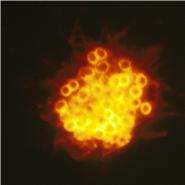
An immunoflourescent image of a neisseria microcolony and its radiating pili. (Photo by Maggie So)

Researchers from The University of Arizona and Columbia University have discovered that tiny filaments on bacteria can bundle together and pull with forces far stronger than experts had previously thought possible.

The team of researchers, including Magdalene “Maggie” So, a member of the BIO5 Institute and the department of immunobiology in the UA College of Medicine, studied Type IV pili – or filaments – on the surface of Neisseria gonorrhoeae, the bacterium that causes the infectious disease gonorrhea. The research results help them understand the role that Type IV pili play in initiating a variety of infectious diseases – including tuberculosis – and how retracting pili allow bacteria to crawl and to exchange genes with each other.

When a bundle of Type IV pili retracts, it pulls with a force in the nanoNewton range, which is 10 times the force of a single retracting filament. The study demonstrates the power and cooperative nature of the nanomotors that cause Type IV pili to retract.

“The motor that causes these filaments to pull is one of the strongest nanomotors known in biology,” So said.

In previous studies, the same group of investigators measured single filament retraction forces in the 50 to 100 picoNewton range. This force allows the bacterium to move an object 10,000 times its own body weight. Retraction forces from a bundle are roughly 10 times higher, allowing the bacterium to move objects 100,000 times its body weight.

Pilus retraction forces are an important factor in how N. gonorrhoeae starts an infection. So, who has studied these microbes for more than 20 years, says N. gonorrhoeae communicates with a human cell by pulling on it. These pulling forces perturb the normal circuitry of the cell. As a result, the infected cell is fooled into lowering its defenses against the infecting microbe.

So said that the team of investigators came up with a new method to measure the tremendous forces applied by retracting pili. They allow bacteria to sit on a dense brushwork of tiny elastic pillars. The pili attach to these pillars. When pili retract, they bend the pillars. By measuring how the pillars bend, the investigators calculate the retraction forces.

Source: University of Arizona


print this article email this article download pdf blog this article bookmark this article     Stumble it Digg this share on Facebook retweet share on Reddit add to delicious
Rate this story - 4 /5 (4 votes)


April 18, 2008 all stories

Comments: 0

4 /5 (4 votes)
  • Stumble this up

  • Digg this

  • share this

  • hide
  • Related Stories

  • Beautiful Bugs in Blue: The Making of Luminous Bacteria
    created Mar 05, 2009 | popularity not rated yet | comments 0
  • Predatory bacterial swarm uses rippling motion to reach prey
    created Oct 29, 2008 | popularity not rated yet | comments 0
  • Running on Microbes
    created Dec 20, 2006 | popularity not rated yet | comments 0
  • Bacterium with grabber arms stops intruders
    created Oct 16, 2009 | popularity not rated yet | comments 0
  • Making more efficient fuel cells
    created Sep 07, 2009 | popularity not rated yet | comments 0


Other News

Rocket science leads to new whale discovery

Rocket science leads to new whale discovery

Biology / Other

created 45 minutes ago | popularity not rated yet | comments 0

Rocket science is opening new doors to understanding how sounds associated with Navy sonar might affect the hearing of a marine mammal - or if they hear it at all.


A male flanged orangutan hangs from a tree in Malaysian Borneo's Sabah State

Malaysia tracks orangutans with implants

Biology / Plants & Animals

created 6 minutes ago | popularity not rated yet | comments 0

Malaysian wildlife authorities are using electronic implants to keep track of orangutans in a bid to protect the endangered apes after they are freed into the wild, an official said Tuesday.


A coating for life: Biodegradable fibers advance stent technology and brain surgery, then disappear

A coating for life: Biodegradable fibers advance stent technology and brain surgery, then disappear

Biology / Biotechnology

created 3 hours ago | popularity 5 / 5 (2) | comments 0

Stents that keep weakened and flabby arteries from collapsing have been true life-savers. But after six months, those stents are no longer needed -- once the arteries are strengthened, they become unnecessary. ...


Report shows dramatic decline in Siberian tigers

Report shows dramatic decline in Siberian tigers

Biology / Ecology

created 1hour ago | popularity not rated yet | comments 0

The Wildlife Conservation Society (WCS) announced today a report revealing that the last remaining population of Siberian tigers has likely declined significantly due to the rising tide of poaching and habitat ...


Fish food fight: Fish don't eat trees after all, says new study

Fish food fight: Fish don't eat trees after all, says new study

Biology / Ecology

created 5 hours ago | popularity 4.5 / 5 (2) | comments 0

(PhysOrg.com) -- What constitutes fish food is a matter of debate. A high-profile study a few years ago suggested that fish get almost 50 percent of their carbon from trees and leaves, evidence for a very ...