The Antarctic deep sea gets colder
April 21, 2008 The Antarctic deep sea gets colder

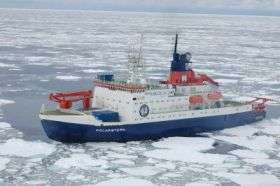
Polarstern in sea ice. Credit: M. Schueller / Alfred Wegener Institute

The Antarctic deep sea gets colder, which might stimulate the circulation of the oceanic water masses. This is the first result of the Polarstern expedition of the Alfred Wegener Institute for Polar and Marine Research in the Helmholtz Association that has just ended in Punta Arenas/Chile. At the same time satellite images from the Antarctic summer have shown the largest sea-ice extent on record. In the coming years autonomous measuring buoys will be used to find out whether the cold Antarctic summer induces a new trend or was only a "slip".

The Polarstern expedition ANT-XXIV/3 was dedicated to examining the oceanic circulation and the oceanic cycles of materials that depend on it. Core themes were the projects CASO (Climate of Antarctica and the Southern Ocean) and GEOTRACES, two of the main projects in the Antarctic in the International Polar Year 2007/08.

Under the direction of Dr. Eberhard Fahrbach, Oceanographer at the Alfred Wegener Institute, 58 scientists from ten countries were on board the research vessel Polarstern in the Southern Ocean from 6 February until 16 April, 2008. They studied ocean currents as well as the distribution of temperature, salt content and trace substances in Antarctic sea water.

"We want to investigate the role of the Southern Ocean for past, present and future climate," chief scientist Fahrbach said. The sinking water masses in the Southern Ocean are part of the overturning in this region and thus play a major role in global climate. "While the last Arctic summer was the warmest on record, we had a cold summer with a sea-ice maximum in the Antarctic. The expedition shall form the basis for understanding the opposing developments in the Arctic and in the Antarctic," Fahrbach said.

In the frame of the GEOTRACES project the scientists found the smallest iron concentrations ever measured in the ocean. As iron is an essential trace element for algal growth, and algae assimilate CO2 from the air, the concentration of iron is an important parameter against the background of the discussion to what extent the oceans may act as a carbon sink.

As the oceanic changes only become visible after several years and also differ spatially, the data achieved during the Polarstern expeditions are not sufficient to discern long-term developments. The data gap can only be closed with the aid of autonomous observing systems, moored at the seafloor or drifting freely, that provide oceanic data for several years. "As a contribution to the Southern Ocean Observation System we deployed, in international cooperation, 18 moored observing stations, and we recovered 20. With a total of 65 floating systems that can also collect data under the sea ice and are active for up to five years we constructed a unique and extensive measuring network," Fahrbach said.

In order to get the public, and especially the young generation, interested in science and research and to sensitise them for environmental processes, two teachers were on board Polarstern. Both took an active part in research work and communicated their experiences to pupils, colleagues and the media via internet and telephone. "We will bring home many impressions from this expedition, and we will be able to provide a lively picture of the polar regions and their impact on the whole earth to the pupils," Charlotte Lohse, teacher at the Heisenberg-Gymnasium in Hamburg, and Stefan Theisen from the Free Waldorf School in Kiel said.

Source: Helmholtz Association of German Research Centres


Rate this story - 4.7 /5 (10 votes)

Rank Filter

Move the slider to adjust rank threshold, so that you can hide some of the comments.


Display comments: newest first

  • CWFlink - Apr 22, 2008
    • Rank: not rated yet
    "While the last Arctic summer was the warmest on record, we had a cold summer with a sea-ice maximum in the Antarctic. The expedition shall form the basis for understanding the opposing developments in the Arctic and in the Antarctic," Fahrbach said.

    So "Global Warming" is not "global" ???

    I know... it is just a "slip"... not a trend. But who says when a series of slips become a trend? We are a world in crisis, but I doubt seriously if we'll die of global warming before we kill ourselves off fighting over who is right and who is wrong.
  • NigelW - Apr 22, 2008
    • Rank: not rated yet
    The lack of iron is definitely something to fret about isnt it. Its a double downer. First: If iron shortage leads to less algae then bang has gone the start of the food chain. Less algae, less krill, less fish, less humans.

    And second: Less biomass leads to less CO2 uptake, further reducing the biosphere's ability to absorb our increasing CO2 emissions. Meaning the rate of increase will be exacerbated. I guess this reinforces the drop in CO2 uptake in the southern ocean that was last year ascribed to the higher mixing rates due the stronger winds caused by the more energetic global climate. So we have multiple hits going on down there. Keep an eye on it please folks!
  • niftyswell - Apr 28, 2008
    • Rank: 1 / 5 (1)
    Strange how every cold event is labeled a 'slip' or an outlyer while every warm event is proof positive. Almost as if someone has an agenda they are trying to prove. We need dispassionate observation and analysis, not reactionary hype whose only solution involves laws, taxes, and sacrifice.

    BTW- I have accepted no $$ from any outside corporate interest in stating my opinion.
  • Harriman - Jul 29, 2008
    • Rank: not rated yet
    If you put a ball of icecream on a plate, when it melts, the "extent" will be larger, and the temperature of the outer part of the melted icecream will be lower than before it was there.

    What is required is an assessment of the stored energy in the system.

    If you are in an igloo, and the igloo starts to melt, some cold meltwater falls onto your forehead, your forehead gets cooler. Would it make sense to determine that since your forehead got cooler, the igloo wasn't melting?

April 21, 2008 all stories

Comments: 4

4.7 /5 (10 votes)

  • hide
  • Related Stories

  • Polar Sea Ice replicated in Hamburg
    created Sep 28, 2009 | popularity not rated yet | comments 0
  • New Antarctic seabed sonar images reveal clues to sea-level rise
    created May 05, 2009 | popularity not rated yet | comments 0
  • Research around the North Pole
    created Oct 20, 2008 | popularity not rated yet | comments 0
  • Arctic ice on the verge of another all-time low
    created Aug 28, 2008 | popularity not rated yet | comments 0
  • RV Polarstern on its way to East Siberian Sea
    created Aug 21, 2008 | popularity not rated yet | comments 0


  • hide
  • Relevant PhysicsForums posts

  • Carbon Dioxide emissions question
    created Feb 08, 2010
  • Photosynthesis vs. carbonization
    created Feb 07, 2010
  • Sheep's footprints
    created Feb 05, 2010
  • How did Victorians estimate the ages of fossils?
    created Feb 03, 2010
  • More from Physics Forums - Earth

Other News

India announces long-range nuclear-capable missile test

Space & Earth / Space Exploration

created 8 minutes ago | popularity not rated yet | comments 0

India will test a nuclear-capable missile with a range of over 5,000 kilometres (3,000 miles) within a year, its top military scientist said Wednesday, risking a rise in regional tensions.


Space shuttle Endeavour pulls in at space station (AP)

Space shuttle Endeavour pulls in at space station

Space & Earth / Space Exploration

created 5 hours ago | popularity 5 / 5 (1) | comments 0

(AP) -- Shuttle Endeavour arrived to a warm welcome at the International Space Station early Wednesday, delivering a new room and observation deck that will come close to completing construction 200 miles ...


Climate 'Tipping Points' May Arrive Without Warning, Says Top Forecaster

Space & Earth / Environment

created 15 hours ago | popularity 3 / 5 (8) | comments 10 | with audio podcast

(PhysOrg.com) -- A new University of California, Davis, study by a top ecological forecaster says it is harder than experts thought to predict when sudden shifts in Earth's natural systems will occur -- a worrisome finding ...


38 percent of world's surface in danger of desertification

38 percent of world's surface in danger of desertification

Space & Earth / Environment

created 12 hours ago | popularity 2 / 5 (4) | comments 6

A team of Spanish researchers has measured the degradation of the planet's soil using the Life Cycle Assessment (LCA), a scientific methodology that analyses the environmental impact of human activities, and ...


A new 3-D map of the interstellar gas within 300 parsecs from the sun

A new 3D map of the interstellar gas within 300 parsecs from the Sun

Space & Earth / Astronomy

created 18 hours ago | popularity 5 / 5 (5) | comments 0 | with audio podcast

(PhysOrg.com) -- Astronomy & Astrophysics is publishing new 3D maps of the interstellar gas in the local area around our Sun. A French-American team of astronomers presents new absorption measurements toward ...