Arctic ice more vulnerable to sunny weather, new study shows
April 21, 2008 NASA Satellite Image

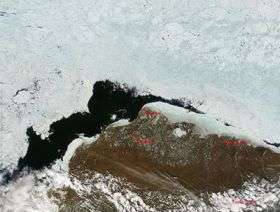
This June 7, 2007 NASA satellite image, taken under mostly cloud-free conditions, shows the beginning of last summer's Arctic sea ice melt. Credit: Image courtesy NASA

The shrinking expanse of Arctic sea ice is increasingly vulnerable to summer sunshine, new research concludes. The study, by scientists at the National Center for Atmospheric Research (NCAR) and Colorado State University (CSU), finds that unusually sunny weather contributed to last summer's record loss of Arctic ice, while similar weather conditions in past summers do not appear to have had comparable impacts.

The study, which draws on observations from instruments on a new group of NASA satellites known as the "A-Train," will be published tomorrow in Geophysical Research Letters. It was funded by NASA and the National Science Foundation, which is NCAR's principal sponsor.

"In a warmer world, the thinner sea ice is becoming increasingly sensitive to year-to-year variations in weather and cloud patterns," says NCAR's Jennifer Kay, the lead author. "A single unusually clear summer can now have a dramatic impact."

The findings indicate that summer sunshine in the Arctic produces more pronounced melting than in the past, largely because there is now less ice to reflect solar radiation back into space. As a result, the presence or absence of clouds now has greater implications for sea ice loss.

Satellite data offer clues to record-shattering 2007 melt

Last summer's loss of Arctic sea ice set a modern-day record, with the ice extent shrinking to a minimum of about 1.6 million square miles (4.1 million square kilometers) in September. That was 43 percent less ice coverage than in 1979, when accurate satellite observations began.

Looking at the first two years of data from radar and lidar on the A-Train satellites, Kay and her colleagues found that total summertime cloud cover in the Western Arctic was 16 percent less in 2007 than the year before. A strong high-pressure system centered north of Alaska kept skies relatively clear. Over a three-month period in the summer, the increased sunshine was strong enough to melt about a foot of surface ice. Over open water, it was sufficient to increase sea-surface temperatures by 4.3 degrees Fahrenheit (2.4 degrees Celsius). Warmer ocean waters can contribute to sea ice loss by melting the ice from the bottom, thereby thinning it and making it more susceptible to future melt.

"Satellite radar and lidar measurements allow us to observe Arctic clouds in a new way," says CSU scientist Tristan L'Ecuyer, a co-author of the study. "These new instruments not only provide a very precise view of where clouds exist but also tell us their height and thickness, which are key properties that determine the amount of sunlight clouds reflect back to space."

The research team also examined longer-term records of Arctic cloud and weather patterns, including a 62-year-long record of cloudiness from surface observations at Barrow, Alaska. They found that the 2007 weather and cloud pattern was unusual but not unprecedented. At Barrow, five other years--1968, 1971, 1976, 1977, and 1991--had less summertime cloud cover than 2007, but without the same impact on sea ice.

A summer feedback cycle

The research suggests that warmth from the Sun will increasingly affect Arctic sea ice loss in the summer. As the ice shrinks, incoming sunshine triggers a spiraling effect: the newly exposed dark ocean waters, much darker than the ice, absorb the Sun's radiation instead of reflecting it. This warms the water and melts more ice, which in turn leads to more absorption of radiation and still more warming.

"Our research indicates that the relative importance of solar radiation in the summer is changing," Kay says. "The sunshine reaching the Arctic is increasingly influential, as there is less ice to reflect it back into space. Dry, sunny conditions in a single summer can now act as a potent force to melt sea ice."

The authors note that, in addition to solar radiation, other factors such as changes in wind patterns and possibly shifts in ocean circulation patterns also influence sea ice loss. In particular, strong winds along regions of sea ice retreat were important to last year's loss of ice. The relative importance of these factors, and the precise extent to which global climate change is driving them, are not yet known.

The University Corporation for Atmospheric Research manages the National Center for Atmospheric Research under primary sponsorship by the National Science Foundation. Opinions, findings, conclusions, or recommendations expressed in this release are those of the author(s) and do not necessarily reflect the views of the National Science Foundation.

Source: National Center for Atmospheric Research


print this article email this article download pdf blog this article bookmark this article     Stumble it Digg this share on Facebook retweet share on Reddit add to delicious
Rate this story - 3.3 /5 (3 votes)

Rank Filter

Move the slider to adjust rank threshold, so that you can hide some of the comments.


Display comments: newest first

  • NotParker - Apr 21, 2008
    • Rank: 1 / 5 (2)
    DUH!!!

    And more Sunshine causes Global Warming.

    Go to the UK Weather Office and look at Sunshine data. Off the chart.

    It has nothing to do with CO2.
  • CWFlink - Apr 22, 2008
    • Rank: 1 / 5 (2)
    Indeed... also note they make no mention of cumulative effects of sunny summers. It could be the earlier sunny summers sublimated ice, thinning the ice sheet for this summer's melt-through.

    Of course, the economic bias today is in favor of outlawing CO2, so the claim will be made that the increase in sunny days was due to the impact of high CO2 on the weather. It is probably just as likely that the reduced emissions of particulate matter due to improving compliance world wide with environmental regulations has led to a reduction in cloud and rain formation, leading to sunny days...

    And think, when we complained about smog over our cities, we were not considering the fact that that smog reflected more sunlight out into space than the asphalt roofs, streets and parking lots would!
    So...
    GETTING RID OF SMOG CAUSES GLOBAL WARMING!

    Ya just gotta keep a sense of humor about this!

April 21, 2008 all stories

Comments: 2

3.3 /5 (3 votes)
  • Stumble this up

  • Digg this

  • share this

  • hide
  • Related Stories

  • Antarctica glacier retreat creates new carbon dioxide store
    created 3 hours ago | popularity not rated yet | comments 0
  • Tackling new Arctic challenges from space
    created Nov 05, 2009 | popularity not rated yet | comments 0
  • Life's Ancient Island in the Ice
    created Oct 29, 2009 | popularity not rated yet | comments 0
  • Feds designate polar bear habitat in Alaska
    created Oct 22, 2009 | popularity not rated yet | comments 0
  • Arctic ice cap 'to disappear in future summers'
    created Oct 15, 2009 | popularity not rated yet | comments 0


  • hide
  • Relevant PhysicsForums posts

  • cycles
    created Nov 08, 2009
  • The Origin of the term 'fossil' fuels
    created Nov 05, 2009
  • co2
    created Nov 03, 2009
  • Early Earths Sulfidic Ocean Conditions
    created Oct 30, 2009
  • vegetation
    created Oct 29, 2009
  • climate change
    created Oct 29, 2009
  • More from Physics Forums - Earth

Other News

Antarctica glacier retreat creates new carbon dioxide store

Antarctica glacier retreat creates new carbon dioxide store

Space & Earth / Earth Sciences

created 3 hours ago | popularity 5 / 5 (1) | comments 1

Large blooms of tiny marine plants called phytoplankton are flourishing in areas of open water left exposed by the recent and rapid melting of ice shelves and glaciers around the Antarctic Peninsula. This ...


Success in 'space elevator' competition (AP)

Success in 'space elevator' competition (Update 3)

Space & Earth / Space Exploration

created Nov 05, 2009 | popularity 4.3 / 5 (33) | comments 53

(AP) -- A robot powered by a ground-based laser beam climbed a long cable dangling from a helicopter on Wednesday to qualify for prize money in a $2 million competition to test the potential reality of the ...


In a Galaxy Far, Far Away...

In a Galaxy Far, Far Away...

Space & Earth / Astronomy

created Nov 06, 2009 | popularity 4.8 / 5 (5) | comments 15

(PhysOrg.com) -- Astronomers have published the discovery of the farthest known object in the cosmos: a star that exploded when the universe was only 630 million years old -- only 4.6% of its current age. ...


'Dropouts' pinpoint earliest galaxies

'Dropouts' pinpoint earliest galaxies

Space & Earth / Astronomy

created Nov 06, 2009 | popularity 4.2 / 5 (10) | comments 13

Astronomers, conducting the broadest survey to date of galaxies from about 800 million years after the Big Bang, have found 22 early galaxies and confirmed the age of one by its characteristic hydrogen signature ...


Space hotel taking bookings for 2012 opening

Space hotel taking bookings for 2012 opening

Space & Earth / Space Exploration

created Nov 05, 2009 | popularity 4.4 / 5 (21) | comments 11

(PhysOrg.com) -- The first orbiting space hotel is on track to open for its first customers in 2012, but hurry, as bookings are filling fast.