Powerful antenna attached to NASA's GLAST satellite
April 21, 2008 Powerful antenna attached to NASA's GLAST satellite

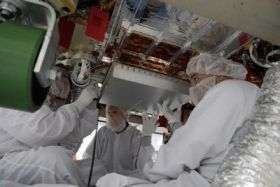
General Dynamics technicians, sitting under the GLAST spacecraft install a high-gain antenna on the spacecraft. Credit: NASA/ Kim Shiflett

The powerful antenna system that will enable NASA's Gamma-ray Large Area Telescope (GLAST) to communicate with stations on Earth has been successfully connected to the spacecraft in the Astrotech payload processing facility near NASA's Kennedy Space Center, Fla.

The Ku Band system is used to downlink science and engineering telemetry. The Ku band system includes a Ku antenna, an antenna pointing mechanism that steers the antenna, and two Ku band transmitters. The Ku band (K-under band) is a portion of the electromagnetic spectrum in the microwave range of frequencies that is used to transmit data.

"The Ku Band system on GLAST enables the transmittal of recorded science and engineering data at a high rate to the ground through the Tracking and Data Relay Satellites (TDRS)," said Al Vernacchio, GLAST Deputy Project Manager at NASA's Goddard Space Flight Center, Greenbelt, Md. "It provides the link that enables the transmission of the large quantity of information gathered by the Large Area Telescope (LAT) and GLAST Burst Monitor (GBM) instruments."

Ku band satellites are also used in satellite communications from remote locations back to a television network's studio for editing and broadcasting.

The S-band antennas have already been connected to GLAST. S-band antennas are used for command uplink, that is, to send commands to the GLAST spacecraft from Earth and to gather real-time engineering telemetry.

Currently, the GLAST satellite is being prepared for launch and is in its final stages of preparation, as the Delta II launch vehicle that will carry it spaceward is also being prepared on Launch-pad 17B.

In the drawings of GLAST, this antenna is the little square panel sticking out below the bottom of the spacecraft. Like the solar panels, the Ku band antenna is stowed at launch and will be deployed once GLAST is in orbit.

The installation of the Ku band antenna completes the integration of the Ku system and of the observatory. The only things that remain are the closeout of the thermal blankets, installation of the star tracker shade and fueling of the propulsion system before the observatory goes to the launch pad. GLAST will launch from the Cape Canaveral Air Station, Fla.

GLAST is a powerful space observatory that will explore the most extreme environments in the Universe, where nature harnesses energies far beyond anything possible on Earth. It will search for signs of new laws of physics and what composes the mysterious dark matter, explain how black holes accelerate immense jets of material to nearly light speed, and help crack the mysteries of the stupendously powerful explosions known as gamma-ray bursts.

NASA’s GLAST mission is an astrophysics and particle physics partnership, developed in collaboration with the U.S. Department of Energy, along with important contributions from academic institutions and partners in France, Germany, Italy, Japan, Sweden, and the United States.

Source: Goddard Space Flight Center


print this article email this article download pdf blog this article bookmark this article     Stumble it Digg this share on Facebook retweet share on Reddit add to delicious
Rate this story - 4.1 /5 (9 votes)


April 21, 2008 all stories

Comments: 0

4.1 /5 (9 votes)
  • Stumble this up

  • Digg this

  • share this

  • hide
  • Related Stories

  • Excitement Builds as GLAST Readies Its Gamma-ray Vision
    created May 30, 2008 | popularity not rated yet | comments 0
  • Delta II Rocket Coming Together for NASA's GLAST Satellite Launch
    created Apr 14, 2008 | popularity not rated yet | comments 0
  • GLAST spacecraft arrives in Florida to prepare for launch
    created Mar 07, 2008 | popularity not rated yet | comments 0
  • 'Extreme Physics' Observatory Prepares for Flight
    created May 18, 2006 | popularity not rated yet | comments 0
  • Possible Fifth Force Would Make Direct Detection of Dark Matter Unlikely
    created Mar 26, 2009 | popularity not rated yet | comments 0


  • hide
  • Relevant PhysicsForums posts

  • Question about 2-body gravity
    created 5 hours ago
  • life on Mars
    created 8 hours ago
  • Semi-major axis from cartesian co-ordinates
    created 20 hours ago
  • Primary Mirror grinding
    created 22 hours ago
  • More from Physics Forums - General Astronomy

Other News

The drying shores of the Dead Sea

Dead Sea needs world help to stay alive

Space & Earth / Environment

created 14 minutes ago | popularity not rated yet | comments 0

The Dead Sea may soon shrink to a lifeless pond as Middle East political strife blocks vital measures needed to halt the decay of the world's lowest and saltiest body of water, experts say.


Shuttle, station crews seal hatches for departure (AP)

Shuttle, station crews seal hatches for departure

Space & Earth / Space Exploration

created 2 minutes ago | popularity not rated yet | comments 0

(AP) -- After nearly a week together, the crews of shuttle Atlantis and the International Space Station said goodbye Tuesday and closed the hatches between them.


LSU gets to the bottom of things -- in Antarctica

Space & Earth / Earth Sciences

created 22 minutes ago | popularity not rated yet | comments 0

Antarctica has long held secrets of the earth's history locked in its icy depths, and until recently, there has been very little information on the environments that have been sealed beneath miles of ice for millions of years. ...


First black holes may have incubated in giant, starlike cocoons, says CU-Boulder study

First black holes may have incubated in giant, starlike cocoons

Space & Earth / Astronomy

created 1hour ago | popularity 5 / 5 (1) | comments 6

(PhysOrg.com) -- The first large black holes in the universe likely formed and grew deep inside gigantic, starlike cocoons that smothered their powerful x-ray radiation and prevented surrounding gases from ...


Researchers Establish Common Seasonal Patterns Among Bacterial Communities in Arctic Rivers

Researchers Establish Common Seasonal Patterns Among Bacterial Communities in Arctic Rivers

Space & Earth / Earth Sciences

created 3 hours ago | popularity not rated yet | comments 0

(PhysOrg.com) -- New research on bacterial communities throughout six large Arctic river ecosystems reveals predictable temporal patterns, suggesting that scientists could use these communities as markers ...