Researchers Create Self-Healing Computer Systems for Spacecraft
April 21st, 2008 Researchers Create Self-Healing Computer Systems for Spacecraft

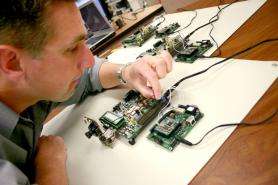
Kevin Carr, an undergraduate in electrical and computer engineering, adjusts one of the transmitter modules that is used to wirelessly link five units being tested in a self-healing computer system. The unit to the left of the transmitter is a Field Programmable Gate Array. Other transmitters and FPGAs can be seen in the background. (Photo by Matt Brailey)

We've all heard about the space missions that are DOA when NASA engineers lose touch with the spacecraft or lander. In other cases, some critical system fails and the mission is compromised.

Both are maddening scenarios because the spacecraft probably could be easily fixed if engineers could just get their hands on the hardware for a few minutes.

Ali Akoglu and his students at The University of Arizona are working on hybrid hardware/software systems that one day might use machine intelligence to allow the spacecraft to heal themselves.

Akoglu, an assistant professor in electrical and computer engineering, is using Field Programmable Gate Arrays, or FPGA, to build these self-healing systems. FPGAs combine software and hardware to produce flexible systems that can be reconfigured at the chip level.

Because some of the hardware functions are carried out at the chip level, the software can be set up to mimic hardware. In this way, the FPGA “firmware” can be reconfigured to emulate different kinds of hardware.

Speed vs. Flexibility

Akoglu explains it this way: There are general-purpose systems, like your desktop computer, which can run a variety of applications. Unfortunately, even with 3 GHz, dual-core processors, they’re extremely slow compared with hardwired systems.

With hardwired systems, the hardware is specific to the purpose. As an example, engineers could build a very fast system that would run Microsoft Word but nothing else. It couldn’t run Excel or any other application. But it would be super fast at what it’s designed for.

“In that case, you have an extremely fast system, but it’s not adaptable,” Akoglu explained. “When new, and better software comes along, you have to go back into the design cycle and start building hardware from scratch.”

“What we need is something in the middle that is the best of both worlds, and that’s what I’m trying to come up with using Field Programmable Arrays,” he said.

Work on the self-healing systems began in 2006 as a project in Akoglu’s graduate-level class. His students presented a paper on the system and sparked interest from NASA, which eventually provided an $85,000 grant to pursue the work.

Akoglu and his students now are in the second phase of the project, which is called SCARS (Scalable Self-Configurable Architecture for Reusable Space Systems). The project is being carried out in collaboration with the Jet Propulsion Laboratory.

Currently, they are testing five hardware units that are linked together wirelessly. The units could represent a combination of five landers and rovers on Mars, for instance.

“When we create a test malfunction, we try to recover in two ways,” he explained. “First, the unit tries to heal itself at the node level by reprogramming the problem circuits.”

If that fails, the second step is for the unit to try to recover by employing redundant circuitry. But if the unit’s onboard resources can’t fix the problem, the network-level intelligence is alerted. In this case, another unit takes over the functions that were carried out by the broken unit.

“The second unit reconfigures itself so it can carry out both its own tasks and the critical tasks from the broken unit,” Akoglu explained.

If two units go down and can’t fix themselves, the three remaining units split up the tasks. All of this is done autonomously without human aid.

Lightning-Fast Processing

Because FPGAs can be programmed to carry on tasks simultaneously, they also can be configured to do lightning-fast processing.

“So if you’re running a loop, and it is running 10,000 times, you can replicate the loop as a processing element in the FPGA ‘n’ number of times,” Akoglu explained. “That means you have an ‘n’ times speed-up.” It’s like creating a huge multicore processor configured for a specific task.

FPGAs traditionally have been used for prototyping circuits because their firmware can be reprogrammed. Rather than creating costly circuits in hardware, engineers can test their ideas quickly and inexpensively in FPGA firmware.

In the past five years, the amount of circuitry that can be crammed into FPGAs has increased dramatically, promoting them from simple test-beds to end products in themselves, Akoglu explained.

The Ridgetop Group, a Tucson company that specializes in diagnosing circuit faults using statistical methods, now is working with Akoglu on the self-healing systems.

“This is the next phase of our project,” Akoglu said. “Our objective is to go beyond predicting a fault to using a self-healing system to fix the predicted fault before it occurs.” This could lead to extremely stable computer systems that could operate for long periods without failure.

Source: University of Arizona


print this article email this article download pdf blog this article bookmark this article     Digg this Stumble it share on Facebook share on Reddit add to delicious save to Yahoo! bookmarks
4.1/5 after 32 votes

Rank Filter

Move the slider to adjust rank threshold, so that you can hide some of the comments.


Display comments: newest first

  • superhuman - Apr 21, 2008
    • Rank: 3 / 5 (2)
    This is not a true 'self healing', this is automatic management of built-in redundancy, but the broken part stays broken.
  • Egnite - Apr 22, 2008
    • Rank: 2.7 / 5 (3)
    "Researchers Create Self-Healing Computer Systems for Spacecraft"

    Is it a computer that fires out lots of nano-bots with tiny soldering irons that fixes any breaks in the circuits? No? Oh, so it's not self-healing then.

April 21st, 2008 all stories
Technology / Engineering

Comments: 2
Rank: 4.1/5 after 32 votes

  • Stumble this up

  • Digg this

  • Share it:
  • share on Facebook
  • share on MySpace
  • share on Slashdot
  • rss-newsfeed
  • share on Google
  • share on Reddit
  • add to delicious
  • save to Yahoo! bookmarks
  • share on Windows Live
  • Add to Mixx!
Rating: 4.1/5 after 32 votes

  • Related Stories

  • Energy-Efficient Intelligent House that Can Learn our Routines
    created Jul 03, 2009 | popularity not rated yet | comments 0
  • Embedded electronics -- cars get cooperative
    created Jul 01, 2009 | popularity not rated yet | comments 0
  • NASA manager pitches a cheaper return-to-moon plan
    created Jun 30, 2009 | popularity not rated yet | comments 0
  • Biology knows best -- human-like vision lets robots navigate naturally
    created Jun 30, 2009 | popularity not rated yet | comments 0
  • Samsung Introduces New 45nm Application Processor
    created Jun 29, 2009 | popularity not rated yet | comments 0

Tags


  • Physicists Demonstrate Quantum Memory with Matter Qubits
    Physicists Demonstrate Quantum Memory with Matter Qubits
    Physics / General Physics
    created Jul 03, 2009 | popularity 4.4 / 5 (17) | comments 1
  • 'Holey' Nanosheets for Wastewater Dye Removal
    Nanotechnology / Nanomaterials
    created Jul 01, 2009 | popularity 5 / 5 (5) | comments 1
  • Jellyfish Robot Swims Like its Biological Counterpart
    Jellyfish Robot Swims Like its Biological Counterpart
    Electronics / Robotics
    created Jun 26, 2009 | popularity 4.4 / 5 (8) | comments 1
  • Could Maxwell's Demon Exist in Nanoscale Systems?
    Could Maxwell's Demon Exist in Nanoscale Systems?
    Physics / General Physics
    created Jun 24, 2009 | popularity 4.4 / 5 (18) | comments 29
  • Living Safely with Robots, Beyond Asimov's Laws
    Living Safely with Robots, Beyond Asimov's Laws
    Electronics / Robotics
    created Jun 22, 2009 | popularity 4.6 / 5 (52) | comments 40
  • Other News

    HTC Touch

    Taiwan's HTC earnings edge down in Q2

    Technology / Business

    created 1hour ago | popularity not rated yet | comments 0

    HTC Corp, Taiwan's leading smartphone maker, said Monday its net profit in the second quarter was down almost two percent from a year earlier.


    Samsung announces earnings estimate (AP)

    Samsung announces earnings estimate

    Technology / Business

    created 1hour ago | popularity not rated yet | comments 0

    (AP) -- Samsung Electronics Co., the world's biggest manufacturer of memory chips, announced quarterly earnings estimates for the first time Monday, saying it hopes to reduce market confusion and speculation ...


    Andreessen making leap from entrepreneur to VC

    Technology / Business

    created 2 hours ago | popularity not rated yet | comments 0

    (AP) -- Having built and sold two technology startups for a combined $11.7 billion, Marc Andreessen is ready to take a stab at, well, finding the next Marc Andreessen.


    Japan demands 119 million dlrs in tax from Amazon: report

    Technology / Business

    created 21 hours ago | popularity 3.6 / 5 (5) | comments 1

    Japanese authorities told a sales affiliate of US retail giant Amazon.com to pay about 119 million dollars in tax for unreported income over a three-year period, a newspaper said Sunday.


    Iconic skyscrapers find new luster by going green (AP)

    Iconic skyscrapers find new luster by going green

    Technology / Energy

    created 22 hours ago | popularity 1 / 5 (1) | comments 0

    (AP) -- When owners of the Empire State Building decided to blanket its towering facade this year with thousands of insulating windows, they were only partly interested in saving energy. They also needed ...