Synchrotron light unveils oil in ancient Buddhist paintings from Bamiyan
April 22nd, 2008 Synchrotron light unveils oil in ancient Buddhist paintings from Bamiyan

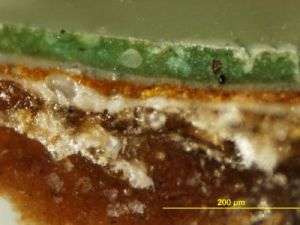
A cross-section of the sample, where the different layers are visible. Credit: National Research Institute for Cultural Properties, Tokyo (Japan)

The world was in shock when in 2001 the Talibans destroyed two ancient colossal Buddha statues in the Afghan region of Bamiyan. Behind those statues, there are caves decorated with precious paintings from 5th to 9th century A.D. The caves also suffered from Taliban destruction, as well as from a severe natural environment, but today they have become the source of a major discovery.

Scientists have proved, thanks to experiments performed at the European Synchrotron Radiation Facility (ESRF), that the paintings were made of oil, hundreds of years before the technique was “invented” in Europe. Results are published today in the peer-reviewed Journal of Analytical Atomic Spectrometry.

In many European history and art books, oil painting is said to have started in the 15th century in Europe. But scientists from the National Research Institute for Cultural Properties in Tokyo (Japan), the Centre of Research and Restoration of the French Museums-CNRS (France), the Getty Conservation Institute (United States) and the ESRF have recently identified drying oils in some of the samples they studied from the Bamiyan caves. Painted in the mid-7th century A.D., the murals show scenes with Buddhas in vermilion robes sitting cross-legged amid palm leaves and mythical creatures. The scientists discovered that 12 out of the 50 caves were painted with oil painting technique, using perhaps walnut and poppy seed drying oils.

A combination of synchrotron techniques such as infrared micro-spectroscopy, micro X-ray fluorescence, micro X-ray absorption spectroscopy or micro X-ray diffraction was crucial for the outcome of the work. "On one hand, the paintings are arranged as superposition of multiple layers, which can be very thin. The micrometric beam provided by synchrotron sources was hence essential to analyze separately each of these layers. On the other hand, these paintings are made with inorganic pigments mixed in organic binders, so we needed different techniques to get the full picture" Marine Cotte, a research scientist at CNRS and an ESRF scientific collaborator explains.

The results showed a high diversity of pigments as well as binders and the scientists identified original ingredients and alteration compounds. Apart from oil-based paint layers, some of the layers were made of natural resins, proteins, gums, and, in some cases, a resinous, varnish-like layer. Protein-based material can indicate the use of hide glue or egg. Within the various pigments, the scientists found a high use of lead whites. These lead carbonates were often used, since Antiquity up to modern times, not only in paintings but also in cosmetics as face whiteners.

“This is the earliest clear example of oil paintings in the world, although drying oils were already used by ancient Romans and Egyptians, but only as medicines and cosmetics”, explains Yoko Taniguchi, leader of the team.

The paintings are probably the work of artists who traveled on the Silk Road, the ancient trade route between China, across Central Asia's desert to the West. However, there are very few studies about this region. “Due to political reasons research on paintings in Central Asia is scarce. We were fortunate to get the opportunity from UNESCO, as a part of conservation project for the World Heritage site Bamiyan, to study these samples and we hope that future research may provide deeper understanding of the painting techniques along the Silk Road and the Eurasian area”, says Taniguchi.

The results were presented in a scientific conference in Japan last January, but are only published today in a peer-reviewed journal.

Source: European Synchrotron Radiation Facility


print this article email this article download pdf blog this article bookmark this article     Digg this Stumble it share on Facebook share on Reddit add to delicious save to Yahoo! bookmarks
4.5/5 after 38 votes

Rank Filter

Move the slider to adjust rank threshold, so that you can hide some of the comments.


Display comments: newest first

  • Mercury_01 - Apr 22, 2008
    • Rank: not rated yet
    Thats not a painting, It's lasagna!

April 22nd, 2008 all stories
Physics / General Physics

Comments: 1
Rank: 4.5/5 after 38 votes

  • Stumble this up

  • Digg this

  • Share it:
  • share on Facebook
  • share on MySpace
  • share on Slashdot
  • rss-newsfeed
  • share on Google
  • share on Reddit
  • add to delicious
  • save to Yahoo! bookmarks
  • share on Windows Live
  • Add to Mixx!
Rating: 4.5/5 after 38 votes

  • Related Stories

  • Study: Oil painting predated European art
    created Apr 28, 2008 | popularity not rated yet | comments 0
  • N.C. Wyeth's coloring technique revealed by Cornell's synchrotron as it uncovers eight decades of paint
    created Jul 20, 2007 | popularity not rated yet | comments 0
  • 'Hidden' Van Gogh painting revealed
    created Jul 30, 2008 | popularity not rated yet | comments 0
  • Software transforms digital photos into old-fashioned paintings
    created Sep 12, 2007 | popularity not rated yet | comments 0
  • Nanomagnetic sponges to clean precious works of art
    created Sep 03, 2007 | popularity not rated yet | comments 0

Tags


  • Physicists Demonstrate Quantum Memory with Matter Qubits
    Physicists Demonstrate Quantum Memory with Matter Qubits
    Physics / General Physics
    created Jul 03, 2009 | popularity 4.4 / 5 (16) | comments 1
  • 'Holey' Nanosheets for Wastewater Dye Removal
    Nanotechnology / Nanomaterials
    created Jul 01, 2009 | popularity 5 / 5 (5) | comments 1
  • Jellyfish Robot Swims Like its Biological Counterpart
    Jellyfish Robot Swims Like its Biological Counterpart
    Electronics / Robotics
    created Jun 26, 2009 | popularity 4.4 / 5 (7) | comments 1
  • Could Maxwell's Demon Exist in Nanoscale Systems?
    Could Maxwell's Demon Exist in Nanoscale Systems?
    Physics / General Physics
    created Jun 24, 2009 | popularity 4.4 / 5 (18) | comments 29
  • Living Safely with Robots, Beyond Asimov's Laws
    Living Safely with Robots, Beyond Asimov's Laws
    Electronics / Robotics
    created Jun 22, 2009 | popularity 4.6 / 5 (52) | comments 40
  • Other News

    Science journals

    How to Spot an Influential Paper Based on its Citations

    Physics / General Physics

    created 18 hours ago | popularity 4 / 5 (7) | comments 5

    (PhysOrg.com) -- At first it may seem that the number of citations received by a published scientific paper is directly related to that paper's quality of content. The higher the quality, the more people read ...


    Scientists create first electronic quantum processor

    Scientists create first electronic quantum processor

    Physics / General Physics

    created Jun 28, 2009 | popularity 4.8 / 5 (50) | comments 39

    A team led by Yale University researchers has created the first rudimentary solid-state quantum processor, taking another step toward the ultimate dream of building a quantum computer.


    Fermilab's CDF observes Omega-sub-b baryon

    Fermilab's CDF observes Omega-sub-b baryon

    Physics / General Physics

    created Jun 29, 2009 | popularity 4.7 / 5 (16) | comments 7

    (PhysOrg.com) -- At a recent physics seminar at the Department of Energy’s Fermi National Accelerator Laboratory, Fermilab physicist Pat Lukens of the CDF experiment announced the observation of a new particle, ...


    New insights, and a new angle, on high-temperature superconductivity

    New insights, and a new angle, on high-temperature superconductivity

    Physics / Superconductivity

    created Jun 29, 2009 | popularity 4.8 / 5 (13) | comments 6

    (PhysOrg.com) -- A Princeton-led research team has revealed surprising information about how electron behavior influences the conduction of electricity in a class of high-temperature superconductors. An increased ...


    The art of invisibility and the perfect cat's eye

    The art of invisibility and the perfect cat's eye

    Physics / Optics & Photonics

    created Jun 30, 2009 | popularity 4 / 5 (8) | comments 6

    (PhysOrg.com) -- In recent years scientists have explored the impossible by developing invisibility or 'cloaking' devices, but can the same technology also help make things more visible?