Physicists investigate 'best friends forever'
April 22nd, 2008 by Lisa Zyga Cell phone network

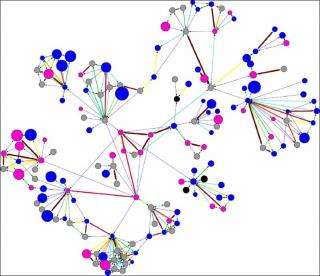
A network model created with data from the study: blue nodes are males, pink nodes are females, and gray nodes are unknown gender. The node size is proportional to the age of the phone user, and the color and width of the links grows with persistence. Image credit: Cesar Hidalgo and Carlos Rodriguez-Sickert.

Some friendships are short and fleeting, while others may last years. Although a wide variety of factors go into determining the strength of our relationships, the long-lasting ones seem to share a number of the same characteristics, according to a recent study.

Using data from nearly 2 million people and 8 million phone calls over the course of a year, physicist Cesar Hidalgo from the University of Notre Dame and sociologist Carlos Rodriguez-Sickert from the Pontifical Catholic University of Chile have investigated the persistence of relationships within the cell phone network. Somewhat intuitively, they found that the leading cause of persistent relationships is reciprocity - returning a friend´s call. Further, they could use these characteristics to predict the nature of relationships in the future.

As the researchers explain in their study, the persistence of the connection between two individuals is a measurement of how often they call each other. The scientists analyzed 15-day intervals, and determined if the two callers made contact within each interval. The greater number of these chunks of time in which contact occurred, the higher the pair´s persistence value was.

The scientists found that the majority (60%) of ties between two callers lasted for just one 15-day interval. The next 20% of ties disappeared slowly throughout the course of the year, and the remaining 20% persisted for the entire one-year period.

The results showed that the strongest factor determining persistence values was when individuals returned calls to each other. When links were reciprocated, those links had a greater chance of persisting for longer time periods. Also, when an individual´s connections had connections among themselves (when a person´s friends knew each other), his or her own connections lasted longer. The results also revealed insight into "social butterflies" - individuals with a high number of links.

"One result that I thought was somehow not so intuitive was the trade-off between the degree (number of links) of a person and the persistence of its ties," Hidalgo told PhysOrg.com. "It has been known for a long time that some people are much more connected than others, yet it was not known whether these highly connected individuals also had a larger number of strong connections. While time constraints may force people with more ties to be less persistent on average, the data also showed that, in absolute terms, people with more ties also have a greater number of persistent ties than those less connected. Highly connected individuals are not trading quality for quantity; rather, they appear to be more socially expressed in both the numbers of links and the persistence or strength of them."

By knowing the characteristics of persistence, the researchers could look at the features of the network for the first 15 days, and predict what the network would look like in the future. Since social connections play a role in areas such as collective decision making and consumption, predicting these connections might help researchers predict some of society´s actions. For example, measuring the persistence of a person´s social ties might open a new dimension for marketing segmentation strategies.

"One area which is interested in new ways of characterizing individuals is marketing," Hidalgo said. "To more effectively market their products, companies have traditionally segmented the targeted population by age, gender, ethnicities and socioeconomic status. As data on the social structure becomes increasingly available, it becomes possible for companies to categorize people based on their local structure on the social network.

"This opens a new layer of information that cannot be accessed otherwise. The social structure surrounding an individual is likely the result of its behavior and personality, hence is likely to carry more relevant information than its age and gender. The persistence of a person´s social relationships is a dynamical measure that can be used to tell us how strongly a person is connected to its peers. It could indicate a level of respect or authority that cannot be captured by purely structural measures, such as the number of links or the density of its social structure."

More information: Hidalgo, Cesar A. and Rodriguez-Sickert, C. "The dynamics of a mobile phone network." Physica A 387 (2008) 3017-3024.


print this article email this article download pdf blog this article bookmark this article     Digg this Stumble it share on Facebook share on Reddit add to delicious save to Yahoo! bookmarks
4.1/5 after 56 votes

Rank Filter

Move the slider to adjust rank threshold, so that you can hide some of the comments.


Display comments: newest first

  • AJW - Apr 22, 2008
    • Rank: 1 / 5 (3)
    Is this the same device used to map sex activity of school children?
  • caeman - Apr 22, 2008
    • Rank: 2 / 5 (3)
    Phone usage? That is so 90's. Maybe if they had tracked e-mails, instead.
  • Cesifoti - Apr 22, 2008
    • Rank: 4.5 / 5 (2)
    There are several advantages of measuring the layer of the social network defined by Mobile Phones, such as the larger market share of mobile phones compared to emails, the more personal nature of the communication: as mobile phone numbers are unlisted, just having them indicates a sort of social connection, plus no Spam and not nearly as many multiple accounts that as in emails, among other arguments that can be found on the original paper.
  • superhuman - Apr 22, 2008
    • Rank: 5 / 5 (1)
    How did they discern social interactions from business interactions?
  • Glis - Apr 23, 2008
    • Rank: 5 / 5 (1)
    Superhuman: Kudos.

    Logic would dictate that if you don't communicate with someone they aren't your friend. 100% of people I never talk to aren't my friends, and if I constantly don't call someone back, eventually communications cease, but that's just me.
  • NeilFarbstein - Oct 21, 2008
    • Rank: 1 / 5 (1)
    My friends TURN STATE'S EVIDENCE!!!!!

April 22nd, 2008 all stories
Physics / General Physics

Comments: 6
Rank: 4.1/5 after 56 votes

  • Stumble this up

  • Digg this

  • Share it:
  • share on Facebook
  • share on MySpace
  • share on Slashdot
  • rss-newsfeed
  • share on Google
  • share on Reddit
  • add to delicious
  • save to Yahoo! bookmarks
  • share on Windows Live
  • Add to Mixx!
Rating: 4.1/5 after 56 votes

  • Related Stories

  • Survey shows significant education discrepancies among second generation immigrants in the Netherlands
    created Nov 19, 2008 | popularity not rated yet | comments 0
  • Overweight kids experience more loneliness, anxiety, study finds
    created Jul 02, 2009 | popularity not rated yet | comments 0
  • Gap between boys and girls persists in tech
    created Jun 18, 2009 | popularity not rated yet | comments 0
  • Why Things Become Unpopular
    created Jun 04, 2009 | popularity not rated yet | comments 0
  • The key to a healthy lifestyle is in the mind
    created Jan 16, 2009 | popularity not rated yet | comments 0

Tags


  • Physicists Demonstrate Quantum Memory with Matter Qubits
    Physicists Demonstrate Quantum Memory with Matter Qubits
    Physics / General Physics
    created 15 hours ago | popularity 4.8 / 5 (8) | comments 1
  • 'Holey' Nanosheets for Wastewater Dye Removal
    Nanotechnology / Nanomaterials
    created Jul 01, 2009 | popularity 5 / 5 (5) | comments 1
  • Jellyfish Robot Swims Like its Biological Counterpart
    Jellyfish Robot Swims Like its Biological Counterpart
    Electronics / Robotics
    created Jun 26, 2009 | popularity 4.4 / 5 (7) | comments 1
  • Could Maxwell's Demon Exist in Nanoscale Systems?
    Could Maxwell's Demon Exist in Nanoscale Systems?
    Physics / General Physics
    created Jun 24, 2009 | popularity 4.4 / 5 (18) | comments 29
  • Living Safely with Robots, Beyond Asimov's Laws
    Living Safely with Robots, Beyond Asimov's Laws
    Electronics / Robotics
    created Jun 22, 2009 | popularity 4.6 / 5 (50) | comments 39
  • Other News

    Physicists Demonstrate Quantum Memory with Matter Qubits

    Physicists Demonstrate Quantum Memory with Matter Qubits

    Physics / General Physics

    created 15 hours ago | popularity 4.8 / 5 (8) | comments 1

    (PhysOrg.com) -- For the first time, scientists have successfully operated a quantum gate between two remote particles of matter, marking an important step toward the development of a quantum computer. In ...


    Scientists create first electronic quantum processor

    Scientists create first electronic quantum processor

    Physics / General Physics

    created Jun 28, 2009 | popularity 4.8 / 5 (49) | comments 38

    A team led by Yale University researchers has created the first rudimentary solid-state quantum processor, taking another step toward the ultimate dream of building a quantum computer.


    Fermilab's CDF observes Omega-sub-b baryon

    Fermilab's CDF observes Omega-sub-b baryon

    Physics / General Physics

    created Jun 29, 2009 | popularity 4.6 / 5 (13) | comments 7

    (PhysOrg.com) -- At a recent physics seminar at the Department of Energy’s Fermi National Accelerator Laboratory, Fermilab physicist Pat Lukens of the CDF experiment announced the observation of a new particle, ...


    New insights, and a new angle, on high-temperature superconductivity

    New insights, and a new angle, on high-temperature superconductivity

    Physics / Superconductivity

    created Jun 29, 2009 | popularity 4.8 / 5 (12) | comments 6

    (PhysOrg.com) -- A Princeton-led research team has revealed surprising information about how electron behavior influences the conduction of electricity in a class of high-temperature superconductors. An increased ...


    The art of invisibility and the perfect cat's eye

    The art of invisibility and the perfect cat's eye

    Physics / Optics & Photonics

    created Jun 30, 2009 | popularity 3.9 / 5 (7) | comments 6

    (PhysOrg.com) -- In recent years scientists have explored the impossible by developing invisibility or 'cloaking' devices, but can the same technology also help make things more visible?