Ugandan monkeys harbor evidence of infection with unknown poxvirus
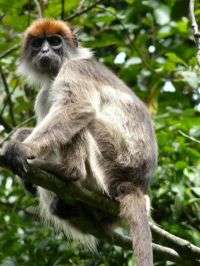
Researchers report this month that red colobus monkeys in a park in western Uganda have been exposed to an unknown orthopoxvirus, a pathogen related to the viruses that cause smallpox, monkeypox and cowpox. Most of the monkeys screened harbor antibodies to a virus that is similar – but not identical – to known orthopoxviruses. The findings appear online in the journal Emerging Infectious Diseases.
This is the first effort to screen Ugandan red colobus monkeys for orthopoxviruses, said Tony Goldberg, a professor of veterinary pathobiology and of anthropology at the University of Illinois and lead author on the study.
“Considering that we found evidence for a new poxvirus pretty much in the first place that we chose to look is suggestive that the actual diversity of poxviruses in nature, especially in relatively unstudied areas like sub-Saharan Africa, may be much greater than we originally thought,” Goldberg said.
The study was begun in 2006 when Colin Chapman, a researcher at McGill University, invited Goldberg to collaborate on a health assessment of two groups of red colobus monkeys in Kibale National Park, in western Uganda.
Chapman, also an associate scientist with the Wildlife Conservation Society, had spent two decades studying the behavior and ecology of the monkeys. He wanted to broaden the study to include an analysis of the pathogens they carried. Wildlife veterinarians from the Wildlife Conservation Society helped collect the samples, and a team from Oregon Health and Science University, led by Mark Slifka, conducted immunological analyses to characterize the virus.
An initial screening for antibodies to the vaccinia virus yielded positive results in about one-quarter of the monkeys tested. This was not clear evidence of infection with vaccinia, however.
“We found that as we screened these monkeys initially for a broad range of poxviruses, many of them came up positive,” Goldberg said.
The researchers were surprised to find that the monkeys harbored antibodies to some, but not all, of the proteins associated with the known poxviruses, Goldberg said. Whatever had infected the monkeys “looked a little bit like monkeypox virus, a little bit like vaccinia virus, a little bit like cowpox virus, but not exactly like any of them,” he said.
“We were forced to conclude in the end based on a series of progressive laboratory tests that yes, these monkeys had been exposed to a poxvirus, but that it was different from any poxvirus that we were using as a reference,” he said.
All the animals were healthy at the time of the study, and no recent cases of human orthopoxvirus infection have been reported in Uganda.
Traditionally, global health authorities look for disease in wildlife only after outbreaks occur in humans. Monkeypox, for example, has caused hundreds of cases of illness in Africa. A 2003 outbreak of monkeypox in humans in the U.S. – traced to rodents imported as pets from sub-Saharan Africa – increased interest in this disease.
Little is known about the global distribution of orthopoxviruses, Goldberg said, but their potential to cross from other animals into humans warrants more attention. (Some believe that smallpox, which killed 300 to 500 million people in the 20th century before it was eradicated in 1980, originated in African rodents thousands of years ago.)
The red colobus monkeys of Kibale are probably not the primary hosts of the virus that infected them, Goldberg said. None of the monkeys was sick when they were tested, an indication that their immune systems had successfully cleared the pathogen. Other mammals, such as rodents, may function as incubators of the virus, he said.
Under the right circumstances, orthopoxviruses can jump from a host species into a new species. This is worrisome in a region known to harbor a diversity of wildlife and where interactions between people and wildlife are on the rise, Goldberg said.
“Western Uganda has one of the fastest growing populations in sub-Saharan Africa,” he said. “People need land, and so do wildlife, and as competition for land becomes fiercer, contact between people and wildlife becomes more common.”
The relatively high prevalence of HIV and AIDS in sub-Saharan Africa also makes human populations more susceptible to pathogens that might otherwise only afflict wildlife.
Goldberg and his colleagues hope the new study increases interest in the diseases currently circulating among mammals in sub-Saharan Africa.
“My prediction is that the more we look, the more we’ll find,” he said.
Source: University of Illinois at Urbana-Champaign


