Early parents didn't stand for weighty kids
April 23rd, 2008 Early parents didn't stand for weighty kids

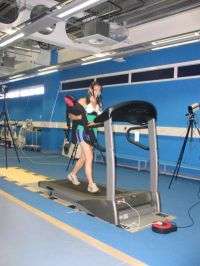
A volunteer carrying baby mannequin on the hip has her energy consumption measured. Credit: University of Manchester

Scientists investigating the reasons why early humans – the so-called hominins – began walking upright say it’s unlikely that the need to carry children was a factor, as has previously been suggested.

Carrying babies that could no longer use their feet to cling to their parents in the way that young apes can has long been thought to be at least one explanation as to why humans became bipedal.

But University of Manchester researchers investigating the energy involved in carrying a child say the physical expense to the mother does not support the idea that walking upright was an evolutionary response to child transportation.

“Walking upright is one of the major characteristics that separates humans from their primate relatives,” said Dr Jo Watson, who carried out the research in the University’s Faculty of Life Sciences.

“Scientists have long hypothesised as to the reasons why hominins became bipedal in a relatively short space of time but the truth is we still don’t know for sure.

“One of the more popular explanations is that walking upright freed our forelimbs allowing us to carry objects, including children; apes have no need to carry their young as they are able to grip using both hands and feet.

“Our study focused on the amount of energy required to carry 10kg loads, including a mannequin child. Importantly, the distribution of the weight varied in each instance.”

The team monitored the oxygen consumption of seven women, all healthy individuals under the age of 30, carrying either a symmetric load, in the form of a weighted vest or a 5kg dumbell in each hand, or an asymmetric load, which was a single 10kg weight carried in one hand or a mannequin infant on one hip.

“Carrying an awkward asymmetric load, such as the infant on one side of the body, is the most energetically expensive way of transporting the weight,” said Dr Watson, whose research is published in the Journal of Human Evolution.

“Unless infant carrying resulted in significant benefits elsewhere, the high cost of carrying an asymmetrical weight suggests that infant carrying was unlikely to have been the evolutionary driving force behind bipedalism.”

The study, carried out with colleagues at the Universities of Sheffield and Salford and funded by the Natural Environment Research Council (NERC), is part of a larger project, run by Dr Bill Sellers at The University of Manchester, which uses computer simulations to understand evolutionary processes, particularly the way in which we and other animals move.

Future plans are to extend this work to assess the energy cost of carrying in great apes. Computer models of early hominins carrying loads will also be built to try and evaluate whether their body shape and posture – long arms and short legs – would have made them noticeably better or worse at carrying than present-day humans. The research team hopes this will help build up a picture of how humans evolved to walk on two legs.

Source: University of Manchester


print this article email this article download pdf blog this article bookmark this article     Digg this Stumble it share on Facebook share on Reddit add to delicious save to Yahoo! bookmarks
3.5/5 after 8 votes


April 23rd, 2008 all stories
Biology /

Comments: 0
Rank: 3.5/5 after 8 votes

  • Stumble this up

  • Digg this

  • Share it:
  • share on Facebook
  • share on MySpace
  • share on Slashdot
  • rss-newsfeed
  • share on Google
  • share on Reddit
  • add to delicious
  • save to Yahoo! bookmarks
  • share on Windows Live
  • Add to Mixx!
Rating: 3.5/5 after 8 votes

  • Related Stories

  • Carry on walking!
    created Mar 31, 2007 | popularity not rated yet | comments 0
  • Engineering autism: Mice with extra chromosome region show many autistic signs
    created Jun 25, 2009 | popularity not rated yet | comments 0
  • Baboons, Humans Adapted Similarly to Malaria (w/ Video)
    created Jun 24, 2009 | popularity not rated yet | comments 0
  • Mouse Model Provides Clues to Human Language Development
    created Jun 24, 2009 | popularity not rated yet | comments 0
  • Key found to how tumor cells invade the brain in childhood cancer
    created Jun 17, 2009 | popularity not rated yet | comments 0

Tags


  • Physicists Demonstrate Quantum Memory with Matter Qubits
    Physicists Demonstrate Quantum Memory with Matter Qubits
    Physics / General Physics
    created Jul 03, 2009 | popularity 4.4 / 5 (17) | comments 1
  • 'Holey' Nanosheets for Wastewater Dye Removal
    Nanotechnology / Nanomaterials
    created Jul 01, 2009 | popularity 5 / 5 (5) | comments 1
  • Jellyfish Robot Swims Like its Biological Counterpart
    Jellyfish Robot Swims Like its Biological Counterpart
    Electronics / Robotics
    created Jun 26, 2009 | popularity 4.4 / 5 (8) | comments 1
  • Could Maxwell's Demon Exist in Nanoscale Systems?
    Could Maxwell's Demon Exist in Nanoscale Systems?
    Physics / General Physics
    created Jun 24, 2009 | popularity 4.4 / 5 (18) | comments 29
  • Living Safely with Robots, Beyond Asimov's Laws
    Living Safely with Robots, Beyond Asimov's Laws
    Electronics / Robotics
    created Jun 22, 2009 | popularity 4.6 / 5 (52) | comments 40
  • Other News

    Researchers uncover the potential for super-sized abalone

    Biology / Microbiology

    created 2 hours ago | popularity not rated yet | comments 0

    (PhysOrg.com) -- Designer abalone could be an option in the foreseeable future, thanks to a project conducted at UQ's Heron Island Research Station and the St Lucia campus.


    Scientists 'rebuild' giant moa using ancient DNA

    Biology / Plants & Animals

    created Jul 01, 2009 | popularity 5 / 5 (10) | comments 12

    (PhysOrg.com) -- Scientists have performed the first DNA-based reconstruction of the giant extinct moa bird, using prehistoric feathers recovered from caves and rock shelters in New Zealand.


    Pacific Giant Salamander (Dicamptodon tenebrosus)

    Salamanders, regenerative wonders, heal like mammals, people

    Biology / Microbiology

    created Jul 01, 2009 | popularity 5 / 5 (20) | comments 11

    The salamander is a superhero of regeneration, able to replace lost limbs, damaged lungs, sliced spinal cord -- even bits of lopped-off brain. But it turns out that remarkable ability isn't so mysterious after ...


    California water plan aims to save Puget Sound orcas

    Biology / Ecology

    created 18 hours ago | popularity not rated yet | comments 0

    A plan to restore salmon runs on California's Sacramento River also could help revive killer whale populations 700 miles to the north in Puget Sound, as federal scientists struggle to protect endangered species in a complex ...


    Genetically modified trees

    Anti-biotech groups obstruct forest biotechnology

    Biology / Biotechnology

    created Jun 30, 2009 | popularity 3.7 / 5 (7) | comments 5

    The potential of forest biotechnology to help address significant social and environmental issues is being "strangled at birth" by the rigid opposition of some groups and regulations that effectively preclude ...