New source for biofuels discovered
April 23, 2008
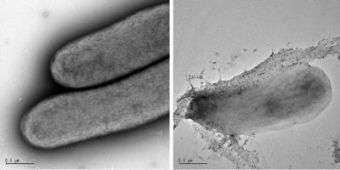
Cyanobacteria, Wild-type and Modified

Left: Two rod-shaped, wild type cyanobacteria. Note the conspicuous absence of any cellulose or sugars on the surface of these cells. Right: A genetically altered cyanobacterium that produced highly visible cellulose (marked by cellulase coupled with an electron dense gold marker). Credit: Brown and Nobles, the University of Texas at Austin

A newly created microbe produces cellulose that can be turned into ethanol and other biofuels, report scientists from The University of Texas at Austin who say the microbe could provide a significant portion of the nation’s transportation fuel if production can be scaled up.

Along with cellulose, the cyanobacteria developed by Professor R. Malcolm Brown Jr. and Dr. David Nobles Jr. secrete glucose and sucrose. These simple sugars are the major sources used to produce ethanol.

“The cyanobacterium is potentially a very inexpensive source for sugars to use for ethanol and designer fuels,” says Nobles, a research associate in the Section of Microbiology and Molecular Genetics.

Brown and Nobles say their cyanobacteria can be grown in production facilities on non-agricultural lands using salty water unsuitable for human consumption or crops.

Other key findings include:

-- The new cyanobacteria use sunlight as an energy source to produce and excrete sugars and cellulose

-- Glucose, cellulose and sucrose can be continually harvested without harming or destroying the cyanobacteria (harvesting cellulose and sugars from true algae or crops, like corn and sugarcane, requires killing the organisms and using enzymes and mechanical methods to extract the sugars)

-- Cyanobacteria that can fix atmospheric nitrogen can be grown without petroleum-based fertilizer input

They recently published their research in the journal Cellulose.

Nobles made the new cyanobacteria (also known as blue-green algae) by giving them a set of cellulose-making genes from a non-photosynthetic “vinegar” bacterium, Acetobacter xylinum, well known as a prolific cellulose producer.

The new cyanobacteria produce a relatively pure, gel-like form of cellulose that can be broken down easily into glucose.

“The problem with cellulose harvested from plants is that it’s difficult to break down because it’s highly crystalline and mixed with lignins [for structure] and other compounds,” Nobles says.

He was surprised to discover that the cyanobacteria also secrete large amounts of glucose or sucrose, sugars that can be directly harvested from the organisms.

“The huge expense in making cellulosic ethanol and biofuels is in using enzymes and mechanical methods to break cellulose down,” says Nobles. “Using the cyanobacteria escapes these expensive processes.”

Sources being used or considered for ethanol production in the United States include switchgrass and wood (cellulose), corn (glucose) and sugarcane (sucrose). True algae are also being developed for biodiesel production.

Brown sees a major benefit in using cyanobacteria to produce ethanol is a reduction in the amount of arable land turned over to fuel production and decreased pressure on forests.

“The pressure is on all these corn farmers to produce corn for non-food sources,” says Brown, the Johnson & Johnson Centennial Chair in Plant Cell Biology. “That same demand, for sucrose, is now being put on Brazil to open up more of the Amazon rainforest to produce more sugarcane for our growing energy needs. We don’t want to do that. You’ll never get the forests back.”

Brown and Nobles calculate that the approximate area needed to produce ethanol with corn to fuel all U.S. transportation needs is around 820,000 square miles, an area almost the size of the entire Midwest.

They hypothesize they could produce an equal amount of ethanol using an area half that size with the cyanobacteria based on current levels of productivity in the lab, but they caution that there is a lot of work ahead before cyanobacteria can provide such fuel in the field. Work with laboratory scale photobioreactors has shown the potential for a 17-fold increase in productivity. If this can be achieved in the field and on a large scale, only 3.5 percent of the area growing corn could be used for cyanobacterial biofuels.

Cyanobacteria are just one of many potential solutions for renewable energy, says Brown.

“There will be many avenues to become completely energy independent, and we want to be part of the overall effort,” Brown says. “Petroleum is a precious commodity. We should be using it to make useful products, not just burning it and turning it into carbon dioxide.”

Brown and Nobles are now researching the best methods to scale up efficient and cost-effective production of cyanobacteria. Two patent applications, 20080085520 and 20080085536, were recently published in the United States Patent and Trade Office.

Source: University of Texas at Austin

4.7 /5 (70 votes)  

Filter


Move the slider to adjust rank threshold, so that you can hide some of the comments.


Display comments: newest first

googleplex
Apr 23, 2008

Rank: 3 / 5 (4)
What do the bacteria eat? Also they need to live in water which is a scarce and expensive commodity.
If solar cells were used an area much smaller than minesota could power the entire USA. The bacteria still use sunlight and are inefficient solar energy produces.
The bacteria are great. Basic physics says solar cells have the potential to be better. Add up the total roof area in the USA (not just USA transportation). When solar panels are cost effective it will be the default choice for roofing material.
Solar panel costs are reducing in accordance with Moores law and hydrocarbon price is rising fast. The break even point is rapidly approaching.
Mercury_01
Apr 23, 2008

Rank: 5 / 5 (1)
the article says they can live in dirty saltwater. I say way to go! I want to see this race of clones enslaved as fast as humanly possible. yeah, solar is going to be very importaint, but were still going to need plenty of liquid fuels. Eternal bondage and servitude to the prokaryotes!
1bigschwantz
Apr 23, 2008

Rank: 2.7 / 5 (3)
Sounds ok, but i think the enviros will find something not to like about it. Were slowly moving too alot of alternate energy sources and they keep saying that things are getting worse (and faster).
TJ_alberta
Apr 24, 2008

Rank: 3 / 5 (3)
hmmm glucose and sucrose. maybe after the fermentation they can just age the ethanol in oak casks and we can have biofriendly burbon.
Egnite
Apr 24, 2008

Rank: 3 / 5 (1)
Yay we can start farming food again, what a luxury!
COCO
Apr 24, 2008

Rank: 2 / 5 (2)
there remains lots of petro in sand and shale - if the damn third worlders would only limit their goals to levels they can manage there will tons of oil for my SUV - let us not jump on some theorectical band wagon.
Algaholic
Apr 24, 2008

Rank: 4 / 5 (1)
This is no great breakthrough. Yes, perhaps they were able to create cyanobacteria that are able to produce cellulose, but this is something that is done by Rhodophyceans, Chlorophyceans, and some Ochrophytes quite regularly. Also, algae do not produce lignin, one of the main limiting factors in using cellulose to produce ethanol, so the fact the bacteria also secrete sugars is not a huge deal.

Also, in answer to these questions:
"What do the bacteria eat? Also they need to live in water which is a scarce and expensive commodity. "
Most cyanobacteria usually require only inorganic nutrients in addition to sunlight to survive (Ca, Na,K,P,Mg,S,Fe,and some trace elements:B,Mn,Zn,Cu,Co,Mo). I have a good recipe for cyano medium if anyone needs it...
And the last time I checked, 2/3 of the Earth was covered in water.

The real problem here is scaling up bioreactors enough without raising costs so as to make algae a feasible energy source.
Bonkers
Apr 24, 2008

Rank: 4 / 5 (2)
solar panels do not scale with Moores law, decreasing chip geometry puts more chips on a wafer, solar cells need area. the efficiency has crept up slowly from 12% to 20% but can't go much higher - it won't double or quadruple.
Wicked
Apr 24, 2008

Rank: 1 / 5 (2)
'%u201CThe pressure is on all these corn farmers to produce corn for non-food sources,%u201D says Brown, the Johnson & Johnson Centennial Chair in Plant Cell Biology.'

It's easy enough to get farmers to stop producing inedible corn. Just have the government stop paying them.
Soylent
Apr 24, 2008

Rank: 5 / 5 (2)
What do the bacteria eat?


Sunlight, CO2, atmospheric nitrogen, a little bit of O2 at night and fertilizer inputs(except for nitrogen).

Also they need to live in water which is a scarce and expensive commodity.


Salt water is essentially free in unlimited quantities.

If solar cells were used an area much smaller than minesota could power the entire USA.


The amount of copper, purified silicon, labour(someone has to clean them) and energy storage you'll need makes this an impractical pipe-dream. Trying to realize it without revolutionary new inventions leads to burning ever more coal.

Basic physics says solar cells have the potential to be better.


Basic economics tells you solar cells are all but useless for grid scale power generation. Basic economics tells you that intermittent electrical power with a resale value close to naught is no substitute for costly liquid fuels capable of being used in an internal combustion engine or the market for oil would not exist.
Soylent
Apr 24, 2008

Rank: 4.7 / 5 (3)
Solar panel costs are reducing in accordance with Moores law and hydrocarbon price is rising fast.


Moore's law tells you nothing about the price of silicon, which has not gone down. Moore's law tells you nothing about the amount of electricity a given slice of silicon can produce, which has inched its way up a handful of percent over decades.

Moore's law tells you the rate of growth in the number of transistors you'll be able to cram onto a given slice of silicon. If this has any bearing on the price of solar cells it is to make high grade silicon more valuable and drive up the cost of high quality solar cells.

The price of copper, aluminium, steel, indium and other commodities used in making solar cells keeps going up, almost as fast oil is.

Heading down that road leads to ever more coal power, which is going to be cheaper than solar and needs no expensive storage in all but the remotest of areas.
Rank 4.7 /5 (70 votes)
Tags

Relevant PhysicsForums posts

More news stories

Miami battling invasion of giant African snails

No one knows how they got there. But an invasion of African giant snails has southern Florida in a panic over potential crop damage, disease and general yuckiness surrounding the slimy gastropods.

Biology / Ecology

created 3 hours ago | popularity not rated yet | comments 1

Cure of ADPKD by selection for spontaneous genetic repair events in Pkd1-mutated iPS cells

A research group including Kyoto University researchers demonstrates that mouse iPS cells, in which genetic correction occurs spontaneously through mitotic recombination, is selectable from the population of genetically mutated ...

Biology / Cell & Microbiology

created 1 hour ago | popularity not rated yet | comments 0

An eye for the tsetse fly

(PhysOrg.com) -- Geoffrey M. Attardo was one of those little boys who made pets of the spiders outside his bedroom window, feeding them and watching as they spun intricate webs. Age has not diminished his ...

Biology / Plants & Animals

created 1 hour ago | popularity not rated yet | comments 0

Protein libraries in a snap

(PhysOrg.com) -- A Rice University undergraduate will depart with not only a degree but also a possible patent for his invention of an efficient way to create protein libraries, an important component of biomolecular ...

Biology / Cell & Microbiology

created 3 hours ago | popularity 5 / 5 (1) | comments 0 | with audio podcast

Fighting crimes against biodiversity: How to catch a killer weed

Invasive species which have the potential to destroy biodiversity and influence global change could be tracked and controlled in the same way as wanted criminals, according to new research from Queen Mary, University of London.

Biology / Ecology

created 4 hours ago | popularity not rated yet | comments 0


Clam fields found at deep, low-temperature Mariana vents

(PhysOrg.com) -- Scientists have marveled at the unusual life forms thriving at high temperature hydrothermal vents of the deep ocean.

Seeing colors in music, tasting flavors in shapes may happen in life's early months

Famed violinist Itzhak Perlman sees a deep forest green whenever he plays a B-flat on his Stradivarius' G string. The A on the E string is red.

Could Venus be shifting gear?

(PhysOrg.com) -- ESA’s Venus Express spacecraft has discovered that our cloud-covered neighbour spins a little slower than previously measured. Peering through the dense atmosphere in the infrared, the ...

Team isolates nerve cells involved in storing long term memory and gene proteins associated with them

(Medical Xpress) -- A research team in Taiwan has succeeded in isolating two nerve cells in fruit fly brains that are believed to be the major players in allowing for the formation of long term memories. Furthermore, ...

Is that sleepiness during pregnancy normal or a sign of sleep apnea?

(Medical Xpress) -- Most pregnant women complain of being tired. Some of them however, could be suffering more than normal fatigue associated with their pregnancy; they may have developed obstructive sleep apnea (OSA), a ...

Engineering images bring life to submerged city

(PhysOrg.com) -- Photo-realistic 3D mapping and digital reconstruction of an ancient underwater city in Greece have earned a team from the University of Sydney's Faculty of Engineering and Information Technologies ...