Mechanisms of memory identified
April 23, 2008 Mechanisms of memory identified

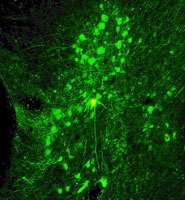
A single neuron (centre) in the perirhinal cortex which is involved in memory processes. Photo by Andy Doherty

Our ability to remember the objects, places and people within our environment is essential for everyday life, although the importance of this is only fully appreciated when recognition memory beings to fail, as in Alzheimer’s disease.

By blocking certain mechanisms that control the way that nerve cells in the brain communicate, scientists from the University of Bristol have been able to prevent visual recognition memory in rats.

This demonstrates they have identified cellular and molecular mechanisms in the brain that may provide a key to understanding processes of recognition memory. The research is published online today in Neuron.

Zafar Bashir, Professor of Cellular Neuroscience, who led the team at Bristol University said: “This is a major step forward in our understanding of recognition memory. We have been able to show that key processes controlling synaptic communication are also vital in learning and memory.”

The ability to recognise elements in the surrounding environment such as faces or places, as well as the ability to learn about that environment, is crucial to our normal functioning in the world. But the actual mechanisms and changes that occur in the brain and allow learning to happen are still not very well understood.

One hypothesis is that changes at the specialised junctions (synapses) between nerve cells in the brain, hold the secrets to learning and memory. The change in the strength of communication between synapses is called synaptic plasticity and, it is believed, the mechanisms of synaptic plasticity may be important for learning and memory. Bashir and his colleagues tested this hypothesis.

Dr Sarah Griffiths, lead author on the paper, explained: “Nerve cells in the perirhinal cortex of the brain are known to be vital for visual recognition memory. Using a combination of biological techniques and behavioural testing, we examined whether the mechanisms involved in synaptic plasticity are also vital for visual recognition memory.”

In their experiments, they were able to identify a key molecular mechanism that controls synaptic plasticity in the perirhinal cortex. They then demonstrated that blocking the same molecular mechanism that controls synaptic plasticity also prevented visual recognition memory in rats. This shows that such memory relies on specific molecular processes in the brain.

Professor Bashir added: “The next step is to try to understand the processes that enable visual memories to be held in our brains for such long periods of time, and why these mechanisms begin to break down in old age.”

Source: University of Bristol


print this article email this article download pdf blog this article bookmark this article     Stumble it Digg this share on Facebook retweet share on Reddit add to delicious
Rate this story - 4.5 /5 (17 votes)


April 23, 2008 all stories

Comments: 0

4.5 /5 (17 votes)
  • Stumble this up

  • Digg this

  • share this

  • hide
  • Related Stories

  • Brain maps help guide you through large-scale space, researchers find
    created Nov 03, 2009 | popularity not rated yet | comments 0
  • The robot children
    created Sep 15, 2009 | popularity not rated yet | comments 0
  • Sleep helps build long-term memories
    created Jun 24, 2009 | popularity not rated yet | comments 0
  • Neurodegeneration study reveals targets of destruction
    created Apr 15, 2009 | popularity not rated yet | comments 0
  • Modification of mutant huntingtin protein increases its clearance from brain cells
    created Apr 02, 2009 | popularity not rated yet | comments 0


  • hide
  • Relevant PhysicsForums posts

  • Chest x-ray???
    created 6 hours ago
  • Multiple Sclerosis & CCSVI
    created Nov 26, 2009
  • 23 Years in a Vegetative State....or not?
    created Nov 25, 2009
  • Has the H1N1 vaccine been scientifically proven to work?
    created Nov 24, 2009
  • More from Physics Forums - Medical Sciences

Other News

eye

Over-the-counter eye drops raise concern over antibiotic resistance

Medicine & Health / Medications

created 18 hours ago | popularity 3.7 / 5 (3) | comments 2

(PhysOrg.com) -- The use of antibiotic eye drops for conjunctivitis has increased by almost half since they became available over the counter at chemists in 2005, data obtained by Oxford University researchers ...


What a grind: Bruxism at night likely a sign of stress by day

Medicine & Health / Health

created 6 hours ago | popularity 5 / 5 (1) | comments 0

You can practically track Steve Barkley's stress by the level of activity in his temporomandibular joint, or TMJ, the hinge joint that connects the lower jaw to the temporal bone of the skull and helps one chew, talk and ...


Overeating can set stage for obesity, researchers say

Medicine & Health / Health

created 11 hours ago | popularity not rated yet | comments 1

It doesn't seem like a fair fight. In one corner loomed the Thanksgiving table, groaning with poultry, pie and mashed potatoes.


New tools for prediction of disease progression in acute childhood leukemia

Medicine & Health / Cancer

created 12 hours ago | popularity not rated yet | comments 0

(PhysOrg.com) -- Researchers at Uppsala University and University Children’s Hospital in Uppsala have devised powerful new tools for typing cells from children with acute lymphatic leukemia and for prediction of how children ...


Nuclear science to fight sleeping sickness

Medicine & Health / Diseases

created 15 hours ago | popularity not rated yet | comments 0

The International Atomic Energy Agency on Friday announced an agreement to help African nations battle the tsetse fly, the main carrier of parasites that causes sleeping sickness with its bites.