Researchers reveal structure of protein that repairs damage to cancer cells
April 23rd, 2008 Researchers reveal structure of protein that repairs damage to cancer cells

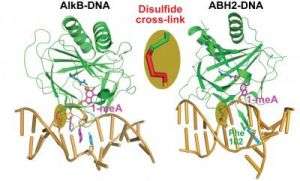
University of Chicago scientists determined the molecular structures of the bacterial AlkB protein and its corresponding human protein, ABH2, shown here chemically cross-linked with strands of DNA. These proteins repair damage that occurs in both healthy and cancerous cells. Both proteins bind weakly to DNA, making it difficult for scientists to identify their structures using conventional techniques. The chemical cross-linking that reinforced the complexes is shown magnified in the oval at top center. Scientists may now be able to design a molecule that interferes with the ability of the ABH2 protein to repair genetic damage in malignant cells. Image courtesy of Chuan He, University of Chicago

A team of University of Chicago scientists has shown how two proteins locate and repair damaged genetic material inside cells.

One protein detects and repairs damage in malignant cells that may result from a certain type of cancer therapy. In a paper published in the April 24 issue of the journal Nature, the team raised the possibility of designing a molecule that could interfere with the repair process, making cancer treatment more effective.

Chuan He, Assistant Professor in Chemistry, led the team. His co-authors included Phoebe Rice, Associate Professor in Biochemistry and Molecular Biology at the University of Chicago, and five researchers from his laboratory: Cai-Guang Yang, Chengqi Yi, Erica Duguid, Christopher Sullivan, and Xing Jian. Their work was supported by the National Institutes of Health, the W.M. Keck Foundation and the Arnold and Mabel Beckman Foundation.

In their Nature paper, the scientists determined, for the first time, the crystal structures (showing the three-dimensional framework of atoms) of two related DNA-repair proteins bound to double-stranded DNA: a bacterial protein called AlkB, and a corresponding human protein, ABH2. Scientists had been seeking the structures of these proteins to better understand how they perform their key roles in repairing DNA.

The bacterial protein can bind to either single- or double-stranded DNA. The strands separate during the replication process, but the bacterial protein avoids the latter. “This is very bizarre, because most other DNA repair proteins prefer double-stranded,” He said. The AlkB protein avoids double-stranded DNA because binding it takes more energy.

“Double-stranded DNA is rigid. Single-stranded is very flexible,” He explained. “You can cause all kinds of distortion in single-stranded without paying much energetic penalty.”

Many labs have unsuccessfully attempted to solve the structure of the bacterial protein with double-stranded DNA. They failed because this family of proteins binds DNA weakly, which foils the application of traditional crystallographic methods, He said. His team reinforced the complex by cross-linking the DNA to the protein.

Previous crystal structures of this protein included only a very short, single-stranded segment of DNA, and did not reveal all of its interactions with larger, more biologically relevant strands of DNA.

“The technique that they used to grow these crystals is very clever,” said Rice, who served as the team’s crystallographer. “It’s a nice application of chemistry to solving important questions in biology.

“Knowing which pieces of the enzyme are important for interacting with double-stranded DNA and which pieces are missing when it would prefer a single strand will help us to predict the functions of related proteins,” Rice said.

Said He: “We’re now applying this same strategy to all kinds of other protein-DNA complexes.”

The AlkB and ABH2 proteins repair alkylation damage to DNA, including the damage caused by alkylating cancer treatments. Alkylation is the addition of certain chemical groups to DNA and is particularly harmful to rapidly growing cells such as cancerous ones.

In an unexpected development last year, a team of European researchers published studies that identified an obesity gene in humans that belongs to the same family of proteins as AlkB. A defect in this gene, FTO, is associated with a weight gain of nearly seven pounds.

“It’s surprising and exciting to see that the demethylation function is linked to obesity,” He said. “Methylation is a type of alkylation that is used to regulate gene expression.” One of his future goals is to determine the function of the FTO protein.

Among their many functions, proteins control chemical reactions in the cell by turning genes off and on. “This family of proteins might use demethylation as a signal to regulate gene activation,” he said. “But this type of demethylation by AlkB and FTO has never been linked to gene activation in the past.”

He oversees a research team of approximately 20 students and postdoctoral scientists, which occupies nearly half of one wing on the third floor of the Gordon Center for Integrative Science. The team collects most of its data at the Department of Energy’s Advanced Photon Source at Argonne National Laboratory.

Source: University of Chicago


print this article email this article download pdf blog this article bookmark this article     Digg this Stumble it share on Facebook share on Reddit add to delicious save to Yahoo! bookmarks
3.5/5 after 4 votes


April 23rd, 2008 all stories
Biology /

Comments: 0
Rank: 3.5/5 after 4 votes

  • Stumble this up

  • Digg this

  • Share it:
  • share on Facebook
  • share on MySpace
  • share on Slashdot
  • rss-newsfeed
  • share on Google
  • share on Reddit
  • add to delicious
  • save to Yahoo! bookmarks
  • share on Windows Live
  • Add to Mixx!
Rating: 3.5/5 after 4 votes

  • Related Stories

  • Researchers find possible environmental causes for Alzheimer's, diabetes
    created 6 hours ago | popularity not rated yet | comments 0
  • Researchers highlight new direction for drug discovery
    created 20 hours ago | popularity not rated yet | comments 0
  • MicroRNAs hold promise for treating diseases in blood vessels
    created 22 hours ago | popularity not rated yet | comments 0
  • Oxygen key to 'cut and paste' of genes
    created Jul 03, 2009 | popularity not rated yet | comments 0
  • New study rewrites textbook on key genetic phenomenon
    created Jul 01, 2009 | popularity not rated yet | comments 0

Tags


  • Physicists Demonstrate Quantum Memory with Matter Qubits
    Physicists Demonstrate Quantum Memory with Matter Qubits
    Physics / General Physics
    created Jul 03, 2009 | popularity 4.4 / 5 (17) | comments 1
  • 'Holey' Nanosheets for Wastewater Dye Removal
    Nanotechnology / Nanomaterials
    created Jul 01, 2009 | popularity 5 / 5 (5) | comments 1
  • Jellyfish Robot Swims Like its Biological Counterpart
    Jellyfish Robot Swims Like its Biological Counterpart
    Electronics / Robotics
    created Jun 26, 2009 | popularity 4.4 / 5 (8) | comments 1
  • Could Maxwell's Demon Exist in Nanoscale Systems?
    Could Maxwell's Demon Exist in Nanoscale Systems?
    Physics / General Physics
    created Jun 24, 2009 | popularity 4.4 / 5 (18) | comments 29
  • Living Safely with Robots, Beyond Asimov's Laws
    Living Safely with Robots, Beyond Asimov's Laws
    Electronics / Robotics
    created Jun 22, 2009 | popularity 4.6 / 5 (53) | comments 40
  • Other News

    Battle of the sexes benefits offspring, says research

    Battle of the sexes benefits offspring, says research

    Biology / Plants & Animals

    created 1hour ago | popularity not rated yet | comments 0

    Parents compensate for a lazy partner by working harder to bring up their offspring, but not enough to completely make up for the lack of parenting, says research by bird biologists at the University of Bath.


    Researchers uncover the potential for super-sized abalone

    Biology / Microbiology

    created 5 hours ago | popularity not rated yet | comments 0

    (PhysOrg.com) -- Designer abalone could be an option in the foreseeable future, thanks to a project conducted at UQ's Heron Island Research Station and the St Lucia campus.


    Scientists 'rebuild' giant moa using ancient DNA

    Biology / Plants & Animals

    created Jul 01, 2009 | popularity 5 / 5 (10) | comments 12

    (PhysOrg.com) -- Scientists have performed the first DNA-based reconstruction of the giant extinct moa bird, using prehistoric feathers recovered from caves and rock shelters in New Zealand.


    Pacific Giant Salamander (Dicamptodon tenebrosus)

    Salamanders, regenerative wonders, heal like mammals, people

    Biology / Microbiology

    created Jul 01, 2009 | popularity 5 / 5 (20) | comments 11

    The salamander is a superhero of regeneration, able to replace lost limbs, damaged lungs, sliced spinal cord -- even bits of lopped-off brain. But it turns out that remarkable ability isn't so mysterious after ...


    California water plan aims to save Puget Sound orcas

    Biology / Ecology

    created 21 hours ago | popularity 4 / 5 (1) | comments 0

    A plan to restore salmon runs on California's Sacramento River also could help revive killer whale populations 700 miles to the north in Puget Sound, as federal scientists struggle to protect endangered species in a complex ...