Radio telescope reveals secrets of massive black hole
April 23, 2008 Radio telescope reveals secrets of massive black hole

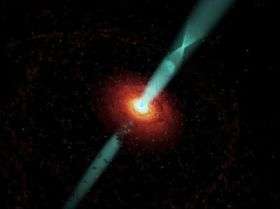
Artist's conception of region near supermassive black hole where twisted magnetic fields propel and shape jet of particles. Credit: Marscher et al., Wolfgang Steffen, Cosmovision, NRAO/AUI/NSF

At the cores of many galaxies, supermassive black holes expel powerful jets of particles at nearly the speed of light. Just how they perform this feat has long been one of the mysteries of astrophysics.

The leading theory says the particles are accelerated by tightly-twisted magnetic fields close to the black hole, but confirming that idea required an elusive close-up view of the jet's inner throat. Now, using the unrivaled resolution of the National Radio Astronomy Observatory's Very Long Baseline Array (VLBA), astronomers have watched material winding a corkscrew outward path and behaving exactly as predicted by the theory. The astronomers reported their findings in the April 24 issue of the journal Nature.

"We have gotten the clearest look yet at the innermost portion of the jet, where the particles actually are accelerated, and everything we see supports the idea that twisted, coiled magnetic fields are propelling the material outward," said Alan Marscher, of Boston University, leader of an international research team. "This is a major advance in our understanding of a remarkable process that occurs throughout the Universe," he added.

Marscher's team studied a galaxy called BL Lacertae (BL Lac), some 950 million light-years from Earth. BL Lac is a blazar, the most energetic type of black-hole-powered galactic core. A black hole is a concentration of mass so dense that not even light can escape its gravitational pull. Supermassive black holes in galaxies' cores power jets of particles and intense radiation in similar objects including quasars and Seyfert galaxies.

Material pulled inward toward the black hole forms a flattened, rotating disk, called an accretion disk. As the material moves from the outer edge of the disk inward, magnetic field lines perpendicular to the disk are twisted, forming a tightly-coiled bundle that, astronomers believe, propels and confines the ejected particles. Closer to the black hole, space itself, including the magnetic fields, is twisted by the strong gravitational pull and rotation of the black hole.

Theorists predicted that material moving outward in this close-in acceleration region would follow a corkscrew-shaped path inside the bundle of twisted magnetic fields. They also predicted that light and other radiation emitted by the moving material would brighten when its rotating path was aimed most directly toward Earth.

Marscher and his colleagues predicted there would also be a flare later when the material hits a stationary shock wave called the "core" some time after it has emerged from the acceleration region.

"That behavior is exactly what we saw," Marscher said, when his team followed an outburst from BL Lac. In late 2005 and early 2006, the astronomers watched BL Lac with an international collection of telescopes as a knot of material was ejected outward through the jet. As the material sped out from the neighborhood of the black hole, the VLBA could pinpoint its location, while other telescopes measured the properties of the radiation emitted from the knot.

Bright bursts of light, X-rays, and gamma rays came when the knot was precisely at locations where the theories said such bursts would be seen. In addition, the alignment of the radio and light waves -- a property called polarization -- rotated as the knot wound its corkscrew path inside the tight throat of twisted magnetic fields.

"We got an unprecedented view of the inner portion of one of these jets and gained information that's very important to understanding how these tremendous particle accelerators work," Marscher said.

Source: National Radio Astronomy Observatory


print this article email this article download pdf blog this article bookmark this article     Stumble it Digg this share on Facebook retweet share on Reddit add to delicious
Rate this story - 4.5 /5 (27 votes)

Rank Filter

Move the slider to adjust rank threshold, so that you can hide some of the comments.


Display comments: newest first

  • googleplex - Apr 23, 2008
    • Rank: not rated yet
    If the super massive black hole is 950 million light years from earth then that means the signals we detect by telescope are that old. I wonder what that black hole looks like today after nearly 1 billion years of accumulating stellar material? Or is a billion years nothing to these large bodies. From a galactic perspective light is very slow, there must be something quicker! I think the effects of gravity are instant over vast distances - perhaps that is a clue?
  • earls - Apr 23, 2008
    • Rank: not rated yet
    Just how massive would a "black hole" with instant gravity have to be to prevent the particles from escaping?

    Something just doesn't add up.
  • mattytheory - Apr 23, 2008
    • Rank: not rated yet
    Gravity is instantaneous when GR fails.
  • brant - Apr 23, 2008
    • Rank: 5 / 5 (1)

    "Theorists predicted that material moving outward in this close-in acceleration region would follow a corkscrew-shaped path inside the bundle of twisted magnetic fields. They also predicted that light and other radiation emitted by the moving material would brighten when its rotating path was aimed most directly toward Earth."

    What a load of baloney. What a non prediction.

    How about predicting where the energy comes from.

    How about predicting the Right Hand Rule when dealing with magnetic fields and electric currents.

    That means if you have a jet shaped twisted magnetic field, there is a electrical current flowing in that jet.
  • WolfAtTheDoor - Apr 24, 2008
    • Rank: not rated yet
    I'm not buying it, either brant. The rotation of the black hole must create some sort of gravitational 'window' that allows the particles from these jets to escape. I think, if anything, this re-enforces how little we know about the frustrating mechanics of gravity.
  • WolfAtTheDoor - Apr 24, 2008
    • Rank: not rated yet
    Okay... let me throw this in bed with Madonna and see if she sleeps with it:

    Gravitational force, like the other forces can be overcome at certain energy levels. Maybe the incoming baryonic matter is accelerated to such an extent that as it collides with the core of the black hole you have huge amounts of energy released, enough to overcome the gravitational force. Maybe some smart cosmologist could even calculate this value someday.

    And btw, I don't buy that the graviton doesn't have mass. It might be a fraction of the mass of other carriers, but it must have some mass, right?
  • earls - Apr 24, 2008
    • Rank: not rated yet
    Interesting point Wolf, perhaps there is a ratio between the size of the black hole and the energy imparted to the incoming matter that always allows it to escape via these jets. Now what percentage of the incoming that escape is another question... And then there's the matter of black holes "radiating" without any incoming matter.

    I'm also inclined to think there's no "black hole" or central "body of mass" also... And it's just an empty "focal point" that the surrounding matter revolves around.

    Take out the central super-masses out of the galaxy rotation equation and see what comes up... Wish I could.

April 23, 2008 all stories

Comments: 7

4.5 /5 (27 votes)
  • Stumble this up

  • Digg this

  • share this

  • hide
  • Related Stories

  • New study confirms exotic electric properties of graphene
    created Nov 17, 2009 | popularity not rated yet | comments 0
  • New Vista of Milky Way Center Unveiled
    created Sep 22, 2009 | popularity not rated yet | comments 0
  • New study will contribute to better understanding of nuclear ignition
    created Aug 31, 2009 | popularity not rated yet | comments 0
  • Lunar Reconnaissance Orbiter to Help Astronauts Survive in Infinity
    created Apr 17, 2009 | popularity not rated yet | comments 0
  • Fermi Gamma-Ray Space Telescope Sees Most Extreme Gamma-Ray Blast Ever
    created Feb 19, 2009 | popularity not rated yet | comments 0


  • hide
  • Relevant PhysicsForums posts

  • Question about 2-body gravity
    created 15 hours ago
  • life on Mars
    created 18 hours ago
  • Semi-major axis from cartesian co-ordinates
    created Nov 23, 2009
  • Primary Mirror grinding
    created Nov 23, 2009
  • More from Physics Forums - General Astronomy

Other News

Cassini Captures Ghostly Dance of Saturn's Northern Lights

Cassini Captures Ghostly Dance of Saturn's Northern Lights (w/ Video)

Space & Earth / Space Exploration

created 8 hours ago | popularity 5 / 5 (3) | comments 0

(PhysOrg.com) -- In the first video showing the auroras above the northern latitudes of Saturn, Cassini has spotted the tallest known "northern lights" in the solar system, flickering in shape and brightness ...


First black holes may have incubated in giant, starlike cocoons, says CU-Boulder study

First black holes may have incubated in giant, starlike cocoons

Space & Earth / Astronomy

created 11 hours ago | popularity 4.4 / 5 (10) | comments 7

(PhysOrg.com) -- The first large black holes in the universe likely formed and grew deep inside gigantic, starlike cocoons that smothered their powerful x-ray radiation and prevented surrounding gases from ...


Infrared Image of Circumstellar Disk Illuminates Massive Star Formation Process

Infrared Image of Circumstellar Disk Illuminates Massive Star Formation Process

Space & Earth / Astronomy

created 6 hours ago | popularity 4.5 / 5 (2) | comments 0

(PhysOrg.com) -- A team of astronomers from Ibaraki University, Japan Aerospace Exploration Agency, Kanagawa University, University of Tokyo, Academica Sinica, and National Astronomical Observatory of Japan ...


ET: Check your voicemail

ET: Check your voicemail

Space & Earth / Space Exploration

created 7 hours ago | popularity 3.4 / 5 (5) | comments 4

(PhysOrg.com) -- Alien beings on faraway planets may not have noticed, but it’s been 35 years since human beings made the first deliberate effort to send them a message.


U.S. losing its lead in space, experts warn Congress

Space & Earth / Space Exploration

created 5 hours ago | popularity 2.5 / 5 (2) | comments 1

America's once clear dominance in space is eroding as other nations, including China, Iran and North Korea, step up their activities, a panel of experts told the House subcommittee on Space and Aeronautics Thursday.