Glaciers reveal Martian climate has been recently active
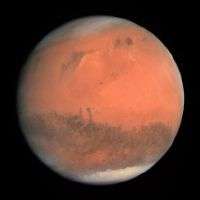
The prevailing thinking is that Mars is a planet whose active climate has been confined to the distant past. About 3.5 billion years ago, the Red Planet had extensive flowing water and then fell quiet - deadly quiet. It didn't seem the climate had changed much since.
Now, in a research article that graces the May cover of Geology, scientists at Brown University think Mars's climate has been much more dynamic than previously believed. After examining stunning high-resolution images taken last year by the Mars Reconnaissance Orbiter, the researchers have documented for the first time that ice packs at least 1 kilometer (0.6 miles) thick and perhaps 2.5 kilometers (1.6 miles) thick existed along Mars's mid-latitude belt as recently as 100 million years ago. In addition, the team believes other images tell them that glaciers flowed in localized areas in the last 10 to 100 million years - akin to the day before yesterday in Mars's geological timeline.
This evidence of recent activity means the Martian climate may change again and could bolster speculation about whether the Red Planet can, or did, support life.
"We've gone from seeing Mars as a dead planet for three-plus billion years to one that has been alive in recent times," said Jay Dickson, a research analyst in the Department of Geological Sciences at Brown and lead author of the Geology paper. "[The finding] has changed our perspective from a planet that has been dry and dead to one that is icy and active."
In fact, Dickson and his co-authors, James Head, a planetary geologist and the Louis and Elizabeth Scherck Distinguished Professor at Brown, and David Marchant, an associate professor in the Department of Earth Sciences at Boston University, believe the images show that Mars has gone through multiple Ice Ages - episodes in its recent past in which the planet's mid-latitudes were covered by glaciers that disappeared with changes in the Red Planet's obliquity, which changes the climate by altering the amount of sunlight falling on different areas.
Dickson and the other researchers focused on an area called Protonilus Mensae-Coloe Fossae. The region is located in Mars's mid-latitude and is marked by splotches of mesas, massifs and steep-walled valleys that separate the lowlands in the north from the highlands in the south.
The team looked in particular at a box canyon set in a low-lying plain. Images show the canyon has moraines - deposits of rocks that mark the limits of a glacier's advance or the path of its retreat. The rock deposit lines appear to show a glacier that flowed up the box canyon, which "physically cannot happen," Dickson said.
Instead, the team deduced the ice in the surrounding plain grew higher than the canyon's walls and then flowed downward onto the top of the canyon, which had become the lowest point on the ice-laden terrain. The team calculated the ice pack must have been one kilometer thick by past measurements of height between the plain and the lip of the canyon. Based on the ice flow patterns, the ice pack could have reached 2.5 kilometers at peak thickness during a period known as the late Amazonian, the authors said.
The finding could have implications for the life-on-Mars argument by strengthening the case for liquid water. Ice can melt two ways: by temperature or by pressure. As currently understood, the Martian climate is dominated by sublimation, the process by which solid substances are transformed directly to vapor. But ice packs can exert such strong pressure
at the base to produce liquid water, which makes the thickness of past glaciers on its surface so intriguing.
Dickson also looked at a lobe across the valley from the box canyon site. There, he saw a clear, semi-circular moraine that had spilled from an ancient tributary on to the surrounding plain. The lobe is superimposed on a past ice deposit and appears to be evidence of more recent glaciation. Although geologists can't date either event, the landscape appears to show at least two periods in which glaciation occurred, bolstering their theory that the Martian climate has undergone past Ice Ages.
Source: Brown University


