Herschel spacecraft assembly complete
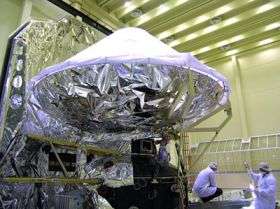
The mirror of the Herschel telescope has now been assembled with the payload and service module, completing the spacecraft structure - an important milestone in the days following through to launch.
The sunshield and solar arrays were assembled with the cryostat and service module on 11 April. The telescope was assembled on 16 April. The spacecraft will be subjected to several mechanical tests over the next few weeks.
The telescope mirror of the Herschel infrared observatory is a 3.5-m diameter technological marvel. It is made from 12 silicon-carbide petals brazed together to form a single structure and coated with a layer of reflective aluminium, forming a remarkably lightweight mirror.
The fully-assembled telescope, which includes the primary mirror, the secondary mirror and its support structure, is a feathery 320 kg; remarkably low for such a sturdy structure capable of withstanding high launch loads and functioning precisely in the harsh environment of space.
This powerful telescope will allow scientists to look deep into space, at long infrared wavelengths. Herschel’s spectral coverage, which ranges from far-infrared to sub-millimetre wavelengths, will be made available for space-based observations for the first time.
Herschel will make it possible to observe and study relatively cool objects everywhere in the universe, from our own back yard to distant galaxies, teaching us much more about the birth and evolution of stars and galaxies.
Source: ESA


