Wanted: a reason to divorce
April 23, 2008
Wanted: a reason to divorce

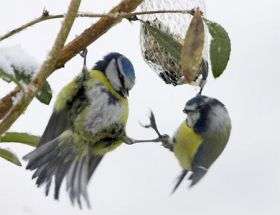
Wars of the Roses amongst blue tits - half of all pairs separate again. Image: Kaspar Delhey/MPI for Ornithology

Divorce is widespread, not only in humans, but also in socially monogamous birds like the blue tit. Behavioural ecologists Mihai Valcu and Bart Kempenaers from the Max Planck Institute for Ornithology in Seewiesen found divorce rates of up to 50% in a long-term study of this species. But why do partners split up? To answer this question, it helps to know who suffers and who benefits from the separation (Animal Behaviour, April 23, 2008).

Previous studies on small passerine birds, such as blue tits, have shown that females do better after divorce. This is because they had more offspring with a new partner.

"These findings have led to the suggestion that the females should take the initiative to leave their partner", says Bart Kempenaers, Director of the Department Behavioural Ecology and Evolutionary Genetics at the Max Planck Institute for Ornithology in Seewiesen.

In their study however, Kempenaers and his colleague Mihai Valcu obtained evidence that the increased reproductive success of divorced females may not be caused by getting a better partner, but by leaving the previous home and moving to a better place. Such breeding dispersal is common in females, in contrast to males, who rarely leave their territory after a divorce.

To separate the effects of territory change and partner change, the Max Planck researchers investigated what happens to the divorced females that stay in or close to their former breeding area. They found that in this case males, but not females, increased their fitness: they mated with larger females and had a higher breeding success compared to their former partner.

So is it the males that make the first step towards separation? "We can only speculate", says Kempenaers. "But our hypothesis is that a larger, stronger female expels the original mate, and takes over the territory and the male." In this case, the separation may not be a decision by one of the partners to leave, but may be caused by competition among females - this would then be the classic reasons for divorce.

Citation: Mihai Valcu and Bart Kempenaers, Causes and consequences of breeding dispersal and divorce in a blue tit (Cyanistes caeruleus) population. Animal Behaviour, April 23, 2008

Source: Max Planck Institute for Ornithology

3.3 /5 (8 votes)  

Rank 3.3 /5 (8 votes)
Tags

Relevant PhysicsForums posts

More news stories

A mitosis mystery solved: How chromosomes align perfectly in a dividing cell

Although the process of mitotic cell division has been studied intensely for more than 50 years, Whitehead Institute researchers have only now solved the mystery of how cells correctly align their chromosomes during symmetric ...

Biology / Cell & Microbiology

created 6 hours ago | popularity 4.5 / 5 (11) | comments 0 | with audio podcast

Researchers find extensive RNA editing in human transcriptome

In a new study published online in Nature Biotechnology, researchers from BGI, the world's largest genomics organization, reported the evidence of extensive RNA editing in a human cell line by analysis of RNA-seq data, demons ...

Biology / Biotechnology

created 6 hours ago | popularity 5 / 5 (4) | comments 0 | with audio podcast

The proteins ensuring genome protection

Researchers from the University of Geneva (UNIGE), Switzerland, have discovered the crucial role of two proteins in developing a cell 'anti-enzyme shield'. This protection system, which operates at the level of molecular ...

Biology / Cell & Microbiology

created 6 hours ago | popularity 5 / 5 (3) | comments 0 | with audio podcast

Entire genome of extinct human decoded from fossil

(PhysOrg.com) -- In 2010, Svante Pääbo and his colleagues presented a draft version of the genome from a small fragment of a human finger bone discovered in Denisova Cave in southern Siberia. The ...

Biology / Biotechnology

created Feb 07, 2012 | popularity 4.7 / 5 (59) | comments 50 | with audio podcast

Why are there so few fish in the Earth's oceans?

(PhysOrg.com) -- A Stony Brook University researcher has found that, contrary to popular belief, there are not plenty of fish in the sea.

Biology / Plants & Animals

created Feb 08, 2012 | popularity 4.2 / 5 (18) | comments 27 | with audio podcast


Scientists discover molecular secrets of 2,000-year-old Chinese herbal remedy

For roughly two thousand years, Chinese herbalists have treated Malaria using a root extract, commonly known as Chang Shan, from a type of hydrangea that grows in Tibet and Nepal. More recent studies suggest that halofuginone, ...

New method to examine batteries -- MRI from the inside

There is an ever-increasing need for advanced batteries for portable electronics, such as phones, cameras, and music players, but also to power electric vehicles and to facilitate the distribution and storage of energy derived ...

Overeating may double risk of memory loss

New research suggests that consuming between 2,100 and 6,000 calories per day may double the risk of memory loss, or mild cognitive impairment (MCI), among people age 70 and older. The study was released today and will be ...

Lab study raises questions over nano-particle impact

Tests involving chickens have raised questions about the impact on health from engineered nano-particles, the ultra-fine grains commonly used in drugs and processed foods, scientists said on Sunday.

Google might launch Drive for cloud storage soon

(PhysOrg.com) -- Google's next big move, according to the Wall Street Journal, is a cloud storage service called Drive. Hardly first to the plate, Google is simply catching up to introducing its cloud reposi ...

Starve a virus, feed a cure? Findings show how some cells protect themselves against HIV

A protein that protects some of our immune cells from the most common and virulent form of HIV works by starving the virus of the molecular building blocks that it needs to replicate, according to research published online ...