Galaxies Gone Wild

April 24, 2008 Galaxies Gone Wild

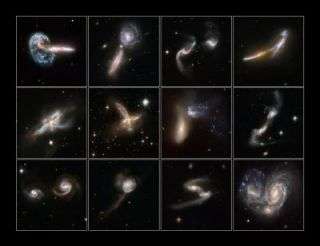
Interacting galaxies are found throughout the Universe, sometimes as dramatic collisions that trigger bursts of star formation, on other occasions as stealthy mergers that result in new galaxies. A series of 59 new images of colliding galaxies has been released from the several terabytes of archived raw images from the NASA/ESA Hubble Space Telescope to mark the 18th anniversary of the telescope's launch. This is the largest collection of Hubble images ever released to the public simultaneously. In this poster are the best 12 images of the collection. Credit: NASA, ESA, the Hubble Heritage Team (STScI/AURA)-ESA/Hubble Collaboration and A. Evans (University of Virginia, Charlottesville/NRAO/Stony Brook University), K. Noll (STScI), and J. Westphal (Caltech)

Interacting galaxies are found throughout the Universe, sometimes as dramatic collisions that trigger bursts of star formation, on other occasions as stealthy mergers that result in new galaxies. A series of 59 new images of colliding galaxies has been released from the several terabytes of archived raw images from the NASA/ESA Hubble Space Telescope to mark the 18th anniversary of the telescope’s launch. This is the largest collection of Hubble images ever released to the public simultaneously.

Galaxy mergers, which were more common in the early Universe than they are today, are thought to be one of the main driving forces for cosmic evolution, turning on quasars, sparking frenetic star births and explosive stellar deaths. Even apparently isolated galaxies will show signs in their internal structure that they have experienced one or more mergers in their past. Each of the various merging galaxies in this series of images is a snapshot of a different instant in the long interaction process.

Our own Milky Way contains the debris of the many smaller galaxies it has encountered and devoured in the past, and it is currently absorbing the Sagittarius dwarf elliptical galaxy. In turn, it looks as if our Milky Way will be subsumed into its giant neighbour, the Andromeda galaxy, resulting in an elliptical galaxy, dubbed "Milkomeda", the new home for the Earth, the Sun and the rest of the Solar System in about two billion years time. The two galaxies are currently rushing towards each other at approximately 500,000 kilometres per hour.

Cutting-edge observations and sophisticated computer models, such as those pioneered by the two Estonian brothers Alar Toomre and Juri Toomre in the 1970s, demonstrate that galaxy collisions are far more common than previously thought. Interactions are slow stately affairs, despite the typically high relative speeds of the interacting galaxies, taking hundreds of millions of years to complete. The interactions usually follow the same progression, and are driven by the tidal pull of gravity. Actual collisions between stars are rare as so much of a galaxy is simply empty space, but as the gravitational webs linking the stars in each galaxy begin to mesh, strong tidal effects disrupt and distort the old patterns leading to new structures, and finally to a new stable configuration.

The pull of the Moon that produces the twice-daily rise and fall of the Earth’s oceans illustrates the nature of tidal interactions. Tides between galaxies are much more disruptive than oceanic tides for two main reasons. Firstly, stars in galaxies, unlike the matter that makes up the Earth, are bound together only by the force of gravity. Secondly, galaxies can pass much closer to each other, relative to their size, than do the Earth and the Moon. The billions of stars in each interacting galaxy move individually, following the pull of gravity from all the other stars, so the interwoven tidal forces can produce the most intricate and varied effects as galaxies pass close to each other.

Typically the first tentative sign of an interaction will be a bridge of matter as the first gentle tugs of gravity tease out dust and gas from the approaching galaxies (IC 2810). As the outer reaches of the galaxies begin to intermingle, long streamers of gas and dust, known as tidal tails, stretch out and sweep back to wrap around the cores (NGC 6786, UCG 335, NGC 6050). These long, often spectacular, tidal tails are the signature of an interaction and can persist long after the main action is over. As the galaxy cores approach each other their gas and dust clouds are buffeted and accelerated dramatically by the conflicting pull of matter from all directions (NGC 6621, NGC 5256). These forces can result in shockwaves rippling through the interstellar clouds (ARP 148). Gas and dust are siphoned into the active central regions, fuelling bursts of star formation that appear as characteristic blue knots of young stars (NGC 454). As the clouds of dust build they are heated so that they radiate strongly, becoming some of the brightest (luminous and ultraluminous) infrared objects (APG 220) in the sky.

These objects emit up to several thousand billion times the luminosity of our Sun. They are the most rapidly star-forming galaxies in today’s Universe and are linked to the occurrence of quasars. Unlike standard spiral galaxies like the Milky Way, which radiate from stars and hot gas distributed over their entire span of perhaps 100 000 light-years, the energy in luminous and ultraluminous infrared galaxies is primarily generated within their central portion, over an extent of 1000 to 10,000 light-years. This energy emanates both from vigorous star formation processes, which can generate up to a few hundred solar masses of new stars per year (in comparison, the Milky Way generates a few solar masses of new stars per year), and from massive accreting black holes, a million to a billion times the mass of the Sun, in the central region.

Intense star formation regions and high levels of infrared and far-infrared radiation are typical of the most active central period of the interaction and are seen in many of the objects in this release. Other visible signs of an interaction are disruptions to the galaxy nuclei (NGC 3256, NGC 17). This disruption may persist long after the interaction is over, both for the case where a larger galaxy has swallowed a much smaller companion and where two more closely matched galaxies have finally separated.

Most of the 59 new Hubble images are part of a large investigation of luminous and ultraluminous infrared galaxies called the GOALS project (Great Observatories All-sky LIRG Survey). This survey combines observations from Hubble, the NASA Spitzer Space Observatory, the NASA Chandra X-Ray Observatory and NASA Galaxy Explorer. The Hubble observations are led by Professor Aaron S. Evans from the University of Virginia and the National Radio Astronomy Observatory (USA).

A number of the interacting galaxies seen here are included in the The Atlas of Peculiar Galaxies, a remarkable catalogue produced by the astronomer Halton Arp in the mid-1960s that built on work by B.A. Vorontsov-Velyaminov from 1959. Arp compiled the catalogue in a pioneering attempt to solve the mystery of the bizarre shapes of galaxies observed by ground-based telescopes. Today, the peculiar structures seen by Arp and others are well understood as the result of complex gravitational interactions.

Source: Hubble Information Centre


Rate this story - 4.4 /5 (32 votes)

Rank Filter

Move the slider to adjust rank threshold, so that you can hide some of the comments.


Display comments: newest first

  • TimESimmons - Apr 24, 2008
    • Rank: 1 / 5 (4)
    But why would galaxies merge? Why don't they carry on orbiting each other forever? Guess what:-

    http://www.presto...ndex.htm
  • earls - Apr 24, 2008
    • Rank: 2 / 5 (2)
    Yeah boyee, here's the real deal:

    http://www.spacet...810.html

    Gorgeous.

    Interesting they mention Arp, but not "intrinsic redshift." Curious because we're lead to believe the Universe is expanding at an increasing rate (due to redshift observations), yet everything is merging together? This is only a suggestion, as the picture is much to large for me to fathom and conceptualize, especially with my limited amount of studied data.

    Also no mentions of plasma/electrical current/magnetic field interactions which must certainly play a large role considering the ratio of the strengths of the forces of EM and G.

    Limiting astronomical interactions to gravity alone gives us little hope for a unified theory.

    Tim, it is suggested that the shapes of the galaxies - the cornerstone of your theory - are due to gravitational tidal forces versus particle on the same level as dark matter.
  • TimESimmons - Apr 24, 2008
    • Rank: 1.7 / 5 (3)
    Earls, show me a simulation that recreates those shapes.

    Also I can believe in large electric currents in deep space plasma but not that they create forces on electrically neutral objects. Again where's the simulation?

    http://www.presto...ndex.htm
  • earls - Apr 24, 2008
    • Rank: 2 / 5 (3)
    I assure you nothing in space is electrically neutral. The earth, sun, moon, planets, everything is charged. I'll be happy to provide evidence if this is an issue.

    As for the simulation:

    http://www.plasma...tion.gif
    http://www.plasma...laxy.jpg
    http://www.plasma...laxy.jpg

    Slightly different as they were not try to simulate a galaxy, but it gives a good idea of plasma interaction:

    http://www.wired....slide=12&slideView=4

    I highly recommend your browse this image gallery:

    http://www.plasma...ewimages
  • earls - Apr 24, 2008
    • Rank: 2.3 / 5 (3)
    More indepth explanation of galaxy formation:

    http://www.plasma...ormation

    A. Peratt's site:

    http://plasmascie...rse.html

    Although I can hardly stand to read it (text/background).
  • TimESimmons - Apr 24, 2008
    • Rank: 2 / 5 (1)
    Sorry I asked! I will study them tonight.
  • TexasMeteorites - Apr 25, 2008
    • Rank: 1 / 5 (1)
    WOW. This would be a very interesting poster if these photos didn't already exist in my chemistry, physics, and astronomy books.
    In fact, taken from ground based intruments, with amazing clarity, I think even NG has published photos like these before.

    SRD
    http://www.bccmet...ary.html
  • Mercury_01 - Apr 25, 2008
    • Rank: 1 / 5 (1)
    I am in line with the growing awareness of electrical phenomenon over large distances. Why is it that so many physicysts still seem to ignore EM influence in large scale cosmology?

    http://www.plasma...ogy.net/
  • vidyunmaya - Apr 26, 2008
    • Rank: 3 / 5 (2)
    Sub:Cosmic Function of the Universe
    Most of these data is very helpful for my next book as continuation to
    COSMOS YOGA VISION DEVELOPMENT SERIES I-IV
    I. NEW-BOOK:SEARCH BEYOND DARK MATTER-IMPORTANT NOTES.
    VISION DEVELOPMENT SERIES IN PHASES COVER %u2013
    COSMOS YOGA SERIES-I 10^3 LY-Tamasoma Jyothirgamyam
    BEYOND DARK MATTER BY VIDYARDHI NANDURI TXU 1-282-571
    JUNE 2005 Copy rights USA - Contact Author

    II.FOR COSMIC VISION: Centre of the Universe
    Heart of the Universe-Nov 2006 - By Vidyardhi Nanduri
    Copy Rights TXU 1-364-245 -
    The Science in Philosophy- Pridhvi Viswam Asya Dharineem
    Cosmos yoga vision series-II- cover upto 10^5 Light Years- pages 132

    III.NEW ADDITIONS: COSMOS YOGA VISION SERIES III- ALL PPT PROJECTIONS
    COSMOLOGY VEDAS INTERLINKS KNOWLEDGE EXPANSION- OCT 2007
    By Vidyardhi Nanduri (US Copyrights Cleared Jan 2008)-111 pages (64 Colour)


    IV.HEART OF UNIVERSE TO DYNAMIC FUNCTION -COSMOS YOGA VISION SERIES IV (DEC 2007)-SPACE COSMOLOGY DIGEST- DIALOGUES AND DIRECTION By Vidyardhi Nanduri
    (US Copyrights Cleared Jan 2008) -82 pages-27 sections [TXU 1-570-647]

    Edit Summary:Cosmology,Cosmogony,Space Science,Philosophy,
    consciousness,interlink fields, alternate cosmology, cosmology-vedas, Cosmology Interlinks, Space Exploration, Knowledge Expansion, Centre of the Universe , Vision Models of the Universe , Dynamic Universe
    http://www.cosmol...spot.com

April 24, 2008 all stories

Comments: 9

4.4 /5 (32 votes)

  • hide
  • Related Stories

  • The Stars behind the Curtain (w/ Video)
    created Feb 03, 2010 | popularity not rated yet | comments 0
  • The Cosmic Distance Scale
    created Jan 29, 2010 | popularity not rated yet | comments 0
  • Black Hole Hunters Set New Distance Record
    created Jan 27, 2010 | popularity not rated yet | comments 0
  • Galaxy Cluster Abell 3627: Two Tails to Tell
    created Jan 22, 2010 | popularity not rated yet | comments 0
  • Herschel readies itself for the Orion Nebula (w/ Video)
    created Jan 20, 2010 | popularity not rated yet | comments 0


  • hide
  • Relevant PhysicsForums posts

Other News

Space shuttle Endeavour pulls in at space station (AP)

Space shuttle Endeavour pulls in at space station

Space & Earth / Space Exploration

created 4 hours ago | popularity not rated yet | comments 0

(AP) -- Shuttle Endeavour arrived to a warm welcome at the International Space Station early Wednesday, delivering a new room and observation deck that will come close to completing construction 200 miles ...


Climate 'Tipping Points' May Arrive Without Warning, Says Top Forecaster

Space & Earth / Environment

created 14 hours ago | popularity 3 / 5 (8) | comments 10 | with audio podcast

(PhysOrg.com) -- A new University of California, Davis, study by a top ecological forecaster says it is harder than experts thought to predict when sudden shifts in Earth's natural systems will occur -- a worrisome finding ...


38 percent of world's surface in danger of desertification

38 percent of world's surface in danger of desertification

Space & Earth / Environment

created 11 hours ago | popularity 2 / 5 (4) | comments 5

A team of Spanish researchers has measured the degradation of the planet's soil using the Life Cycle Assessment (LCA), a scientific methodology that analyses the environmental impact of human activities, and ...


A new 3-D map of the interstellar gas within 300 parsecs from the sun

A new 3D map of the interstellar gas within 300 parsecs from the Sun

Space & Earth / Astronomy

created 17 hours ago | popularity 5 / 5 (5) | comments 0 | with audio podcast

(PhysOrg.com) -- Astronomy & Astrophysics is publishing new 3D maps of the interstellar gas in the local area around our Sun. A French-American team of astronomers presents new absorption measurements toward ...


URI researcher calls for global effort to monitor marine pollutants

Space & Earth / Environment

created 15 hours ago | popularity 3 / 5 (2) | comments 1

A University of Rhode Island researcher who studies chemical pollutants in the marine environment has called on colleagues around the world to establish a global monitoring network to verify that the chemicals banned by the ...