Study Captures Brain's Activity Processing Speech
Rad, Lad. You might be able to hear the difference, but to many children and adults, these words sound exactly the same. The problem isn’t that they can’t hear the sounds. The problem is that they can’t tell them apart.
One in 20 children in kindergarten has difficulties understanding speech that are not related to hearing or problems with their ears. The reason is that speech discrimination is a problem solved in the brain, not in the ear. How does the brain process speech sounds? Very little was known, until now.
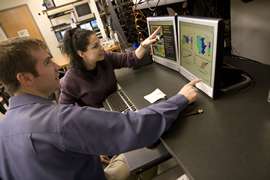
Enter Dr. Michael Kilgard and Crystal Engineer. Kilgard is a neuroscientist in the School of Behavioral and Brain Sciences at the University of Texas at Dallas. His lab is one of the few in the world that studies how individual neurons process speech stimuli. Engineer is one of Professor Kilgard’s doctoral students. Together they conducted a study to provide the first-ever description of how speech sounds are processed by neurons in the brain. This insight may offer a new approach to treating children with speech processing disorders.
“Now that we’ve cracked the door on this important problem, we should be able to understand the neural basis of many common speech processing disorders and use this information to develop new treatments,” said Dr. Kilgard.
The study is part of Engineer’s dissertation, “Cortical activity patterns predict speech discrimination ability,” and will be published in the May issue of Nature Neuroscience, the top research journal in the field of neuroscience. The advance, online publication of the study is now available on the Nature Neuroscience Web site.
This research is groundbreaking for a number of reasons. Prior studies have used a synthetic voice and tested the response to only a few words. Engineer and Kilgard had a much broader scope. They tested all the consonant sounds in the English language using a human voice. Microelectrodes inserted into a rat’s auditory cortex enabled the researchers to capture the patterns of neural activity generated by each consonant with incredible precision. Recording techniques that can be used with human subjects (such as MRI and EEG) lack the precision to track the activity of individual neurons.
The recordings showed that contrary to prior belief it’s not the quantity of neurons that fire in response to a speech sound that is important. It is which neurons are firing and exactly when they are firing – down to the millisecond – that is critical.
Based on the patterns of activity shown in the neural recordings, Kilgard and Engineer believed they could predict the rats’ ability to discriminate the speech sounds. They hypothesized that speech sounds that generate similar patterns of neural activity would be impossible for the brain, and thus the rat, to tell apart. In contrast, speech sounds that generate dissimilar patterns would be easy for rats to tell apart.
To test their theory, they trained rats to press a lever in response to some speech sounds and not others. Although rats can’t talk and certainly don’t have language, the new study reveals that rats can easily hear the difference between most speech sounds. The auditory system in rats and many other animals are surprisingly similar to humans’.
For example, the neural responses for the words dad and sad are very different. (See video.) As expected, rats can easily distinguish between these two words. The neural responses for the words rad and lad are very similar. Not surprisingly, rats, like many children, find it very difficult to differentiate between these two words.
The neural patterns explain the rats’ ability to differentiate between different speech sounds. “Our study is the first to tie the perception of speech sounds to the neural response of the same sounds,” said Engineer.
So, they’ve cracked the code, now what? The implications are huge. The perception of speech sounds is important because these are the acoustic building blocks of language. Scientists couldn’t begin to isolate the problems with speech and hearing disorders until they understood how speech sounds are normally processed in the brain.
Already, one of the most cited researchers in the world on neuroplasticity, the brain’s ability to change, Kilgard has big plans for his UT Dallas students and lab. He not only tackles ambitious topics in neuroscience, but in the process, he creates hands-on opportunities for his students at every level to get involved. This is what inspired Engineer to pursue her Ph.D.
“Dr. Kilgard encourages undergraduates to follow their interests. They have the rare opportunity to initiate and run their own projects and publish in prestigious journals. If it weren’t for these opportunities, I wouldn’t have gone on to graduate school,” said Engineer. She has worked with Kilgard since 2003, as an undergraduate, and expects to complete her Ph.D in August.
The emphasis on student involvement is illustrated by the number and diversity of the authors listed on the Nature Neuroscience study. Engineer and Kilgard’s research team included master’s students Claudia Perez and Helen Chen; undergraduates Ryan Carraway and Kevin Chang; and Ph.D. students Amanda Reed, Jai Shetake and Vikram Jakkamsetti.
“This paper in Nature Neuroscience is a great testimony to the level of graduate education students receive at UT Dallas. Dr. Kilgard is a wonderful mentor who helps students develop into independent researchers,” said Dr. Bert Moore, dean of the School of Behavioral and Brain Sciences. “We are proud of both Crystal and Mike for this exciting research.”
Source: UT Dallas


