Molecular analysis confirms T. rex's evolutionary link to birds
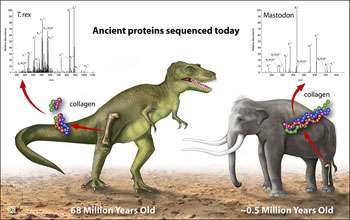
Putting more meat on the theory that dinosaurs’ closest living relatives are modern-day birds, molecular analysis of a shred of 68-million-year-old Tyrannosaurus rex protein – along with that of 21 modern species – confirms that dinosaurs share common ancestry with chickens, ostriches, and to a lesser extent, alligators.
The work, published this week in the journal Science, represents the first use of mo-lecular data to place a non-avian dinosaur in a phylogenetic tree that traces the evolution of species. The scientists also report that similar analysis of 160,000- to 600,000-year-old collagen protein sequences derived from mastodon bone establishes a close phylogenetic relationship between that extinct species and modern elephants.
“These results match predictions made from skeletal anatomy, providing the first molecular evidence for the evolutionary relationships of a non-avian dinosaur,” says co-author Chris Organ, a postdoctoral researcher in organismic and evolutionary biology at Harvard University. “Even though we only had six peptides – just 89 amino acids – from T. rex, we were able to establish these relationships with a relatively high degree of sup-port. With more data, we’d likely see the T. rex branch on the phylogenetic tree between alligators and chickens and ostriches, though we can’t resolve this position with currently available data.”
The current paper builds on work reported in Science last year. In that paper, a team headed by John M. Asara and Lewis C. Cantley, both of Beth Israel Deaconess Medi-cal Center (BIDMC) and Harvard Medical School (HMS), first captured and sequenced tiny pieces of collagen protein from T. rex. For the current work, Organ and Asara and their colleagues used sophisticated algorithms to compare collagen protein from several dozen species. The goal: placing T. rex on the animal kingdom’s family tree using molecu-lar evidence.
“Most of the collagen sequence was obtained from protein and genome databases but we also needed to sequence some critical organisms, including modern alligator and modern ostrich, by mass spectrometry,” says Asara, director of the mass spectrometry core facility at BIDMC and instructor in pathology at HMS. “We determined that T. rex, in fact, grouped with birds – ostrich and chicken – better than any other organism that we studied. We also show that it groups better with birds than modern reptiles, such as alliga-tors and green anole lizards.”
While scientists have long suspected that birds, and not more basal reptiles, are di-nosaurs’ closest living relatives, for years that hypothesis rested largely on morphological similarities in bird and dinosaur skeletons.
The scraps of dinosaur protein were wrested from a fossil femur discovered in 2003 by John Horner of the Museum of the Rockies in a barren fossil-rich stretch of land that spans Wyoming and Montana. Mary H. Schweitzer of North Carolina State Univer-sity (NCSU) and the North Carolina Museum of Natural Sciences discovered soft-tissue preservation in the T. rex bone in 2005; Asara became involved in analysis of the colla-gen protein because of his expertise in mass spectrometry techniques capable of se-quencing minute amounts of protein from human tumors. While it appears impossible to salvage DNA from the bone, Asara was able to extract precious slivers of protein.
The current work by Organ and Asara suggests that the extracted protein from the fossilized dinosaur tissue is authentic, rather than contamination from a living spe-cies.
“These results support the endogenous origin of the preserved collagen mole-cules,” the researchers write.
Source: Harvard University


