Refining the date of the K/T boundary and the dinosaur extinction
April 24, 2008 Refining the date of dinosaur extinction

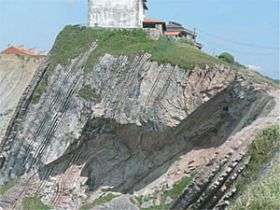
At Zumaia in the Basque country of northern Spain, sediments laid down around the end of the Cretaceous period show layers of light limestone and dark marl reflecting warm and cool periods, respectively, in Earth's climate. These alternating climatic periods are caused by 100,000-year and 405,000-year cycles in Earth's orbital eccentricity. Because Earth's orbit, and thus the relative ages of the sediment layers, can be precisely calculated, dating of the sediments by the argon-argon method provided a much-needed calibration of the method and made it possible to pinpoint the Cretaceous/Tertiary boundary at 65.95 million years ago. (Image courtesy of PNAS)

Scientists at the University of California, Berkeley, and the Berkeley Geochronology Center have pinpointed the date of the dinosaurs' extinction more precisely than ever thanks to refinements to a common technique for dating rocks and fossils.

The argon-argon dating method has been widely used to determine the age of rocks, whether they're thousands or billions of years old. Nevertheless, the technique had systematic errors that produced dates with uncertainties of about 2.5 percent, according to Paul Renne, director of the Berkeley Geochronology Center and an adjunct professor of earth and planetary science at UC Berkeley.

Renne and his colleagues in Berkeley and in the Netherlands now have lowered this uncertainty to 0.25 percent and brought it into agreement with other isotopic methods of dating rocks, such as uranium/lead dating. As a result, argon-argon dating today can provide more precise absolute dates for many geologic events, ranging from volcanic eruptions and earthquakes to the extinction of the dinosaurs and many other creatures at the end of the Cretaceous period and the beginning of the Tertiary period. That boundary had previously been dated at 65.5 million years ago, give or take 300,000 years.

According to a paper by Renne's team in the April 25 issue of Science, the best date for the Cretaceous-Tertiary, or K/T, boundary is now 65.95 million years, give or take 40,000 years.

"The importance of the argon-argon technique is that it is the only technique that has the dynamic range to cover nearly all of Earth's history," Renne said. "What this refinement means is that you can use different chronometers now and get the same answer, whereas, that wasn't true before."

Renne noted that the greater precision matters little for recent events, such as the emergence of human ancestors in Africa 6 million years ago, because the uncertainty is only a few tens of thousands of years.

"Where it really adds up is in dating events in the early solar system," Renne said. "A 1 percent difference at 4.5 billion years is almost 50 million years."

One major implication of the revision involves the formation of meteorites, planetessimals and planets in the early solar system, he said. Argon-argon dating was giving a lower date than other methods for the formation of meteorites, suggesting that they cooled slowly during the solar system's infancy.

"The new result implies that many of these meteorites cooled very, very quickly, which is consistent with what is known or suggested from other studies using other isotopic systems," he said. "The evolution of the early solar system - the accretion of planetessimals, the differentiation of bodies by gravity while still hot - happened very fast. Argon-argon dating is now no longer at odds with that evidence, but is very consistent with it."

Renne has warned geologists for a decade of uncertainty in the argon-argon method and has been correcting his own data since 2000, but it took a collaboration that he initiated in 1998 with Jan R. Wijbrans of the Free University in the Netherlands to obtain convincing evidence. Wijbrans and his Dutch colleagues were studying a unique series of sediments from the Messinian Melilla-Nador Basin on the coast of Morocco that contain records of cycles in Earth's climate that reflect changes in Earth's orbit that can be precisely calculated.

Wijbrans' colleague Frits Hilgen at the University of Utrecht, a coauthor of the study, has been one of the world's leaders in translating the record of orbital cycles into a time scale for geologists, according to Renne. Renne's group had proposed using the astronomical tuning approach to calibrate the argon-argon method as early as 1994, but lacked ideal sedimentary sequences to realize the full power of this approach. The collaboration brought together all the appropriate expertise to bring this approach to fruition, he said.

"The problem with astronomical dating of much older sediments, even when they contain clear records of astronomical cycles, is that you're talking about a pattern that is not anchored anywhere," Renne said. "You see a bunch of repetitions of features in sediments, but you don't know where to start counting."

Argon-argon dating of volcanic ash, or tephra, in these sediments provided that anchor, he said, synchronizing the methods and making each one more precise. The argon-argon analyses were conducted both in Berkeley and Amsterdam to eliminate interlaboratory bias.

Argon-argon dating, developed at UC Berkeley in the 1960s, is based on the fact that the naturally-occurring isotope potassium-40 decays to argon-40 with a 1.25-billion-year half-life. Single-grain rock samples are irradiated with neutrons to convert potassium-40 to argon-39, which is normally not present in nature. The ratio of argon-39 to argon-39 then provides a measurement of the age of the sample.

"This should be the last big revision of argon-argon dating," Renne said. "We've finally narrowed it down to where we are talking about fractions-of-a-percent revisions in the future, at most."

Source: University of California - Berkeley


print this article email this article download pdf blog this article bookmark this article     Stumble it Digg this share on Facebook retweet share on Reddit add to delicious
Rate this story - 4.4 /5 (19 votes)

Rank Filter

Move the slider to adjust rank threshold, so that you can hide some of the comments.


Display comments: newest first

  • out7x - Apr 25, 2008
    • Rank: 1 / 5 (1)
    poor explanation of argon-argon dating.
    Has anyone dated the oceans?
  • superhuman - Apr 27, 2008
    • Rank: 5 / 5 (1)
    >The ratio of argon-39 to argon-39 then provides a measurement of the age of the sample.

    Should be "The ratio of argon-40 to argon-39 then provides a measurement of the age of the sample."

    When the rock is formed it contains only potassium-40 K40 (since Argon is a noble gas), then when it ages some of K40 atoms decay to argon-40 Ar40 which is trapped in the sample. Since the half-life of K40 is known if we can measure how many K40 atoms decayed to Ar40 and how many are still intact, we can calculate how much time passed since the rock formed.
    For practical reasons instead of measuring K40 directly they convert it to Ar39 and measure the ratio of Ar40/Ar39 which is enough to calculate the age.
  • Graeme - Apr 28, 2008
    • Rank: not rated yet
    Actually it seems that K39 is converted to Ar39 by absorbing neutrons and emmitting protons. There seems to be a confusion with this.

April 24, 2008 all stories

Comments: 3

4.4 /5 (19 votes)
  • Stumble this up

  • Digg this

  • share this

  • hide
  • Related Stories

  • Poll finds sexting common among young people
    created Dec 03, 2009 | popularity not rated yet | comments 0
  • Dating the Bronze Age
    created Dec 02, 2009 | popularity not rated yet | comments 0
  • Chubby hubby is common, but ethnicity matters
    created Dec 01, 2009 | popularity not rated yet | comments 0
  • Home Field Advantage Often Overestimated In College Football
    created Dec 01, 2009 | popularity not rated yet | comments 0
  • Scientists report first effective medical therapy for rare stomach disorder
    created Nov 25, 2009 | popularity not rated yet | comments 0


  • hide
  • Relevant PhysicsForums posts

  • Glucose effectiveness and insulin sensitivity
    created Dec 02, 2009
  • Conflict about classifying Protist?
    created Dec 01, 2009
  • snake gourd vs an egg
    created Nov 30, 2009
  • burns
    created Nov 30, 2009
  • What type of adhesive to use with Aspergillus Niger experiments?
    created Nov 30, 2009
  • Is it true that
    created Nov 27, 2009
  • More from Physics Forums - Biology

Other News

Obama science advisers grilled over hacked e-mails

Other Sciences / Other

created Dec 03, 2009 | popularity 2.3 / 5 (3) | comments 11

(AP) -- House Republicans pointed to controversial e-mails leaked from climate scientists and said it was evidence of corruption. Top administration scientists looking at the same thing found no such sign, saying it doesn't ...


Britain shuts down UFO-hunting unit

Other Sciences / Other

created Dec 04, 2009 | popularity 3.7 / 5 (3) | comments 5

The British government has shut a unit which has investigated UFO sightings for more than 50 years, judging its resources better spent on more earthly threats, it said Friday.


Santa's Sleigh: NC State Researcher Explains Science Behind St. Nick?s Christmas Magic

Santa's Sleigh: Researcher Explains Science Behind St. Nick's Christmas Magic

Other Sciences / Other

created Dec 02, 2009 | popularity 4.9 / 5 (10) | comments 6

(PhysOrg.com) -- Santa skeptics have long considered St. Nick’s ability to deliver toys to the world’s good girls and boys in the course of one night a scientific impossibility. But new research shows that ...


Are the effects of pornography negligible?

Other Sciences / Social Sciences

created Dec 01, 2009 | popularity 4.2 / 5 (19) | comments 5

A Université de Montréal researcher, funded by the Interdisciplinary Research Center on Family Violence and Violence Against Women, has launched a new study to examine the effects of pornography on men. "We ...


Male and female shopping strategies show evolution at work in the mall

Other Sciences / Social Sciences

created Dec 02, 2009 | popularity 4 / 5 (13) | comments 2

Male and female shopping styles are in our genes---and we can look to evolution for the reason. Daniel Kruger, research faculty at the University of Michigan School of Public Health, says it's perfectly natural that men often ...