Shoulder Motor Balks on Opportunity Rover's Robotic Arm
April 24, 2008
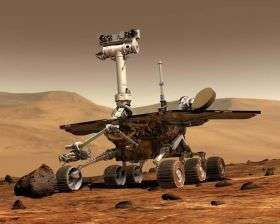
Artist's concept of Mars Exploration Rover. Image credit: NASA/JPL-Caltech/Cornell University.
A small motor in the robotic arm of NASA's Mars Exploration Rover Opportunity that began stalling occasionally more than two years ago has become more troublesome recently.
Rover engineers at NASA's Jet Propulsion Laboratory, Pasadena, Calif., are diagnosing why the motor, one of five in the robotic arm, stalled on April 14 after much less motion that day than in the case of several earlier stalls. They are also examining whether the motor can be used and assessing the impact on Opportunity's work if the motor were no longer usable.
The motor controls sideways motion at the shoulder joint of the rover robotic arm. Other motors provide up-and-down motion at the shoulder and maneuverability at the elbow and wrist. A turret at the end of the arm has four tools that the arm places in contact with rocks and soils to study their composition and texture.
"Even under the worst-case scenario for this motor, Opportunity still has the capability to do some contact science with the arm," said JPL's John Callas, project manager for the twin rovers Opportunity and Spirit. "The vehicle has quite a bit of versatility to continue the high-priority investigations in Victoria Crater and back out on the Meridiani plains after exiting the crater."
The performance of the motor in the past week is consistent with increased resistance in the electrical circuit, such as from degrading of wire in the winding, rather than a mechanical jam. Additional tests are planned for checking whether the apparent resistance is localized or intermittent.
Opportunity and Spirit landed on Mars in January 2004 to begin missions originally planned for three months. They have continued operating for more than four years, though each with some signs of aging.
Opportunity's balky shoulder motor began stalling occasionally in November 2005. The motor could still be operated by applying increased voltage. Engineers assessed it has an increased likelihood of becoming unusable, however, so the team changed its standard procedures for stowing and unstowing the arm.
Until then, on days when the arm would not be used, the team kept it stowed, resting on a hook under the front of the rover deck. Motion of the stall-prone shoulder motor is necessary to unstow the arm, so if the motor were to become unusable with the arm in the stowed position, the arm could not be deployed again. With diminished confidence in the balky motor, the team began unstowing the arm at the end of each day's drive rather than leaving it stowed overnight. This keeps the arm available for use even if the motor then stops working.
This spring, Opportunity is crossing an inner slope of Victoria Crater to reach the base of a cliff portion of the crater rim, a promontory called "Cape Verde." On April 14, Opportunity was backing out of a sandy patch encountered on the path toward Cape Verde from the area where the rover descended into the crater. As usual, the commands included unstowing the arm at the end of the day's short drive. The shoulder motor barely got the arm unstowed before stalling.
"We'll hold off backing out of the sand until after we've completed the diagnostic tests on the motor," Callas said. "The rover is stable and safe in its current situation, and not under any urgency. So we will take the time to act cautiously."
Source: NASA
-
Curiosity rover will serve as terramechanics instrument in explortation of Martian soils
Jan 20, 2012 |
5 / 5 (2) |
0
-
Researchers aim for 'direct brain control' of prosthetic arms (w/ Video)
Jul 27, 2011 |
4.5 / 5 (2) |
0
-
Opportunity rover tops 20 miles of Mars driving
Jul 20, 2011 |
5 / 5 (6) |
11
-
NJIT biomedical engineer helps stroke patients
Feb 08, 2011 |
5 / 5 (1) |
0
-
Five things about NASA's Mars Curiosity rover
Sep 16, 2010 |
5 / 5 (6) |
6
-
Fast photon control brings quantum photonic technologies closer
1 minute ago |
not rated yet |
0
-
Engineers build first sub-10-nm carbon nanotube transistor
Feb 01, 2012 |
4.9 / 5 (33) |
30
-
Something old, something new: Evolution and the structural divergence of duplicate genes
Jan 31, 2012 |
4.6 / 5 (7) |
1
-
The hidden nanoworld of ice crystals: Revealing the dynamic behavior of quasi-liquid layers
Jan 30, 2012 |
5 / 5 (5) |
1
-
Stock market network reveals investor clustering
Jan 27, 2012 |
3.9 / 5 (23) |
8
-
Is Venus Slowing Down?
1 hour ago
-
Never ending outer space.....
Feb 11, 2012
-
Neutron Star fragments?
Feb 11, 2012
-
stationary or not?
Feb 11, 2012
-
Scale of the Universe
Feb 10, 2012
-
Titan's lack of impact craters
Feb 09, 2012
- More from Physics Forums - General Astronomy
More news stories
Transforming galaxies
(PhysOrg.com) -- Many of the Universe's galaxies are like our own, displaying beautiful spiral arms wrapping around a bright nucleus. Examples in this stunning image, taken with the Wide Field Camera 3 on ...
48 minutes ago |
5 / 5 (1) |
0
|
A continent ablaze in auroral and manmade light
The North American continent is literally set ablaze in a confluence of Auroral and Manmade light captured in spectacular new videos snapped by the astronauts serving aboard the International Space Station ...
Space & Earth / Space Exploration
41 minutes ago |
not rated yet |
0
A better picture of clouds
Some of us look at clouds and see animal shapes. Scientists are looking beyond. For the first time, a team of scientists led by Pacific Northwest National Laboratory used actual measurements of clouds and ...
Space & Earth / Earth Sciences
43 minutes ago |
not rated yet |
0
Scientists drill two miles down to ancient Lake Vostok
(PhysOrg.com) -- Russian scientists last week finished penetrating more than two miles through the Antarctic ice sheet to Lake Vostok, a huge freshwater lake that has been buried under the ice for millions ...
Space & Earth / Earth Sciences
32 minutes ago |
5 / 5 (1) |
0
Earth-facing sunspot doubles in size
The latest sunspot region to traverse the face of the Sun has nearly doubled in size as it aims Earthward, as seen in the animation above from NASAs Solar Dynamics Observatory. (Click image to play the ...
Space & Earth / Space Exploration
1 hour ago |
not rated yet |
0
'Smart' microcapsules in a single step
(PhysOrg.com) -- A new, single-step method of fabricating microcapsules, which have potential commercial applications in industries including medicine, agriculture and diagnostics, has been developed by researchers ...
New ability to regrow blood vessels holds promise for treatment of heart disease
(Medical Xpress) -- University of Texas at Austin researchers have demonstrated a new and more effective method for regrowing blood vessels in the heart and limbs a research advancement that could have ...
Ethanol mandate not the best option
Many people are willing to pay a premium for ethanol, but not enough to justify the government mandate for the corn-based fuel, a Michigan State University economist argues.
Nanostructured electrodes for rechargeable sodium-Ion batteries
Highly efficient 3V cathodes for rechargeable sodium-ion batteries have been developed by users from Argonne National Laboratory's Materials Science, Chemical Sciences & Engineering, and X-ray Sciences Divisions, ...
New tumor suppressor gene identified
A recent study published in Clinical Cancer Research suggests that the protein hVps37A suppresses tumor growth in ovarian cancer. The work, which was funded by the Austrian Science Fund FWF, shows, for th ...
A lost world? How zooarchaeology can inform biodiversity conservation
A new study of tropical forests will provide a 50,000-year perspective on how animal biodiversity has changed, explored through an archaeological investigation of animal bones.
Apr 24, 2008
Rank: 3 / 5 (2)
Apr 24, 2008
Rank: 5 / 5 (1)
Apr 25, 2008
Rank: not rated yet