Earthquake in Illinois could portend an emerging threat
April 24th, 2008 Earthquake in Illinois could portend an emerging threat

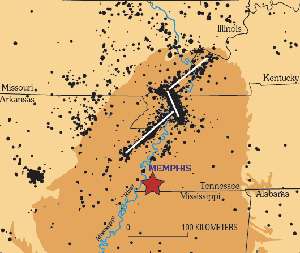
Map of the region surrounding Memphis, TN. Darker orange area is covered by think sediments called the Mississippi embayment, that affect how the ground shakes during earthquakes. White lines indicate likely locations of faults, and black dots show the locations of earthquakes since the mid-1970s. Image courtesy CERI

To the surprise of many, the earthquake on April 18, 2008, about 120 miles east of St. Louis, originated in the Wabash Valley Fault and not the better-known and more-dreaded New Madrid Fault in Missouri's bootheel.

The concern of Douglas Wiens, Ph.D., and Michael Wysession, Ph.D., seismologists at Washington University in St. Louis, is that the New Madrid Fault may have seen its day and the Wabash Fault is the new kid on the block.

The earthquake registered 5.2 on the Richter scale and hit at 4:40 a.m. with a strong aftershock occurring at approximately 10:15 a.m. that morning, followed by lesser ones in subsequent days. The initial earthquake was felt in parts of 16 states.

"I think everyone's interested in the Wabash Valley Fault because a lot of the attention has been on the New Madrid Fault, but the Wabash Valley Fault could be the more dangerous one, at least for St. Louis and Illinois," said Wiens, professor of earth and planetary sciences in Arts & Sciences. "The strongest earthquakes in the last few years have come from the Wabash Valley Fault, which needs more investigation."

Wiens said that seismologist Robert Hermann of Saint Louis University, Gary Pavils of Indiana University, and several geologists including Steven Obermeir of the U.S. Geological Survey (USGS), have made studies of the Wabash Valley Fault. Pavils also has run a dense local array of stations and recorded many very small earthquakes at the Wabash Valley Fault. Hermann has studied the 1968 magnitude 5.5 earthquake, the largest ever recorded there. Obermeir and others have found disturbed sediments from previous earthquakes along the fault with estimated magnitudes of about 7 on the Richter scale over the past several thousand years.

According to Wysession, there are 200,000 earthquakes recorded every year, with a magnitude 6 earthquake happening every three days somewhere in the world.

"There hasn't been a magnitude 6 earthquake on the New Madrid zone in more than 100 years, yet in 20 years there have been three magnitude 5 or better earthquakes on the Wabash Valley Fault," said Wyssession, associate professor of earth and planetary sciences. "There is evidence that sometime in the past the Wabash Valley Fault has produced as strong as magnitude 7 earthquakes. On the other hand, the New Madrid Fault has been very quiet for a long time now. Clearly, the Wabash Valley Fault has gotten our deserved attention."

Wysession said a recent re-analysis of data by USGS shows that the New Madrid fault risk is much less than was thought three decades ago. The three notable earthquakes that occurred at the end of 1811 and the beginning of 1812 were not magnitude 8s, rather magnitude 7s. A magnitude 8 is 30 times more explosive than a magnitude 7.

"The damage to the region by those earthquakes has been exaggerated," Wysession said. "St. Louis was here at the time, and all that happened was some chimneys fell in East St. Louis. The little village of St. Genevieve, closer to the fault zone, had no damage at all. But, let's face it, St. Louis is the biggest city in the region of both faults, and the Wabash Valley Fault is closer to us. If the big one does occur, it's looking more like it will come out of Illinois."

Wysession said that the North American Earth's crust is filled with cracks and faults, and that an earthquake can occur anywhere on the continent. Many of the faults are undetected.

"As the continents bang into each other, sometimes they pull apart, and the crust cracks and ruptures, causing earthquakes," he explained. "This whole region of New Madrid and the Wabash Valley seismic zone became a rift zone about 750 million years ago when the continent almost broke apart. There was a lot of volcanic activity, a lot of seismic activity. The crust got stretched and thinned. By looking at seismometers, we can actually see many of these faults in the thinning of crusts underground."

Wysession said that an earthquake in the Midwest will be felt ten times farther away than one occurring in the western United States because the crust beneath the Midwest is very old, stiff and cold. The rock is about 1.7 billion years old and the seismic waves can travel very long distances through this type of crust. It can be felt hundreds of miles away, even if it was a smaller earthquake. In the western United States, the rock is hotter, and thus it dampens the shock waves and they are not felt as far away.

Despite the fact that most seismologists, including Wysession and Wiens, don't think it likely that earthquakes ever will be predicted — which inevitably dredges up memories of the 1990 Midwest earthquake scare sparked by Iben Browning — Wysession says that there are some precursory phenomena that have been observed right before some earthquakes. Radon or helium gas may leak out of the ground as the ground cracks. Sometimes water well pressure changes, or there's a change in the magnetic field. Electrical resistivity changes have been noted, too.

"These are changes we can measure with instruments, but we can't sense them as humans," he said. "Many people think that animals sense atmospheric changes. You always get stories about Rover going bananas right before an earthquake. But until Rover learns to tell us what he's barking about, we won't be able to employ animals in any predictive way. "

Source: Washington University in St. Louis


print this article email this article download pdf blog this article bookmark this article     Digg this Stumble it share on Facebook share on Reddit add to delicious save to Yahoo! bookmarks
4.4/5 after 17 votes

Rank Filter

Move the slider to adjust rank threshold, so that you can hide some of the comments.


Display comments: newest first

  • out7x - Apr 25, 2008
    • Rank: 1 / 5 (1)
    PreCambrian strike-slip? Any seismic on this?
  • Gravity2 - Apr 25, 2008
    • Rank: 5 / 5 (1)
    Earthquakes are manifestations of Earth Expansion. Our Planet Earth is Expanding and has expanded to almost twice its original size. The Earth was once the size of the Moon. The Expansion of the Earth has been going on for millions of years and will continue for millions more. We have to realize that all River Valleys are expansion faults that were established eons ago. All river valleys are prone to earthquakes. Earthquakes can also occur anywhere on the surface of the earth as the tension built up is released. There is no mystery to earthquakes. Earthquakes tell us that our earth is cracked up: is cracking up. These cracks occur anywhere and everywhere. The mystery is that we dont know and cant predict where the next crack will occur. Earthquakes are taking place at every moment of every day somewhere in the world. The expansion is global and the sooner we realize that our earth is expanding the sooner we will understand why we have earthquakes. We only know that we cant tell where the next one will strike. Now the interesting proof of earth expansion is this. As the Earth Expands seas recede from shorelines worldwide and the recession process of the seas has been going on for as long as the earth has been expanding. We dont notice the seas recession because we dont know that the Earth is expanding. We also dont know why we have Earthquakes. So you see we are way behind in our understanding of what is really going on with our Earth. When we accept one anomaly we will begin to understand the other anomalies. We will begin to understand many things about our earth if we just realize that our earth is expanding and that is why we have earthquakes. Read "THE MYSTERIOUS RECEDING SEAS" by Richard Guy at www.widemargin2000.com
    QED
  • WolfAtTheDoor - Apr 25, 2008
    • Rank: 5 / 5 (1)
    Uh... what?
  • rubberman - Apr 26, 2008
    • Rank: 5 / 5 (1)
    Somehow, this guy managed to get himself a computer.....
  • HoP - Apr 28, 2008
    • Rank: 5 / 5 (1)
    I am glad I am intelligent and educated enough to be able to tell total babble from science. Guys like this scare me.

April 24th, 2008 all stories
Space & Earth / Earth Sciences

Comments: 5
Rank: 4.4/5 after 17 votes

  • Stumble this up

  • Digg this

  • Share it:
  • share on Facebook
  • share on MySpace
  • share on Slashdot
  • rss-newsfeed
  • share on Google
  • share on Reddit
  • add to delicious
  • save to Yahoo! bookmarks
  • share on Windows Live
  • Add to Mixx!
Rating: 4.4/5 after 17 votes

  • Related Stories

  • Typhoons trigger earthquakes on Taiwan: scientists
    created Jun 10, 2009 | popularity not rated yet | comments 0
  • Latest quake highlights Los Angeles seismic danger
    created May 19, 2009 | popularity not rated yet | comments 0
  • Studies offers new picture of Lake Tahoe's earthquake potential
    created Apr 29, 2009 | popularity not rated yet | comments 0
  • Solomon Islands earthquake sheds light on enhanced tsunami risk
    created Apr 09, 2009 | popularity not rated yet | comments 0
  • Quake predictability still distant dream, say seismologists
    created Apr 07, 2009 | popularity not rated yet | comments 0

Tags


  • Physicists Demonstrate Quantum Memory with Matter Qubits
    Physicists Demonstrate Quantum Memory with Matter Qubits
    Physics / General Physics
    created Jul 03, 2009 | popularity 4.4 / 5 (17) | comments 1
  • 'Holey' Nanosheets for Wastewater Dye Removal
    Nanotechnology / Nanomaterials
    created Jul 01, 2009 | popularity 5 / 5 (5) | comments 1
  • Jellyfish Robot Swims Like its Biological Counterpart
    Jellyfish Robot Swims Like its Biological Counterpart
    Electronics / Robotics
    created Jun 26, 2009 | popularity 4.4 / 5 (8) | comments 1
  • Could Maxwell's Demon Exist in Nanoscale Systems?
    Could Maxwell's Demon Exist in Nanoscale Systems?
    Physics / General Physics
    created Jun 24, 2009 | popularity 4.4 / 5 (18) | comments 29
  • Living Safely with Robots, Beyond Asimov's Laws
    Living Safely with Robots, Beyond Asimov's Laws
    Electronics / Robotics
    created Jun 22, 2009 | popularity 4.6 / 5 (52) | comments 40
  • Other News

    Forty years ago man first walked on the moon

    Space & Earth / Space Exploration

    created 17 hours ago | popularity 4.3 / 5 (3) | comments 2

    Forty years ago on July 20, 1969, American astronaut Neil Armstrong realized the oldest dream of human civilizations when he became the first man to walk on the moon.


    The least sea ice in 800 years

    The least sea ice in 800 years

    Space & Earth / Earth Sciences

    created Jul 01, 2009 | popularity 4.2 / 5 (62) | comments 59

    New research, which reconstructs the extent of ice in the sea between Greenland and Svalbard from the 13th century to the present indicates that there has never been so little sea ice as there is now. The ...


    Gas around young galaxy

    Intense heat killed the Universe's would-be galaxies, researchers say

    Space & Earth / Astronomy

    created Jul 01, 2009 | popularity 3.4 / 5 (21) | comments 27

    (PhysOrg.com) -- Our Milky Way galaxy only survived because it was already immersed in a large clump of dark matter which trapped gases inside it, scientists led by Durham University's Institute for Computational ...


    Scientists' Drill Hits Magma: Only Third Time on Record

    Scientists' Drill Hits Magma: Only Third Time on Record

    Space & Earth / Earth Sciences

    created Jun 29, 2009 | popularity 4.7 / 5 (22) | comments 19

    (PhysOrg.com) -- Scientists drilling a borehole deep into Iceland’s rocky crust to explore new methods of using geothermal energy hit a major roadblock on Thursday: Their drill ran into molten rock at a depth ...


    NASA manager pitches a cheaper return-to-moon plan

    Space & Earth / Space Exploration

    created Jun 30, 2009 | popularity 4 / 5 (7) | comments 18

    (AP) -- Like a car salesman pushing a luxury vehicle that the customer no longer can afford, NASA has pulled out of its back pocket a deal for a cheaper ride to the moon.