On shaky ground: UH Prof finds geological faults threaten Houston
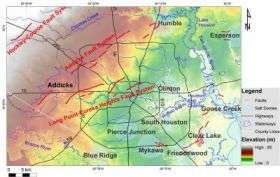
After finding more than 300 surface faults in Harris County, a University of Houston geologist now has information that could be vitally useful to the region’s builders and city planners.
This information – the most accurate and comprehensive of its kind – was discovered by Shuhab Khan, assistant professor of geology, and Richard Engelkemeir, a geology Ph.D. student, using advanced radar-like laser technology. Although geologists have long known of the existence of faults in Southeast Texas, only recently have UH researchers produced a comprehensive map pinpointing the locations of the faults. A Houston-area map showing active surface faults is available at http://www.uh.edu/news-events/archive/nr/2008/04april/geological-faultsph.html.
While the ground moving beneath Houstonians feet is not felt at the magnitude of recent earthquakes in San Antonio and Illinois, this shaky ground could mean trouble for buildings, roads and pipelines located on one of these hundreds of faults traversing the region’s surface.
“These shifting fault lines originated millions of years ago during the formation of the Gulf of Mexico,” Khan said. “While they are not the kinds that wreak havoc in earthquake-prone California and now the Midwest, they can move up to 1 inch a year, causing serious damage over the course of several years to buildings and streets that straddle a fault line. Additionally, structures on the subsiding side of the fault line could be more susceptible to flooding due to the lower elevation over time.”
Khan and Engelkemeir recently presented their findings in Geosphere, a bimonthly online-only journal published by the Geological Society of America that highlights research results from all fields of the geosciences. They began by looking at data compiled during a 2001 study funded by the Federal Emergency Management Administration (FEMA) and the Harris County Flood Control District. That year, Tropical Storm Allison dumped nearly 40 inches of rain on the Houston area during the course of five days, causing nearly two dozen deaths and billions of dollars in property damage.
To update floodplain maps, FEMA and the flood district employed lidar technology – the optical analog of radar meaning ‘light detection and ranging’ – to survey the topography and elevation of the county. From an aircraft flying overhead, laser beams were directed toward the ground. The time between the laser beam pulse and the return reflection from any given point on the ground was used to determine the distance between the instrument and that point on the surface. Buildings and vegetation were then removed from the model to produce a map that recorded even the most subtle surface elevation differences.
Khan and Engelkemeir pored over the data, refining the grids to identify the more than 300 faults. Many were associated with the salt domes in the southeast part of the county. Others were located in the northwest portion of the county near highways Texas 6 and I-10, where there is ongoing subsidence, or sinking, of the ground.
During the summer of 2005, Engelkemeir personally visited about 50 of the faults he located with the lidar data, looking for signs of deformation and displacement where the land on one side of the fault was rising over the other. At many of the faults, he saw cracks in street pavements, with residents living nearby reporting foundation problems. At one home there was about a yard of displacement between the garage and the house. At another site, a building had been so damaged by ground shifts it was condemned.
Geologists are still studying what causes fault movements and the resulting subsidence in the region, with some attributing it to land-use practices such as groundwater and petroleum withdrawal, Engelkemeir said.
Khan is now turning his attention to Fort Bend County. Using lidar data, Cecilia Ramirez, a master’s student working under Khan, has found one potential fault near the Brazos River levee.
“By knowing the location of surface faults, builders and government planners will be able to avoid those areas or accommodate potential ground shifts in their construction plans,” Khan said. “And we must still keep in mind that while lidar has allowed us to identify previously unmapped faults, there still might be faults in the region that have yet to be located.”
Khan has given numerous talks on this work at both scientific meetings for a number of geological and petroleum organizations, as well as at more general meetings attended by the city of Houston and other local and state agencies.
Source: University of Houston


