Jules Verne boosts ISS orbit
April 25, 2008 Jules Verne boosts ISS orbit

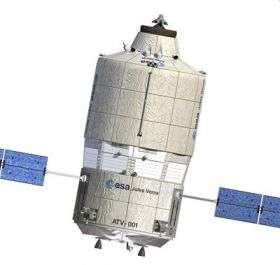
The Automated Transfer Vehicle (ATV) is the first fully automatic re-supply spacecraft of its kind. ESA's Jules Verne ATV is the first European space supplier for the ISS. It was launched 9 March 2008 from Europe's spaceport in Kourou, French Guiana. Credits: ESA - D.Ducros

ESA's Jules Verne ATV was used for the first time early this morning to raise the orbit of the International Space Station. A 740-second burn of the Automated Transfer Vehicle's main engines successfully lifted the altitude of the 280-tonne Station by around 4.5 km to a height of 342 km above the Earth's surface.

After the ATV Control Centre (ATV-CC) in Toulouse, France, had 'woken up' Jules Verne ATV, the manoeuvre started at 06:22 CEST (04:22 GMT) this morning and provided a 2.65 m/s thrust using two of the ATV's four main engines. Controllers at ATV-CC closely monitored ATV's subsystems throughout the long manoeuvre.

"The Station's altitude naturally decreases with atmospheric drag. Until now this has been compensated for by performing a re-boost using the Russian Progress, the Space Shuttle or by the ISS itself," explains Alberto Novelli, ESA’s Mission Director at ATV-CC. "Today, ATV has successfully demonstrated that it too is able to perform this vital function. Only Progress and ATV can provide this high level of re-boost. ATV is unique due to the quantity of fuel available for such manoeuvres."

The re-boost manoeuvre comes just three weeks after Jules Verne ATV successfully docked with ISS on 3 April 2008 delivering 1150 kg of dry cargo, including food, clothes and equipment, as well as additional supplies of water, oxygen and fuel. Since then, the European ISS resupply spacecraft has been in dormant mode attached to the docking port on the Russian Zvezda module.

Today's re-boost sets up the International Space Station for the arrival of Space Shuttle Discovery on the STS-124 mission to deliver the Japanese Kibo laboratory. STS-124 is currently targeted for launch on 31 May 2008. Further re-boost manoeuvres using ATV are scheduled for 12 June, 8 July and 6 August.

Jules Verne ATV is scheduled to remain docked to the International Space Station until early August. At the end of its mission, Jules Verne, loaded with up to 6.5 tonnes of material no longer required by the ISS, will undock and then burn up completely during a guided and controlled re-entry high over the Pacific Ocean.

Source: ESA


print this article email this article download pdf blog this article bookmark this article     Stumble it Digg this share on Facebook retweet share on Reddit add to delicious
Rate this story - 4.6 /5 (13 votes)


April 25, 2008 all stories

Comments: 0

4.6 /5 (13 votes)
  • Stumble this up

  • Digg this

  • share this

  • hide
  • Related Stories

  • Columbus, one year on orbit
    created Feb 11, 2009 | popularity not rated yet | comments 0
  • Successful re-entry marks bright future for ATV
    created Sep 29, 2008 | popularity not rated yet | comments 0
  • Jules Verne prepares for ISS departure
    created Sep 02, 2008 | popularity not rated yet | comments 0
  • Record boost for ATV to raise ISS orbit
    created Jun 20, 2008 | popularity not rated yet | comments 0
  • Jules Verne refuels the ISS
    created Jun 18, 2008 | popularity not rated yet | comments 0


  • hide
  • Relevant PhysicsForums posts

  • Question about 2-body gravity
    created 1hour ago
  • life on Mars
    created 4 hours ago
  • Semi-major axis from cartesian co-ordinates
    created 16 hours ago
  • Primary Mirror grinding
    created 18 hours ago
  • More from Physics Forums - General Astronomy

Other News

From Greenhouse to Icehouse

From Greenhouse to Icehouse

Space & Earth / Earth Sciences

created 2 hours ago | popularity 4 / 5 (2) | comments 5

A new study that reconstructed ocean temperatures from millions of years ago could provide new insight into how the Earth responds to climate change.


'Cosmic fruit machine' matches collisions

'Cosmic fruit machine' matches collisions

Space & Earth / Astronomy

created 5 hours ago | popularity 5 / 5 (1) | comments 1

(PhysOrg.com) -- A new website will give everyone the chance to contribute to science by playing a 'cosmic fruit machine' and compare images of colliding galaxies with millions of simulated images of galactic ...


Humanity would need five Earths to create the resources needed if everyone lived as like Americans, a report has stated

Mankind using Earth's resources at alarming rate

Space & Earth / Environment

created 2 hours ago | popularity 2.6 / 5 (5) | comments 6

Humanity would need five Earths to produce the resources needed if everyone lived as profligately as Americans, according to a report issued Tuesday.


Supervolcano eruption -- in Sumatra -- deforested India 73,000 years ago

Supervolcano eruption -- in Sumatra -- deforested India 73,000 years ago

Space & Earth / Earth Sciences

created 20 hours ago | popularity 4.4 / 5 (12) | comments 2

A new study provides "incontrovertible evidence" that the volcanic super-eruption of Toba on the island of Sumatra about 73,000 years ago deforested much of central India, some 3,000 miles from the epicenter, ...


New computer-developed map shows more extensive valley network on Mars

New computer-developed map shows more extensive valley network on Mars

Space & Earth / Space Exploration

created 18 hours ago | popularity 4.5 / 5 (8) | comments 0

New research adds to the growing body of evidence suggesting the Red Planet once had an ocean.