Second Galileo satellite launched successfully
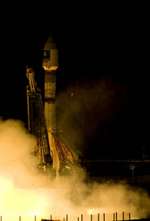
Designed to provide the whole planet with a highly accurate Global Navigation Satellite System under civilian control, Europe’s Galileo project moved a step closer as a second test satellite was launched successfully from Kazakhstan.
GIOVE-B (Galileo In-Orbit Validation Element-B) is designed to test novel, key technologies for the Galileo network which is due to become operational in 2013.
It was successfully launched on board a Soyuz-Fregat rocket from the Baikonur Cosmodrome and joins GIOVE-A – which was built and is operated by Surrey Satellite Technology Limited (SSTL) – in medium Earth orbit.
As with GIOVE-A, GIOVE-B will test the key technologies of the Galileo system. It carries a high-precision passive maser atomic clock - the most accurate clock ever flown in space.
The payload for GIOVE-B has been developed by EADS Astrium Limited in the UK. Its team tested and integrated the equipment on board the satellite. GIOVE-B has been built by an industrial consortium headed by Astrium GmbH (Germany) while Thales Alenia Space (Italy) as subcontractor has carried out satellite assembly, integration and testing.
Science and Innovation Minister Ian Pearson said: “The UK has been a major investor in the development of Galileo, and the launch of GIOVE-B is an important milestone for the Galileo programme.
“The roles played by UK companies have been critical, and demonstrate the engineering and skill base that has been developed in the UK. I am pleased that British companies will continue to play key roles within the Community-funded Galileo programme. It is a clear demonstration that the UK remains at the core of space development both in ESA and the EU.”
The launch of GIOVE-B – which had a lift-off mass of 530 kg and is the size of a telephone box – took place from Kazakhstan at 04:16:02 local time 27 April 2008 (23:16 hours on 26 April BST in the UK).
The development of Galileo was funded jointly by the European Space Agency (ESA) and European Union (EU). The EU will now build a civil system of 30 satellites and a complete ground support network to offer users of satellite navigation with an accuracy of less than a metre.
Unlike current navigation systems, such as the USA’s Global Positioning System (GPS), Galileo is expected to offer commercial guarantees of service and provide inbuilt integrity information. This will make it suitable for applications where safety is critical. This could include the following areas:
-- With a greater number of satellites being provided by both GPS and Galileo, there will be greater reliability and availability. For example, there will be tremendous potential for improving air traffic control. It could allow planes to reduce their reliance on ground-based beacons or radio signals and could help improve safety in poor weather conditions.
-- More and more drivers are expected to adopt satellite navigation. Freight companies will be able to use Galileo to track containers more closely and could help them combat theft and fraud.
-- Satellite technology is also being developed to help older and more vulnerable people. If they were to suffer a medical crisis, an inbuilt satellite navigation system receiver in conjunction with mobile phone technology could alert emergency services to their location.
-- When Galileo reaches full operational capability, its satellites will provide coverage of even the most remote parts of the globe. Up until now, coverage of latitudes in the Arctic has been patchy at best.
Dr Mike Healy, Director of Earth Observation, Navigation and Science for Astrium Ltd, said: “GIOVE-B will broadcast the first fully representative Galileo navigation signals, enabling scientists and engineers to move the programme to a new development level.
“The Astrium built payload is pivotal to achieving this aim and this launch is a major step towards the Galileo operational system.”
Once the satellite navigation payload has been activated, the first signals from the spacecraft will be detected using a purpose-built L-band receiver on the 25 metre Chilbolton antenna in Hampshire, operated by the Science and Technology Facilities Council (STFC). This receiver has been designed and built by STFC engineers, and operates over the frequency band 1100 – 1700 MHz.
Source: ESA


