MIT professor will lead science team for NASA satellite to map Earth's water cycle
April 28, 2008
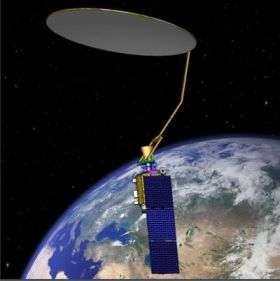
The orbiting SMAP satellite will make simultaneous radiometer and radar measurements using a shared reflector antenna that is rotated to scan the Earth surface. The large 6 meter in diameter reflector is made up of light-weight deployable mesh material that stows for launch in the rocket enclosure. Image Courtesy of NASA Jet Propulsion Laboratory
MIT Professor Dara Entekhabi will lead the science team designing a NASA satellite mission to make global soil moisture and freeze/thaw measurements, data essential to the accuracy of weather forecasts and predictions of global carbon cycle and climate. NASA announced recently that the Soil Moisture Active-Passive mission (SMAP) is scheduled to launch December 2012.
At present, scientists have no network for gathering soil moisture data as they do for rainfall, winds, humidity and temperature. Instead, that data is gathered only at a few scattered points around the world.
“Soil moisture is the lynchpin of the water, energy and carbon cycles over land. It is the variable that links these three cycles through its control on evaporation and plant transpiration. Global monitoring of this variable will allow a new perspective on how these three cycles work and vary together in the Earth system.” said Entekhabi, director of the Parsons Laboratory for Environmental Science and Engineering in MIT’s Department of Civil and Environmental Engineering.
“Additionally because soil moisture is a state variable that controls both water and energy fluxes at the land surface, we anticipate that assimilation of the global observations will improve the skill in numerical weather prediction, especially for events that are influenced by these fluxes at the base of the atmosphere,” said Entekhabi.
The SMAP mission is based on an earlier satellite project led by Entekhabi that had been selected by NASA from among 20 proposals and scheduled for a 2009 launch. However, the Hydrosphere State Mission (Hydros) was cancelled abruptly in 2005 when funding for NASA’s earth sciences missions was diverted. But in July 2007, the National Research Council recommended that NASA make the soil moisture measurement project a top priority and place it on a fast track for launch.
The Jet Propulsion Laboratory (JPL) in Pasadena, Calif., is the lead NASA center for the project, with participation from NASA's Goddard Space Flight Center (GSFC) in Greenbelt, Md. NASA’s lead scientists on the project are Eni Njoku, SMAP project scientist at JPL, and Peggy O’Neill, SMAP deputy project scientist at GSFC.
“Research conducted by MIT faculty and students is at the forefront of SMAP’s science objectives, and MIT can play an important role in contributing to the mission’s algorithms and science products,” said Njoku, who earned his Ph.D. from MIT in 1976. “MIT students have the opportunity to be involved in many aspects of the mission.”
SMAP’s launch in 2012 is feasible in part because Entekhabi and other scientists continued to develop the mission, even when NASA’s support was withdrawn in 2005.
The instruments that will be deployed in SMAP will gather both passive and active low-frequency microwave measurements on a continuous basis, essentially creating a map of global surface soil moisture. A 6-meter deployable mesh antenna on a satellite will gather data across a swath of 1,000 kilometers, creating ribbons of measurements around the globe and completing the cycle every few days.
In addition to measuring soil moisture, the satellite will detect if the surface moisture is frozen. In forests, the freeze/thaw state determines the length of the growing season and the balance between carbon assimilation into biomass and the loss of carbon due to vegetation respiration. The result of this balance can tell scientists if a forest is a net source or net sink of carbon.
One mission obstacle that Entekhabi and team solved last year was integrating the two types of measurements the satellite would gather: passive measurements collected by radiometer, and active collected by radar. The radiometer measurements provide highly accurate data at a coarse resolution of 40 kilometers. The radar measurements provide much higher resolution (3 kilometers), but with less sensitivity. The combination of the two measurements through algorithms designed by the SMAP science team will result in accurate mapping of global soil moisture at 10 km.
Source: Massachusetts Institute of Technology
-
An electronic green thumb
Feb 01, 2012 |
not rated yet |
0
-
Remote sensing places nature at our fingertips
Jan 30, 2012 |
not rated yet |
0
-
NASA studies vegetation canopy water content, soil moisture
Dec 22, 2011 |
not rated yet |
0
-
Satellites can help to grow the perfect grape
Dec 21, 2011 |
4 / 5 (1) |
0
-
Climate change blamed for dead trees in Africa
Dec 12, 2011 |
3.7 / 5 (6) |
25
-
Engineers build first sub-10-nm carbon nanotube transistor
Feb 01, 2012 |
4.9 / 5 (32) |
30
-
Something old, something new: Evolution and the structural divergence of duplicate genes
Jan 31, 2012 |
4.6 / 5 (7) |
1
-
The hidden nanoworld of ice crystals: Revealing the dynamic behavior of quasi-liquid layers
Jan 30, 2012 |
5 / 5 (4) |
1
-
Stock market network reveals investor clustering
Jan 27, 2012 |
3.9 / 5 (23) |
8
-
Of microchemistry and molecules: Electronic microfluidic device synthesizes biocompatible probes
Jan 26, 2012 |
5 / 5 (2) |
0
-
Never ending outer space.....
16 hours ago
-
Neutron Star fragments?
18 hours ago
-
stationary or not?
22 hours ago
-
Scale of the Universe
Feb 10, 2012
-
Titan's lack of impact craters
Feb 09, 2012
-
Real pictures of black hole eating a star?
Feb 08, 2012
- More from Physics Forums - General Astronomy
More news stories
Salvage workers begin pumping fuel from Italian shipwreck
Salvage workers Sunday began pumping fuel from the shipwrecked Italian cruise liner Costa Concordia, a day ahead of schedule, officials said.
2 hours ago |
not rated yet |
0
Latin America mining boom clashes with conservation
Latin America is experiencing a mining boom as prices rise fuelled by a hike in global demand, but the region is also being hit by a wave of violent protests, strikes and rallies by environmentalists.
10 hours ago |
5 / 5 (1) |
1
Political leaders play key role in how worried Americans are by climate change: study
More than extreme weather events and the work of scientists, it is national political leaders who influence how much Americans worry about the threat of climate change, new research finds.
Feb 06, 2012 |
5 / 5 (6) |
73
NASA budget will axe Mars deal with Europe: scientists
US President Barack Obama's budget proposal to be submitted next week for 2013 will cut NASA's budget by 20 percent and eliminate a major partnership with Europe on Mars exploration, scientists said Thursday.
Space & Earth / Space Exploration
Feb 10, 2012 |
5 / 5 (3) |
58
Humans may have helped the decline of African rainforests 3000 years ago
(PhysOrg.com) -- Large areas of rainforests in Central Africa mysteriously disappeared over three thousand years ago, to be replaced by savannas. The prevailing theory has been that the cause was a change ...
Scientists discover molecular secrets of 2,000-year-old Chinese herbal remedy
For roughly two thousand years, Chinese herbalists have treated Malaria using a root extract, commonly known as Chang Shan, from a type of hydrangea that grows in Tibet and Nepal. More recent studies suggest that halofuginone, ...
New method to examine batteries -- MRI from the inside
There is an ever-increasing need for advanced batteries for portable electronics, such as phones, cameras, and music players, but also to power electric vehicles and to facilitate the distribution and storage of energy derived ...
Google might launch Drive for cloud storage soon
(PhysOrg.com) -- Google's next big move, according to the Wall Street Journal, is a cloud storage service called Drive. Hardly first to the plate, Google is simply catching up to introducing its cloud reposi ...
Lab study raises questions over nano-particle impact
Tests involving chickens have raised questions about the impact on health from engineered nano-particles, the ultra-fine grains commonly used in drugs and processed foods, scientists said on Sunday.
A mitosis mystery solved: How chromosomes align perfectly in a dividing cell
Although the process of mitotic cell division has been studied intensely for more than 50 years, Whitehead Institute researchers have only now solved the mystery of how cells correctly align their chromosomes during symmetric ...
Starve a virus, feed a cure? Findings show how some cells protect themselves against HIV
A protein that protects some of our immune cells from the most common and virulent form of HIV works by starving the virus of the molecular building blocks that it needs to replicate, according to research published online ...