Scientists Explore Brain's Reaction to Potent Hallucinogen
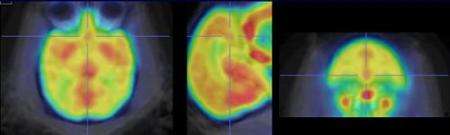
Brain-imaging studies performed in animals at the U.S. Department of Energy’s Brookhaven National Laboratory provide researchers with clues about why an increasingly popular recreational drug that causes hallucinations and motor-function impairment in humans is abused. Using trace amounts of Salvia divinorum – also known as “salvia,” a Mexican mint plant that can be smoked in the form of dried leaves or serum – Brookhaven scientists found that the drug’s behavior in the brains of primates mimics the extremely fast and brief “high” observed in humans. Their results are now published online in the journal NeuroImage.
Quickly gaining popularity among teenagers and young adults, salvia is legal in most states, but is grabbing the attention of municipal lawmakers. Numerous states have placed controls on salvia or salvinorin A – the plant’s active component – and others, including New York, are considering restrictions.
“This is probably one of the most potent hallucinogens known,” said Brookhaven chemist Jacob Hooker, the lead author of the study, which is the first to look at how the drug travels through the brain. “It’s really important that we study drugs like salvia and how they affect the brain in order to understand why they are abused and to investigate their medicinal relevance, both of which can inform policy makers.”
Hooker and fellow researchers used positron emission tomography, or PET scanning, to watch the distribution of salvinorin A in the brains of anesthetized primates. In this technique, the scientists administer a radioactively labeled form of salvinorin A (at concentrations far below pharmacologically active doses) and use the PET scanner to track its site-specific concentrations in various brain regions.
Within 40 seconds of administration, the researchers found a peak concentration of salvinorin A in the brain – nearly 10 times faster than the rate at which cocaine enters the brain. About 16 minutes later, the drug was essentially gone. This pattern parallels the effects described by human users, who experience an almost immediate high that starts fading away within 5 to 10 minutes.
High concentrations of the drug were localized to the cerebellum and visual cortex, which are parts of the brain responsible for motor function and vision, respectively. Based on their results and published data from human use, the scientists estimate that just 10 micrograms of salvia in the brain is needed to cause psychoactive effects in humans.
Salvia doesn’t cause the typical euphoric state associated with other hallucinogens like LSD, Hooker said. The drug targets a receptor that is known to modulate pain and could be important for therapies as far reaching as mood disorders.
“Most people don’t find this class of drugs very pleasurable,” Hooker said. “So perhaps the main draw or reason for its appeal relates to the rapid onset and short duration of its effects, which are incredibly unique. The kinetics are often as important as the abused drug itself.”
The Brookhaven team plans to conduct further studies related to salvia’s abuse potential. The scientists also hope to develop radioactive tracers that can better probe the brain receptors to which salvia binds. Such studies could possibly lead to therapies for chronic pain and mood disorders.
Source: Brookhaven National Laboratory


