Laser experiments offer insight into evolution of 'gas giants'
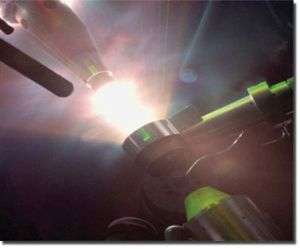
By shooting the high-energy Omega laser onto precompressed samples of planetary fluids, scientists are gaining a better understanding of the evolution and internal structure of Jupiter, Saturn and extrasolar giant planets.
The properties of dense helium (He) — which happens to be a principal constituent of giant gas planets like Jupiter — at thermodynamic conditions between those of condensed matter and high-temperature plasmas are theoretically challenging and unexplored experimentally.
Laboratory scientists collaborating with researchers at the Laboratory for Laser Energetics, CEA France and UC Berkeley were able to determine the equation of state (EOS) for fluid He at pressures above 100 GPa (one million times more pressure than the Earth’s atmosphere — one GPa (gigapascal) equals 10,000 atmospheres).
The only previous high temperature and pressure He EOS data available for constraining planetary models was performed at LLNL by Bill Nellis and his team using a two-stage gas gun. However, those earlier experiments used cryogenic techniques at ambient pressure so their densities were significantly lower than those achieved with the precompressed samples. Also, the final pressures, 16 GPa for a single shock, were significantly lower than the new laser shock data.
Theoretical research points out that material deep within a planet’s interior could exhibit unusual characteristics, such as high-temperature superconductivity, superfluidity and Wigner crystallization.
“The state of materials in the center of a giant planet are difficult to observe and challenging to create or predict,” said Gilbert Collins of the Physical Sciences Directorate. “Defining the equation of state of helium at these pressures is a first step to deepen our understanding of these massive objects.”
Jupiter is thought to contain matter to near 100 Mbar (100 million atmospheres of pressure.)
The LLNL team of Jon Eggert, Peter Celliers, Damien Hicks and Collins, together with several university collaborators from UC Berkeley, the Carnegie Geophysical Institute, CEA, Princeton, Washington State and the University of Michigan, plan to conduct experiments at the National Ignition Facility. There they will be able to recreate and characterize the core states of solar and extrasolar giants, as well as terrestrial planets, such as the recently discovered “superEarths,” to better understand the evolution of such planets throughout the universe.
Using the Omega laser at the Laboratory for Laser Energetics at the University of Rochester, the team launched strong shocks in He that was already compressed to an initial high state of pressure and density in a diamond anvil cell. Precompression allows researchers to tune the sample’s initial density and the final states that can be achieved with strong shocks.
Quartz was used as a reference material, allowing shock velocities to be determined just before and after the shock crossed the quartz-He interface. This technique reduced the measurement uncertainty as compared to previous studies.
“By applying a strong shock to a precompressed sample,” Collins said, “we can re-create the deep interior states of solar and extrasolar giant planets.”
The diamond anvil’s thickness determines the initial precompressed pressure. To prevent the sample from being heated before the shock, a preheat barrier was used to absorb the high-energy X-rays. An ultrafast diagnostic called VISAR (Velocity Interferometer System for Any Reflector), which works like a speedometer for shocks, recorded the shock velocity of the sample and reference material. From these data, the team determined the density and pressure of the shocked precompressed helium.
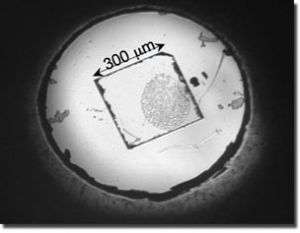
A pre-compressed helium sample is shown prior to shot in diamond anvil cell. The square is quartz reference, the circle is a gasket containing high-pressure fluid helium. After the shot, all that remains is a 2 mm hole in the target.
By applying laser-driven shocks to statically compressed samples, equation of state data for fluid He have been obtained with sufficient accuracy in the 100 GPa pressure range to test theoretical predictions.
They also discovered that near 100 GPa, the shock-compressed He transformed to an electronically conductive state and the shock front reflects the 532-nanometer probe laser beam of the VISAR.
The research also has other applications in the national security arena because the extreme conditions in a planet’s deep interior also occur during a nuclear weapon detonation. Plans are under way to significantly extend these research results with experiments at the National Ignition Facility.
The research appeared in the March 28 edition of Physical Review Letters.
Source: Lawrence Livermore National Laboratory


