No Power Use in Standby: New Zero-Watt Monitor
April 28, 2008 No Power Use in Standby: New Zero-Watt Monitor

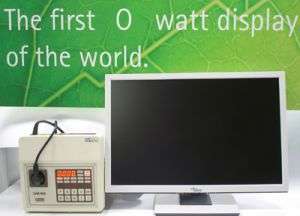
Computer monitors in standby mode will soon save far more energy. Fujitsu Siemens Computers has developed the world’s first monitor that requires no electricity at all in idle mode. The innovation is based on a new switch in the monitor that shuts it down entirely when the computer signal is absent and turns it on again when the signal reappears. With this switch, the display saves several euros per year in power costs. Beginning in the summer of 2008, this “zero-watt monitor” will be sold for the price of a conventional monitor.

Computer monitors in standby mode will soon save far more energy. Fujitsu Siemens Computers has developed the world’s first monitor that requires no electricity at all in idle mode.

The innovation is based on a new switch in the monitor that shuts it down entirely when the computer signal is absent and turns it on again when the signal reappears. With this switch, the display saves several euros per year in power costs. Beginning in the summer of 2008, this “zero-watt monitor” will be sold for the price of a conventional monitor.

At the end of a work day, the same routine occurs in most offices when the computer is shut down. But the monitor usually stays on—it automatically enters standby mode when there is no signal from the computer. Despite the minimal power consumption, this idle mode can entail tens of thousands of euros in additional power costs per year for large companies with several thousand computers.

The zero-watt monitor from Fujitsu Siemens Computers was chosen as “Innovation of the Year” at this year’s CeBIT computer trade show. The primary component is a circuit element in the power supply unit of the monitor that is switched by the PC. As soon as the video signal of the computer subsides, a relay—an electrically powered switch—with two switching positions automatically interrupts the entire electrical circuit of the monitor. When the computer signal returns again, the low currents that then begin to flow across the interface are sufficient to trigger the relay and thereby restart the monitor.

The zero-watt monitor, which will initially be marketed to corporate customers beginning in the summer of 2008, adds to the range of “green” IT products sold by Fujitsu Siemens Computers. This is another component of the long-term strategy of the company, which also stresses environmental compatibility in its laptops, PCs and servers.

Several years ago, for instance, some of the Esprimo Professional PCs were the first systems to be certified with the “Blue Angel” environmental label. The Esprimo P Energy Saving Edition, uses as little as around 87 kilowatt hours in its standard configuration, less than half of the 183 kWh needed on average by nearly four-year-old office PCs.

Source: Siemens


Rate this story - 4.2 /5 (33 votes)

Rank Filter

Move the slider to adjust rank threshold, so that you can hide some of the comments.


Display comments: newest first

  • Egnite - Apr 29, 2008
    • Rank: 4.5 / 5 (2)
    Yay they've finally found a replacement for that pointless power consuming red LED on the front of our electrical appliances. Lets hope they can figure out a method of using it in TVs and such aswell as monitors.
  • itistoday - Apr 29, 2008
    • Rank: 5 / 5 (2)
    Is it LED backlit as well? That would be a killer combo.
  • Soylent - Apr 29, 2008
    • Rank: 4 / 5 (3)
    Yay they've finally found a replacement for that pointless power consuming red LED on the front of our electrical appliances. Lets hope they can figure out a method of using it in TVs and such aswell as monitors.


    Huzzah! That evil red LED consumed milliwatts of power.

    That is not where the standby power was wasted and I don't believe even the 'zero watt' display does away with it.
  • DGBEACH - May 05, 2008
    • Rank: 5 / 5 (1)
    The "relay" that they are adding also consumes power, about 2-watts-worth per day on average. If the screen is usually OFF, then it is a winning solution, otherwise they have created a screen that actually consumes MORE energy (an additional 5-watts per day).

April 28, 2008 all stories

Comments: 4

4.2 /5 (33 votes)

  • hide
  • Related Stories

  • Millimeter-scale, energy-harvesting sensor system developed
    created Feb 08, 2010 | popularity not rated yet | comments 0
  • Grid computing for the masses
    created Feb 04, 2010 | popularity not rated yet | comments 0
  • Google complaint highlights China-based hacking
    created Feb 03, 2010 | popularity not rated yet | comments 0
  • Making it easier to save energy
    created Jan 15, 2010 | popularity not rated yet | comments 0
  • Herschel HIFI instrument resumes quest for water in Universe
    created Jan 15, 2010 | popularity not rated yet | comments 0


  • hide
  • Relevant PhysicsForums posts

Other News

Robot to take starring roles in S.Korea plays

Electronics / Robotics

created 2 hours ago | popularity not rated yet | comments 0

A South Korean-developed robot that played to acclaim in "Robot Princess and the Seven Dwarfs" is set for more leading theatre roles this year, a scientist said Wednesday.


Student Builds Spider Robot From Spare Parts

Student Builds Spider Robot From Spare Parts (w/ Video)

Electronics / Robotics

created 14 hours ago | popularity 4.6 / 5 (11) | comments 3

Picture a spider-like robot that teaches itself to walk, can adapt when damaged and watches its maker as he moves around the room. That might sound terrifying.


Seagate Ships 10,000 RPM 600 GB 2.5-inch Hard Drive

Electronics / Hardware

created 12 hours ago | popularity 2.7 / 5 (3) | comments 0

Seagate today announced worldwide shipments of its Savvio 10K.4 hard disk drive (HDD), the world's highest-capacity and most reliable 2.5-inch enterprise-class drive.


Millimeter-scale, energy-harvesting sensor system developed

Millimeter-scale, energy-harvesting sensor system developed

Electronics / Hardware

created Feb 08, 2010 | popularity 4.8 / 5 (12) | comments 5 | with audio podcast

(PhysOrg.com) -- A 9-cubic millimeter solar-powered sensor system developed at the University of Michigan is the smallest that can harvest energy from its surroundings to operate nearly perpetually.


Robonaut 2: NASA, GM Create Cutting Edge Robotic Technology

Robonaut 2: NASA, GM Create Cutting Edge Robotic Technology

Electronics / Robotics

created Feb 04, 2010 | popularity 4.5 / 5 (13) | comments 8 | with audio podcast

(PhysOrg.com) -- Robonaut is evolving. NASA and General Motors are working together to accelerate development of the next generation of robots and related technologies for use in the automotive and aerospace ...