Virtual world therapeautic for addicts: study shows
April 28, 2008
Virtual world therapeautic for addicts:  UH study shows

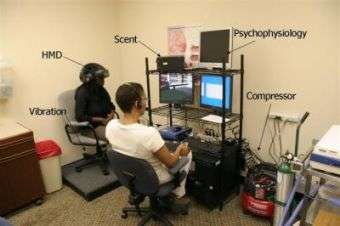
Participant (left) wears the VR helmet and is guided by a monitor through the virtual environments. Credit: Professor Patrick Bordnick

Patients in therapy to overcome addictions have a new arena to test their coping skills—the virtual world. A new study by University of Houston Associate Professor Patrick Bordnick found that a virtual reality (VR) environment can provide the climate necessary to spark an alcohol craving so that patients can practice how to say “no” in a realistic and safe setting.

“As a therapist, I can tell you to pretend my office is a bar, and I can ask you to close your eyes and imagine the environment, but you’ll know that it’s not real,” Bordnick said. “In this virtual environment you are at a bar or at a party or in a real-life situation. What we found was that participants had real-life responses.”

Bordnick, of the UH Graduate College of Social Work, investigates VR as a tool for assessing and treating addictions. He studied 40 alcohol-dependent people who were not receiving treatment (32 men and eight women). Wearing a VR helmet, each was guided through 18 minutes of virtual social environments that included drinking. The participant’s drink of choice was included in each scene. Using a game pad, each rated his or her cravings and attention to the alcohol details in each room. Each then was interviewed following the experience.

“What we found was that the VR environments were real enough that their cravings were intensified. So, now we can develop coping skills, practice them in those very realistic environments until those skills are working tools for them to use in real life,” Bordnick said.

His VR environments, developed with a company called Virtually Better, feature different scenarios that an addict may find challenging: a bar with imbibing patrons, a house party with guests drinking and smoking, a convenient store with cigarettes and alcoholic beverages within reach, a designated smoking section outside of a building or a room with an arguing couple. The environments use actors in each scene as opposed to computer-generated characters. In addition, the study added another layer of realism. A device sprayed the air with scents the participant may encounter in the various scenarios—cigarette smoke, alcoholic beverages, pizza or aromas associated with the outdoors.

“This study shows us the value of using virtual reality as a tool for assessing and treating addictions. Future studies should explore the importance of environmental settings and other cues on cravings and relapse,” Bordnick said.

His study is available online in the journal Addictive Behaviors.

Bordnick also has VR environments to help soldiers from Iraq, those with a fear of flying, fear of public speaking and fear of heights.

Source: University of Houston


Rank 3 /5 (3 votes)
Tags

Relevant PhysicsForums posts

More news stories

New ability to regrow blood vessels holds promise for treatment of heart disease

(Medical Xpress) -- University of Texas at Austin researchers have demonstrated a new and more effective method for regrowing blood vessels in the heart and limbs — a research advancement that could have ...

Medicine & Health / Research

created 27 minutes ago | popularity 5 / 5 (3) | comments 0 | with audio podcast

New tumor suppressor gene identified

A recent study published in Clinical Cancer Research suggests that the protein hVps37A suppresses tumor growth in ovarian cancer. The work, which was funded by the Austrian Science Fund FWF, shows, for th ...

Medicine & Health / Cancer

created 1 hour ago | popularity 4.7 / 5 (3) | comments 0

Motivation to exercise affects behavior

(Medical Xpress) -- For many people, the motivation to exercise fluctuates from week to week, and these fluctuations predict whether they will be physically active, according to researchers at Penn State. In an effort to ...

Medicine & Health / Health

created 17 minutes ago | popularity not rated yet | comments 0 | with audio podcast

'It's not nutritious until it's eaten'

As part of her "Let's Move! Initiative," First Lady Michelle Obama unveiled a new web resource highlighting new changes in the Chefs Move to Schools, during a CMST gathering in Dallas, TX today. CMTS advocates ...

Medicine & Health / Health

created 4 minutes ago | popularity not rated yet | comments 0

Packard Children's has smallest child yet to get pacemaker

Jaya Maharaj was 15 minutes old when she was sent to surgery at Lucile Packard Children’s Hospital and given a pacemaker that saved her life. The tiny girl — born nine weeks early, weighing 3.5 pounds, ...

Medicine & Health / Cardiology

created 56 minutes ago | popularity not rated yet | comments 0


Fast photon control brings quantum photonic technologies closer

(PhysOrg.com) -- Using photons instead of electrons to transmit information could lead to faster and more secure ways to communicate, among other advantages. Now a team of physicists has taken another step toward realizing ...

Transforming galaxies

(PhysOrg.com) -- Many of the Universe's galaxies are like our own, displaying beautiful spiral arms wrapping around a bright nucleus. Examples in this stunning image, taken with the Wide Field Camera 3 on ...

'Smart' microcapsules in a single step

(PhysOrg.com) -- A new, single-step method of fabricating microcapsules, which have potential commercial applications in industries including medicine, agriculture and diagnostics, has been developed by researchers ...

A continent ablaze in auroral and manmade light

The North American continent is literally set ablaze in a confluence of Auroral and Manmade light captured in spectacular new videos snapped by the astronauts serving aboard the International Space Station ...

Nanostructured electrodes for rechargeable sodium-Ion batteries

Highly efficient 3V cathodes for rechargeable sodium-ion batteries have been developed by users from Argonne National Laboratory's Materials Science, Chemical Sciences & Engineering, and X-ray Sciences Divisions, ...

A lost world? How zooarchaeology can inform biodiversity conservation

A new study of tropical forests will provide a 50,000-year perspective on how animal biodiversity has changed, explored through an archaeological investigation of animal bones.