Compact galaxies in early universe pack a big punch
April 29, 2008
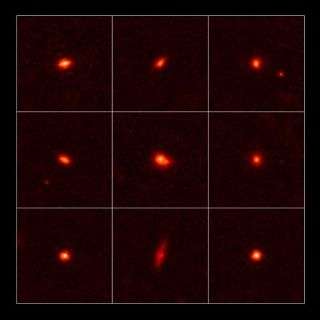
These images taken by the NASA/ESA Hubble Space Telescope show nine compact, ultra-dense galaxies as they appeared 11 billion years ago. The galaxies are only 5,000 light-years across and yet are 200 billion times more massive than the Sun. They are a fraction of the size of today's grownup galaxies but contain the same number of stars. Each galaxy could fit inside the central hub of our Milky Way Galaxy. Hubble's Near Infrared Camera and Multi-Object Spectrometer snapped these images between June 2006 and June 2007. Credit: NASA, ESA, P. van Dokkum (Yale University), M. Franx (Leiden University, The Netherlands), and G. Illingworth (University of California and Lick Observatory, Santa Cruz)
Imagine receiving an announcement touting the birth of a baby 50 centimetres long and weighing 80 kilograms. After reading this puzzling message, you would immediately think the baby’s weight was a misprint.
Astronomers looking at galaxies in the Universe’s distant past received a similar perplexing announcement when they found nine young, compact galaxies, each weighing in at 200 billion times the mass of the Sun. The galaxies, each only 5,000 light-years across, are a fraction of the size of today's grownup galaxies but contain approximately the same number of stars. Each galaxy could fit inside the central hub of our Milky Way Galaxy.
Astronomers used the NASA/ESA Hubble Space Telescope and the W.M. Keck Observatory on Mauna Kea, Hawaii, to study the galaxies as they existed 11 billion years ago, when the Universe was less than 3 billion years old.
“Seeing the compact sizes of these galaxies is a puzzle", said Pieter G. van Dokkum of Yale University in New Haven, Connecticut, USA, who led the study. "No massive galaxy at this distance has ever been observed to be so compact. These galaxies would have to change a lot over 11 billion years, growing five times bigger. They could get larger by colliding with other galaxies, but such collisions may not be the complete answer. It is not yet clear how they would build themselves up to become the large galaxies we see today”.
To determine the sizes of the galaxies, the team used the Near Infrared Camera and Multi-Object Spectrometer on Hubble. The Keck observations were carried out with assistance of a powerful laser to correct for image blurring caused by the Earth's atmosphere. Only Hubble, Keck and ESO’s Very Large Telescope are really able to measure the sizes of these galaxies as they are very small and far away.
Van Dokkum and his colleagues studied the galaxies in 2006 with the Gemini South Telescope Near-Infrared Spectrograph, on Cerro Pachon in the Chilean Andes. Those observations provided the galaxies’ distances and showed that the stars are a half a billion to a billion years old. The most massive stars had already exploded as supernovae.
“In the Hubble Deep Field, astronomers found that star-forming galaxies are small”, said Marijn Franx of Leiden University, The Netherlands. “However, these galaxies were also very low in mass. They weigh much less than our Milky Way. Our study, which surveyed a much larger area than in the Hubble Deep Field, surprisingly shows that galaxies with the same weight as our Milky Way were also very small in the past. All galaxies look really different in early times, even massive ones that formed their stars early”.
The ultra-dense galaxies might comprise half of all galaxies of that mass 11 billion years ago, van Dokkum said, forming the building blocks of today’s largest galaxies.
How did these small, crowded galaxies form? One way, suggested van Dokkum, involves the interaction of dark matter and hydrogen gas in the nascent Universe. Dark matter is an invisible form of matter that accounts for most of the Universe’s mass. Shortly after the Big Bang, the Universe contained an uneven landscape of dark matter. Hydrogen gas became trapped in pockets of the invisible material and began spinning rapidly in dark matter’s gravitational whirlpool, forming stars at a furious rate.
Based on the galaxies’ mass, which is derived from their colour, the astronomers estimated that the stars are spinning around their galactic disks at roughly 400 to 500 kilometres per second. Stars in today’s galaxies, by contrast, are travelling at about half that speed because they are larger and rotate more slowly than the compact galaxies.
These galaxies are ideal targets for the Wide Field Camera 3, which is scheduled to be installed aboard Hubble during Servicing Mission 4 in the fall of 2008.
The findings appeared in the April 10 issue of The Astrophysical Journal Letters.
Source: ESA/Hubble Information Centre
-
NASA's Galaxy Evolution explorer in standby mode
Feb 08, 2012 |
3.5 / 5 (2) |
1
-
Hubble zooms in on a magnified galaxy
Feb 02, 2012 |
5 / 5 (13) |
11
-
The wild early lives of today's most massive galaxies
Jan 25, 2012 |
4.4 / 5 (5) |
2
-
UA makes mirrors for world's largest telescope
Jan 18, 2012 |
4.8 / 5 (5) |
1
-
Astronomers find a dark matter galaxy far, far away
Jan 18, 2012 |
4.3 / 5 (9) |
8
-
Engineers build first sub-10-nm carbon nanotube transistor
Feb 01, 2012 |
4.9 / 5 (31) |
30
-
Something old, something new: Evolution and the structural divergence of duplicate genes
Jan 31, 2012 |
4.6 / 5 (7) |
1
-
The hidden nanoworld of ice crystals: Revealing the dynamic behavior of quasi-liquid layers
Jan 30, 2012 |
5 / 5 (3) |
1
-
Stock market network reveals investor clustering
Jan 27, 2012 |
3.9 / 5 (23) |
8
-
Of microchemistry and molecules: Electronic microfluidic device synthesizes biocompatible probes
Jan 26, 2012 |
5 / 5 (1) |
0
-
Scale of the Universe
12 hours ago
-
Titan's lack of impact craters
Feb 09, 2012
-
Real pictures of black hole eating a star?
Feb 08, 2012
-
Hypothetical way to travel faster than light, but not technically exceed lightspeed
Feb 06, 2012
-
How do scientists monitor the Sun's activity?
Feb 05, 2012
-
Search patterns in observational studies
Feb 05, 2012
- More from Physics Forums - General Astronomy
More news stories
Humans may have helped the decline of African rainforests 3000 years ago
(PhysOrg.com) -- Large areas of rainforests in Central Africa mysteriously disappeared over three thousand years ago, to be replaced by savannas. The prevailing theory has been that the cause was a change ...
Could Venus be shifting gear?
(PhysOrg.com) -- ESAs Venus Express spacecraft has discovered that our cloud-covered neighbour spins a little slower than previously measured. Peering through the dense atmosphere in the infrared, the ...
Space & Earth / Space Exploration
19 hours ago |
5 / 5 (7) |
8
|
NASA budget will axe Mars deal with Europe: scientists
US President Barack Obama's budget proposal to be submitted next week for 2013 will cut NASA's budget by 20 percent and eliminate a major partnership with Europe on Mars exploration, scientists said Thursday.
Space & Earth / Space Exploration
22 hours ago |
5 / 5 (2) |
19
Mars Science Laboratory computer issue resolved
(PhysOrg.com) -- Engineers have found the root cause of a computer reset that occurred two months ago on NASA's Mars Science Laboratory and have determined how to correct it.
Space & Earth / Space Exploration
20 hours ago |
4.7 / 5 (6) |
4
|
Two new moons for Jupiter
Advances in technology have lead to the discovery of new planets outside of our Solar System, and now even new moons in our own backyard.
Space & Earth / Space Exploration
19 hours ago |
4 / 5 (1) |
7
Anonymous knocks CIA website offline (Update)
The website of the Central Intelligence Agency was inaccessible on Friday after the hacker group Anonymous claimed to have knocked it offline.
New error-correcting codes guarantee the fastest possible rate of data transmission
Error-correcting codes are one of the triumphs of the digital age. Theyre a way of encoding information so that it can be transmitted across a communication channel such as an optical fiber o ...
Small modular reactor design could be a 'SUPERSTAR'
(PhysOrg.com) -- Though most of today's nuclear reactors are cooled by water, we've long known that there are alternatives; in fact, the world's first nuclear-powered electricity in 1951 came from a reactor ...
New power source discovered
(PhysOrg.com) -- Researchers at the Massachusetts Institute of Technology (MIT) and RMIT University have made a breakthrough in energy storage and power generation.
The power of estrogen -- male snakes attract other males
A new study has shown that boosting the estrogen levels of male garter snakes causes them to secrete the same pheromones that females use to attract suitors, and turned the males into just about the sexiest ...
Google users warned of threat to smartphone wallets
Users of Google smartphone wallets were being warned on Friday that there is a way to crack pass codes intended to thwart thieves from going on illicit shopping sprees.
Apr 29, 2008
Rank: 4 / 5 (1)
Seems like the Heavens above are nothing but one large contradiction of physics.
Apr 29, 2008
Rank: 2 / 5 (1)
E=Total[m(1 plus D)] where D is the Distance from Big Bang point and the sum is of all spatial values of D from D=0 to D=selected value.
BTW, following Newton (1) gravity is decreased when mass is decreased and (2) acceleration of a body is given by dividing the force acting upon it by its mass. By plain common sense, best scientific approach, the combination of those two 'laws' may explain the accelerating cosmic expansion of galaxy clusters, based on the above E/ m/ D suggested relationship.
Thus the young "condensed galaxies" are, in fact, what later evolved into galactic clusters.
Dov Henis
Apr 29, 2008
Rank: not rated yet
Apr 29, 2008
Rank: 4 / 5 (1)
Might "Quasars" be ultra-compact galaxies eating themselves
( hence
a) the absence of such galaxies hereabouts, and
b) the production of "Quasars" only way-back-then
)
'twould solve 2 significant problems with one simple cancellation, yes?
Apr 30, 2008
Rank: 4 / 5 (1)
c) This predicts that there are galaxy-mass black-holes, with nothing spinning into 'em
( because there isn't anything left nearby )
littering space, with approximately the same frequency of the ultra-compact-galaxies...
At the old-edge of Universe there'd be quasars & ultra-compact-galaxies,
nearer there'd be a "phase-transition", and nearer there'd be only the black-holes, invisible.
Therefore, some of the "missing mass" would be in these things,
& they should be findable.
Also, that boundary should be findable,
& consistent,
right 'round our Universe.
Apr 30, 2008
Rank: 4 / 5 (1)
May 01, 2008
Rank: 4 / 5 (1)
a) that may not apply to ultra-compact galaxies, and
b) there's no rule that prevents the ultra-crowded stars from combining into crowds of black-holes, & them eating the *visible* galaxy out from existence, eventually combining into single black-holes.
You're probably right, however, and considering such questions ought not be done...
: )
May 06, 2008
Rank: not rated yet