Absinthe uncorked: The 'Green Fairy' was boozy -- but not psychedelic
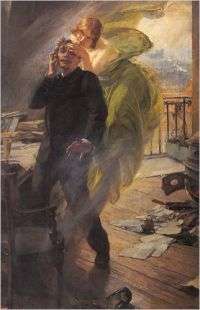
A new study may end the century-old controversy over what ingredient in absinthe caused the exotic green aperitif’s supposed mind-altering effects and toxic side-effects when consumed to excess. In the most comprehensive analysis of old bottles of original absinthe — once quaffed by the likes of van Gogh, Degas, Toulouse-Lautrec and Picasso to enhance their creativity — a team of scientists from Europe and the United States have concluded the culprit was plain and simple:
A high alcohol content, rather than thujone, the compound widely believed responsible for absinthe’s effects. Although consumed diluted with water, absinthe contained about 70 percent alcohol, giving it a 140-proof wallop. Most gin, vodka, and whiskey are 80 – 100-proof and contain 40-50 percent alcohol or ethanol.
The study is scheduled for the May 14, 2008 issue of the American Chemical Society’s bi-weekly Journal of Agricultural and Food Chemistry, where the full text of the article can be downloaded now without charge.
Absinthe took on legendary status in late 19th-Century Paris among bohemian artists and writers. They believed it expanded consciousness with psychedelic effects and called it “the Green Fairy” and “the Green Muse.” The drink’s popularity spread through Europe and to the United States. However, illness and violent episodes among drinkers gave absinthe the reputation as a dangerous drug, and it was banned in Europe and elsewhere.
In the new study, Dirk W. Lachenmeier and colleagues point out that scientists know very little about the composition of the original absinthe produced in France before that country banned the drink in 1915. Only a single study had analyzed one sample of preban absinthe. The researchers analyzed 13 samples of preban absinthe from sealed bottles — “the first time that such a wide ranging analysis of absinthe from the preban era has been attempted,” they say.
The analysis included thujone, widely regarded as the “active” ingredient in absinthe. “It is certainly at the root of absinthe’s reputation as being more drug than drink,” according to Lachenmeier. Thujone was blamed for “absinthe madness” and “absinthism,” a collection of symptoms including hallucinations, facial contractions, numbness, and dementia.
However, the study found relatively small concentrations of thujone, amounts less than previously estimated and not sufficient to explain absinthism. Thujone levels in preban absinthe actually were about the same as those in modern absinthe, produced since 1988, when the European Union (EU) lifted its ban on absinthe production. Laboratory tests found no other compound that could explain absinthe’s effects. “All things considered, nothing besides ethanol was found in the absinthes that was able to explain the syndrome of absinthism,” according to Lachenmeier.
He says that scientific data cannot explain preban absinthe’s reputation as a psychedelic substance. Recent historical research on absinthism concluded that the condition probably was alcoholism, Lachenmeier indicates.
“Today it seems a substantial minority of consumers want these myths to be true, even if there is no empirical evidence that they are,” says Lachenmeier. “It is hoped that this paper will go some way to refute at least the first of these myths, conclusively demonstrating that the thujone content of a representative selection of preban absinthe... fell within the modern EU limit.”
Source: American Chemical Society


