Micro-origami: Researchers fold up micrometer-scale 'voxels' for drug delivery
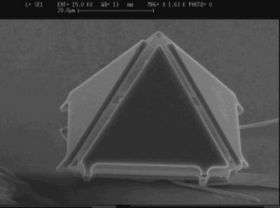
Researchers at the USC Information Sciences Institute have demonstrated a way to manufacture miniscule closed containers that might be used to deliver precise micro- or even nano-quantities of drugs.
According to ISI project leader Peter Will, who is also a research professor in the Viterbi School of Engineering, the new technique, described in a paper in the Journal of Micromechanics and Microengineering, is a two-step process.
Part one is the creation of flat patterns, origami, of exactly the fold up shapes familiar to kindergarten children making paper pyramids, cubes or other solids, except that these are as small 40 micrometers (µm) on a side. (1 inch = 25,400 µm)
Instead of paper, the USC researchers created the patterns in polysilicon sitting on top of a thin film of gold, using a well-established commercial silicon wafer process called PolyMUMPs. The next step was clearing the polysilicon off the hinge areas by etching.
When the blanks were later electrocoated with permalloy to make them magnetic, the photomask used left hinge areas uncoated, to make sure they were the places that folded.
Then the folding had to be accomplished. First the researchers bent the hinges by application of magnetic force to the permalloy. Water pressure and capillary forces generated by submerging the tiny blanks in water, and drying them off did the final folding into shape.
The experiments spend considerable time comparing various methods of controlling the closure effects of water drying with simple flaps designed to close over each other to form "envelops," the directing water from different directions sequence the closing. Varying the time of trying could produce tighter seams.
"Our experiments show" says the paper, that "the combination of partial folding of structures by magnetic actuation and liquid closure to bring the structures to their final closed state is an extremely promising technique for mass production of large arrays of micrometer size …voxels. Furthermore, we believe that future optimization of the voxel hinge geometry and composition should allow for extensions of our work to" much smaller voxels.
The Voxel team - consisting of Will, professor of chemistry Bruce Koel (who has since gone to Lehigh University), former post-doctoral researcher Alejandro Bugacov and former grad student (now graduate) Rob Gagler folded a number of different shapes, including four- and five-sided pyramids, pentagonal 'lotus' shapes, and also simple square plates that folded over each other to make flat mini-envelopes.
Will has been pursuing the idea of creating voxels for many years, "way back to my days in HP labs, when I was working in Medical and Chemical applications." The USC team designed the chips using MEMSPRO CAD software; the actual chip fabrication was done in France.
"The experimental work was done on campus," said Will, "since ISI doesn't have a wet lab."
The paper is "Voxels: volume-enclosing microstructures," J. Micromech. Microeng. 18 (2008) 055025.
Source: University of Southern California


