Can a Polymer Help Curb Arctic Ice Melting?
April 29, 2008 By Laura Mgrdichian Can a Polymer Help Curb Arctic Ice Melting?

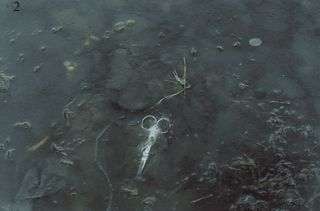
After 15 minutes, a hole cut into the ice of a river near Moscow is not frozen enough to support the weight of heavy iron scissors, which sink partially into the water.

In order to help prevent the melting of Arctic ice, a process that has been occurring at alarming rates in recent years, which many scientists believe is due gradual global warming, a group of researchers have proposed a partial solution that is quite novel: covering select small regions with a layer of a porous polymer that would reflect sunlight and promote freezing, thereby reducing melting.

When ice in the polar regions melts, dumping large quantities of unsalted water into the ocean, there are many negative consequences. For example, the extra water—a sea-level increase of about two millimeters per year—tends to bulge around the equator due to Earth's rotation, possibly stimulating tropical storms and making them more powerful and frequent.
Can a Polymer Help Curb Arctic Ice Melting?

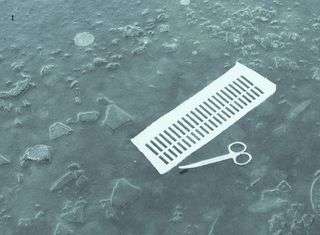
An equal sized hole in the ice, this time with a polymer raft placed in it. Fifteen minutes later, the ice is thick enough to support the scissors´ weight.

Another issue is the lack of ice that remains available to reflect sunlight, since ice is a far better reflector than water, turning away 70-90 percent of the Sun's rays compared to just 7-10 percent for water. This absorbed light heats the water, furthering the melting.

Additionally, large areas of the Arctic ice are unstable. In areas where super-chilled water mixes with ice pieces ranging from a few millimeters to a meter in size, the waves and currents of the water prevent the pieces from aggregating into larger ice platforms.

Tamara Tulaikova, a researcher at the Institute of Geophere Dynamics at the Russian Academy of Sciences, along with her colleagues, believe that covering some of these regions with sheets of a very thin, porous polymer material could help the ice pieces form larger icebergs.

She told PhysOrg.com, “It could be possible, under the right weather conditions with no wind, to distribute these polymer films by airplane. Each piece of film would be several meters in dimension. The polymer would help calm the local waters and have a better reflectivity than open water, and its tiny cavities would draw up water and provide sites for the ice to crystallize.”

In each polymer “raft,” as the group calls them, capillary forces would coax the water up into the cavities, which would each be about 150 micrometers (millionths of a meter) in diameter and about 0.2 meters in height. The water would then have a chance to freeze, providing the foundation for the growth of a large ice structure.

The rafts would also calm the choppy waters nearby and reflect more of the sun's rays than sea water.

“Each porous polymer raft would act like a floating refrigerator,” said Tulaikova.

She and her colleagues, including researchers from the Moscow Institute of Physics and Technology and The University of Aizu in Japan, tested the effectiveness of the rafts on a river near Moscow near the end of autumn on a sunny, windy day, with water and air temperatures of -1°C (30°F) -3°C (27°F), respectively.

They cut out two meter-sized holes in the ice, placed a polymer raft in one and left the other empty for comparison. After 15 minutes the ice near the raft was so thick that it could support heavy iron scissors, while the ice in the empty hole was still in the very beginning stages of formation.

The researchers also tested the rafts in salty water via several experiments on days of varying temperature and weather during the 2005/2006 Russian winter. Temperatures varied from -2°C to -30°C (-22°F). They noticed similar results as the river experiment.

The group says that composite rafts consisting of both porous and salt-repellent layers and an upper reflecting layer consisting of steel ribbing, originally developed for the water-purification industry, could be more suitable for ocean use.

This research is published in the March 19, 2008, online edition of the Journal of Applied Physics.

Citation: J. Appl. Phys. 103, 064506 (2008); DOI:10.1063/1.2885341

Copyright 2008 PhysOrg.com.
All rights reserved. This material may not be published, broadcast, rewritten or redistributed in whole or part without the express written permission of PhysOrg.com.


print this article email this article download pdf blog this article bookmark this article     Stumble it Digg this share on Facebook retweet share on Reddit add to delicious
Rate this story - 3.3 /5 (40 votes)

Rank Filter

Move the slider to adjust rank threshold, so that you can hide some of the comments.


Display comments: newest first

  • Arthur_Dent - Apr 29, 2008
    • Rank: 3.6 / 5 (9)
    And...

    Just what exactly are wildlife to do with the plastic sheets?

    Eat them?

    Or just get caught in them, choke on them, & be drowned by them?

    IF they biodegraded very-quickly, I'd be impressed, but it seems to be a "solution" to one problem that does more damage to the world, long-term, than not-doing-it.

    ( seems to me, anyhow: I'm no expert )
  • Mercury_01 - Apr 29, 2008
    • Rank: 3.3 / 5 (7)
    Tiny floating refrigerators huh, Oh, I see. And will you be flying it like a roll of saran wrap flapping in the wind? DUMB!
  • zevkirsh - Apr 29, 2008
    • Rank: 3 / 5 (7)
    our efforts to save our environment will only wind up destroying it more. this is an obvious case in point.
  • ShadowRam - Apr 29, 2008
    • Rank: 3.3 / 5 (7)
    Doesn't seem like a very smart idea at all.
  • Commentateur - Apr 29, 2008
    • Rank: 2.6 / 5 (7)
    It might provide convenient dumping areas for all those unwanted iron scissors we've been so bothered by....
  • WolfAtTheDoor - Apr 29, 2008
    • Rank: 3.2 / 5 (5)
    our efforts to save our environment will only wind up destroying it more. this is an obvious case in point.

    Yeah, this screams 'bad idea' to me. I understand there's probably some research value to this, but I hope someone puts the brakes on this project before someone starts saran wrapping our glaciers.

    We understand there are changes occurring to our climate, but we don't FULLY understand how or why it's happening. Until we know exactly, I agree, we'd end up screwing things up worse.
  • aufever - Apr 30, 2008
    • Rank: 2.2 / 5 (5)
    Could some of the Arctic Ice Melt be a result of soot from Asia being taken to high latitudes and deposited on the Ice, therefore making them a Heat Sink.
  • COCO - Apr 30, 2008
    • Rank: 1 / 5 (2)
    my god - is this site now degenerated into an infomerrical for bad science and worse solutions to non-existant problems - reminds me of a euro suggestion to toss nuclear waste into warheads and send these ballistic garbage cans deep into sea bottoms - real clarity here would help a lot.
  • Mercury_01 - Apr 30, 2008
    • Rank: 1 / 5 (3)
    WTF?
  • deepsand - Apr 30, 2008
    • Rank: 3 / 5 (3)
    And...

    Just what exactly are wildlife to do with the plastic sheets?

    Eat them?

    Or just get caught in them, choke on them, & be drowned by them?

    IF they biodegraded very-quickly, I'd be impressed, but it seems to be a "solution" to one problem that does more damage to the world, long-term, than not-doing-it.

    ( seems to me, anyhow: I'm no expert )


    As envisioned, the polymer sheets would be INSIDE the ice that forms around it, and therefore not exposed to wildlife.

    And, if used to renew large PERMANENT flows, as appears to be the plan, the polymer will remain so encased for a considerable amount of time.

    Still, eventual exposure of some must be expected. And, as this article fails to address the long term charteristics of this polymer, we're left to speculate.
  • marjon - May 01, 2008
    • Rank: 2 / 5 (4)
    Why is a polar ice cap a good thing?
  • mikiwud - May 01, 2008
    • Rank: 1 / 5 (3)
    This is a day early,officially going to get cold for 10 years.

April 29, 2008 all stories

Comments: 12

3.3 /5 (40 votes)
  • Stumble this up

  • Digg this

  • share this

  • hide
  • Related Stories


  • hide
  • Relevant PhysicsForums posts

  • antibonding MO do they exist in reality?
    created 10 hours ago
  • temperature dependence on intrinsic carrier concentration
    created 14 hours ago
  • fermi level simple explanation
    created 18 hours ago
  • Absorption spectrum of water ice, infrared
    created 21 hours ago
  • wonder about atom characteristic
    created Nov 06, 2009
  • Proton mobility vs. conductance in ice
    created Nov 04, 2009
  • More from Physics Forums - Atomic, Solid State, Comp. Physics

Other News

Stars Fueled by Dark Matter Could Hold Secrets to the Universe

Stars Fueled by Dark Matter Could Hold Secrets to the Universe

Physics / General Physics

created Nov 03, 2009 | popularity 4.5 / 5 (51) | comments 41

(PhysOrg.com) -- The first stars in the universe may have been very different from the stars we see today, yet they may hold clues to understanding some of the mysterious features of the universe. These "dark ...


Second Law of Thermodynamics May Explain Economic Evolution

Second Law of Thermodynamics May Explain Economic Evolution

Physics / General Physics

created Nov 02, 2009 | popularity 4.3 / 5 (30) | comments 28

(PhysOrg.com) -- Terms such as the "invisible hand," laissez-faire policy, and free-market principles suggest that economic growth and decline in capitalist societies seem to be somehow self-regulated. Now, ...


High-performance plasmas may make reliable, efficient fusion power a reality

High-performance plasmas may make reliable, efficient fusion power a reality

Physics / Plasma Physics

created Nov 02, 2009 | popularity 4.7 / 5 (39) | comments 32

In the quest to produce nuclear fusion energy, researchers from the DIII-D National Fusion Facility have recently confirmed long-standing theoretical predictions that performance, efficiency and reliability ...


'Teapot effect' solved

Solving Teapot Effect

Physics / General Physics

created Nov 02, 2009 | popularity 4.9 / 5 (11) | comments 10

(PhysOrg.com) -- A team of scientists from France have worked out why teapots dribble at low flow rates, and how to stop them. The effect is called the "teapot effect", and solving it could finally put an ...


Laser accelerated protons to the highest energies so far

Researchers use trident laser to accelerate protons to record energies

Physics / General Physics

created Nov 02, 2009 | popularity 4.7 / 5 (6) | comments 10

An international team of physicists at Los Alamos National Laboratory has succeeded in using intense laser light to accelerate protons to energies never before achieved. Using this technique, scientists can ...