Cassini Spacecraft Tracks Raging Saturn Storm
April 29, 2008
Cassini Spacecraft Tracks Raging Saturn Storm

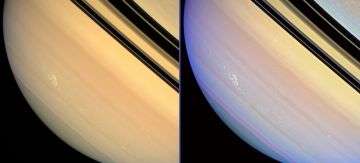
An enhanced color view of a storm on Saturn. The larger view includes a view showing Saturn in colors that approximate what the human eye would see. Image credit: NASA/JPL/Space Science Institute

As a powerful electrical storm rages on Saturn with lightning bolts 10,000 times more powerful than those found on Earth, the Cassini spacecraft continues its five-month watch over the dramatic events.

Scientists with NASA's Cassini-Huygens mission have been tracking the visibly bright, lightning-generating storm--the longest continually observed electrical storm ever monitored by Cassini.

Saturn's electrical storms resemble terrestrial thunderstorms, but on a much larger scale. Storms on Saturn have diameters of several thousand kilometers (thousands of miles), and radio signals produced by their lightning are thousands of times more powerful than those produced by terrestrial thunderstorms.

Lightning flashes within the persistent storm produce radio waves called Saturn electrostatic discharges, which the radio and plasma wave science instrument first detected on Nov. 27, 2007. Cassini's imaging cameras monitored the position and appearance of the storm, first spotting it about a week later, on Dec. 6.

"The electrostatic radio outbursts have waxed and waned in intensity for five months now," said Georg Fischer, an associate with the radio and plasma wave science team at the University of Iowa, Iowa City. "We saw similar storms in 2004 and 2006 that each lasted for nearly a month, but this storm is longer-lived by far. And it appeared after nearly two years during which we did not detect any electrical storm activity from Saturn."

The new storm is located in Saturn's southern hemisphere--in a region nicknamed "Storm Alley" by mission scientists--where the previous lightning storms were observed by Cassini. "In order to see the storm, the imaging cameras have to be looking at the right place at the right time, and whenever our cameras see the storm, the radio outbursts are there," said Ulyana Dyudina, an associate of the Cassini imaging team at the California Institute of Technology in Pasadena, Calif.

Cassini's radio plasma wave instrument detects the storm every time it rotates into view, which happens every 10 hours and 40 minutes, the approximate length of a Saturn day. Every few seconds the storm gives off a radio pulse lasting for about a tenth of a second, which is typical of lightning bolts and other electrical discharges. These radio waves are detected even when the storm is over the horizon as viewed from Cassini, a result of the bending of radio waves by the planet's atmosphere.

Amateur astronomers have kept track of the storm over its five-month lifetime. "Since Cassini's camera cannot track the storm every day, the amateur data are invaluable," said Fischer. "I am in continuous contact with astronomers from around the world."

The long-lived storm will likely provide information on the processes powering Saturn's intense lightning activity. Cassini scientists will continue to monitor Storm Alley as the seasons change, bringing the onset of autumn to the planet’s southern hemisphere.

Color images of the storm are available at http://ciclops.org .

Source: NASA

Filter


Move the slider to adjust rank threshold, so that you can hide some of the comments.


Display comments: newest first

Egnite
Apr 30, 2008

Rank: not rated yet
Nice way to get re-instated neil! Spam and shout as much as you want but I don't think it'll help your case as much as it will piss most of u off.
Rank 4 /5 (12 votes)
Tags

Related Stories
Relevant PhysicsForums posts
  • Never ending outer space.....
    created15 hours ago
  • Neutron Star fragments?
    created17 hours ago
  • stationary or not?
    created21 hours ago
  • Scale of the Universe
    createdFeb 10, 2012
  • Titan's lack of impact craters
    createdFeb 09, 2012
  • Real pictures of black hole eating a star?
    createdFeb 08, 2012
  • More from Physics Forums - General Astronomy

More news stories

Salvage workers begin pumping fuel from Italian shipwreck

Salvage workers Sunday began pumping fuel from the shipwrecked Italian cruise liner Costa Concordia, a day ahead of schedule, officials said.

Space & Earth / Environment

created 2 minutes ago | popularity not rated yet | comments 0

Latin America mining boom clashes with conservation

Latin America is experiencing a mining boom as prices rise fuelled by a hike in global demand, but the region is also being hit by a wave of violent protests, strikes and rallies by environmentalists.

Space & Earth / Environment

created 8 hours ago | popularity not rated yet | comments 0

Political leaders play key role in how worried Americans are by climate change: study

More than extreme weather events and the work of scientists, it is national political leaders who influence how much Americans worry about the threat of climate change, new research finds.

Space & Earth / Environment

created Feb 06, 2012 | popularity 5 / 5 (6) | comments 73

NASA budget will axe Mars deal with Europe: scientists

US President Barack Obama's budget proposal to be submitted next week for 2013 will cut NASA's budget by 20 percent and eliminate a major partnership with Europe on Mars exploration, scientists said Thursday.

Space & Earth / Space Exploration

created Feb 10, 2012 | popularity 5 / 5 (3) | comments 55

Humans may have helped the decline of African rainforests 3000 years ago

(PhysOrg.com) -- Large areas of rainforests in Central Africa mysteriously disappeared over three thousand years ago, to be replaced by savannas. The prevailing theory has been that the cause was a change ...

Space & Earth / Environment

created Feb 10, 2012 | popularity 4.1 / 5 (14) | comments 20 | with audio podcast report


Scientists discover molecular secrets of 2,000-year-old Chinese herbal remedy

For roughly two thousand years, Chinese herbalists have treated Malaria using a root extract, commonly known as Chang Shan, from a type of hydrangea that grows in Tibet and Nepal. More recent studies suggest that halofuginone, ...

New method to examine batteries -- MRI from the inside

There is an ever-increasing need for advanced batteries for portable electronics, such as phones, cameras, and music players, but also to power electric vehicles and to facilitate the distribution and storage of energy derived ...

A mitosis mystery solved: How chromosomes align perfectly in a dividing cell

Although the process of mitotic cell division has been studied intensely for more than 50 years, Whitehead Institute researchers have only now solved the mystery of how cells correctly align their chromosomes during symmetric ...

Starve a virus, feed a cure? Findings show how some cells protect themselves against HIV

A protein that protects some of our immune cells from the most common and virulent form of HIV works by starving the virus of the molecular building blocks that it needs to replicate, according to research published online ...

Researchers find extensive RNA editing in human transcriptome

In a new study published online in Nature Biotechnology, researchers from BGI, the world's largest genomics organization, reported the evidence of extensive RNA editing in a human cell line by analysis of RNA-seq data, demons ...

The proteins ensuring genome protection

Researchers from the University of Geneva (UNIGE), Switzerland, have discovered the crucial role of two proteins in developing a cell 'anti-enzyme shield'. This protection system, which operates at the level of molecular ...