RFID Chips Make Luggage Transport Reliable
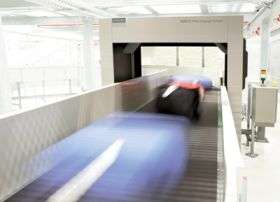
Transporting passenger baggage between the world’s airports is expected to become far more reliable in the future — with RFID technology. Siemens has developed a system that relies on a radio chip to replace the bar code attached to a suitcase. The new technology will substantially reduce scanning errors and resulting sorting and delivery errors.
The system, which has been exhibited at the Terminal Passenger Expo in Amsterdam, scans RFID chips with a success rate of 99.9 percent — far higher than that of the bar codes previously used.
The International Air Transport Association (IATA), an umbrella organization of airlines and airports, is now urging its members to label passenger luggage with RFID chips at the check-in counter. The IATA estimates that these RFID solutions could help to realize savings of hundreds of millions of euros annually worldwide. The costs that would be eliminated are a result of misrouted or lost suitcases.
When bags fail to arrive at their destinations, it is frequently because the bar codes attached to the luggage become crumpled up or concealed. Later, a sorting unit at the conveyor belt fails to read the data correctly and assigns the wrong forwarding route to these items of luggage.
In the case of the new technology, the passengers submit their luggage at the check-in counter, as before, and the ground staff attaches a paper strap to it. But the strap now has an integrated radio chip with antenna, microprocessor and a memory to record all the relevant information.
The suitcases are then transported on a conveyor belt through a tunnel equipped with non-contact RFID reading and writing machines. The data is read in real time, quickly processed with efficient algorithms, and turned over to the luggage management system that controls the movement of all baggage. The system uniquely identifies the radio chip even when it is situated in an awkward position because, unlike a bar code, it does not require optical contact to be scanned.
This system has undergone thorough field trials at the Airport Center in Fürth, the test airport run by Siemens. More than three million pieces of luggage passed by the RFID receivers and were sorted while moving at the same speed at which luggage is moved in a real airport.
Together with more than 30 other technological “endorsers,” Siemens Building Technologies has also committed itself to a promotion plan. The company provides building owners with information about the program and helps participants with the technical implementation of their action plans. So far, for example, Siemens has helped the University of the Arts in Berlin and the Italian financial services firm Unicredito reduce the energy consumption of their buildings.
Source: Siemens


