Scientists, Engineers Use Autonomic Computing to Study the Secret Lives of Plants
Scientists and engineers at The University of Arizona's Biospehere 2 are teaming up to study the secret lives of plants – secrets that the plants have kept well hidden until now.
Biosphere 2 – the University's 3.14-acre, glass-enclosed living laboratory – provides the perfect controlled environment for precisely pinpointing those moments when plants initiate changes in their environment or are changed by their environment. Until now scientists had two less-than-satisfactory avenues for studying the effects of plants on their environment and vice versa – lab experiments and fieldwork. Conditions can be tightly controlled in the lab, but the experiments are done under far-from-real-world conditions. On the other hand, fieldwork provides real-world conditions, but scientists have little control over the variables.
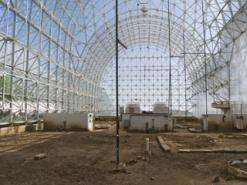
Biosphere 2, with its huge indoor area, thousands of sealed windows and welded, stainless steel liner – in effect, a gigantic terrarium – bridges this gap between the lab and the field.
“B2 is on a spatial scale that encompasses the complexities we care about in the real world, but it has the environmental control of our controlled laboratory experiments,” says Travis Huxman, director of Biosphere 2 and the Biosphere 2 Earthscience program, which is working on issues related to global environmental change.
Biology Meets Computer Intelligence
Experiments beginning this fall in Biosphere 2 will combine two seemingly disparate systems – living plants and computer intelligence – to help scientists learn more about global change.
Some of the research questions include how plants acquire and allocate resources to survival, growth, and reproduction; how global change affects these processes; and what these changes mean to how ecosystems function. This includes both how past climates have influenced plant evolution and how future climates may alter relationships between plants and their environment. Of particular interest is how plants would use water in future climates, which would affect how much of that resource would be available for use by society.
The computer intelligence includes autonomic computing systems and robotic sensors from the UA’s branch of the National Science Foundation Center for Autonomic Computing, known as CAC. Other CAC branches are located at the University of Florida and Rutgers University.
Autonomic computing systems behave much like a biological nervous system, which regulates such things as heartbeat, breathing and digestion, with minimal need for conscious thought.
The UA’s CAC has been working on systems that allow computers to detect and defeat hacker attacks without human intervention. “A system that stores secure information could use a self-protecting algorithm to detect and mount a defense against intruders trying to break in, disable and possibly destroy the system,” said Salim Hariri, director of the center.
In the Biosphere 2 experiments, autonomic computer systems will monitor plant, soil and air vital signs, such as atmospheric carbon dioxide, water use, and temperature.
The system will include a grid of sensors on the ground and a similar grid suspended in the air. Mobile robot sensors also will be placed in Biosphere 2 and can be dispatched to carry out further measurements when necessary – again, completely under autonomic computer system control, without the need for humans to do anything.
In one experiment slated to begin this fall, researchers will build three sloping hills about 30 yards long and 20 yards wide to study how vegetation on a hillside influences the water balance both in the ground and surrounding air.
The researchers want to better understand how plants modify the amount of time a water molecule spends in the soil and how that affects the reactions that take place in soil only when it’s wet.
The researchers also plan to study how variations in ground cover change the amount of water contained in the atmosphere, soil and vegetation and how this, in turn, changes air temperature, said Huxman, an associate professor in the UA department of ecology and evolutionary biology.
“The autonomic computer system will detect the subtle changes in the environment, alert researchers and also dispatch sensor robots to gather additional information if needed,” said Hariri, A professor in the electrical and computer engineering department.
Computers Make Ideal 'Lab Rats'
Monitoring experiments moment by moment, hour after hour and day after day is something humans aren’t very good at, but at which computers excel, Hariri said. “Computers don’t get bored and they’re always fully awake,” he said. “Computers are very good at waiting. They’re ready to pick up on subtle changes instantly. Then they can alert us to changes at the instant they happen, even if that happens to be at 3 a.m. Sunday morning.”
Humans also can inject noise into the data, Hariri added. “When you touch a plant or even walk through an area, you disturb the local environment. Passive sensors are fixed in place and don’t disturb their surroundings when taking measurements.”
Traditional plant and hydrologic research also is notoriously glacial, Hariri noted. Researchers often wait years between the start of an experiment, the modeling phase and the final results.
“With autonomic computing, we can accelerate this cycle,” Hariri said. “Instead of waiting five or seven years, we can do these experiments in real time, immediately gathering and analyzing data.”
Now biologists will be able to run a computer simulation of plant behavior right alongside plants growing in Biosphere 2’s experimental plots. When there’s a disparity between the predicted and experimental results, “we can adjust the models in real time using autonomic sensors and robots,” Hariri said. This creates a real-time iterative process in which the actual behavior and modeled behavior quickly converge through the use of a detailed feedback loop, he said.
“This is the most important aspect of this research effort,” Hariri added. “We are accelerating the research. That’s the story of Biosphere 2. We have a huge, controlled environment in which to run experiments and analyze them in real time.”
“Scientists don’t fully understand the relationships between climate, plant processes, and hydrology,” Hariri said. “The research we’re conducting at Biosphere 2 will help us better understand these things – and to quickly understand them – through the accelerated discovery cycle that autonomic computing makes possible.”
Source: University of Arizona


