High-Flying Electrons May Provide New Test of Quantum Theory
April 29th, 2008 High-Flying Electrons May Provide New Test of Quantum Theory

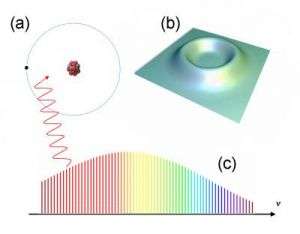
(a) In a Rydberg atom, an electron (black dot) is far away from the atomic nucleus (red and grey core). (b) Probability map for an electron in a Rydberg atom shows that it has virtually no probability of being near the nucleus in the center. (c) An optical frequency comb for producing ultraprecise colors of light can trigger quantum energy jumps useful for accurately measuring the Rydberg constant. Credit: NIST

Researchers at the National Institute of Standards and Technology and Max Planck Institute for Physics in Germany believe they can achieve a significant increase in the accuracy of one of the fundamental constants of nature by boosting an electron to an orbit as far as possible from the atomic nucleus that binds it. The experiment, outlined in a new paper, would not only mean more accurate identifications of elements in everything from stars to environmental pollutants but also could put the modern theory of the atom to the most stringent tests yet.

The physicists’ quarry is the Rydberg constant, the quantity that specifies the precise color of light that is emitted when an electron jumps from one energy level to another in an atom. The current value of the Rydberg constant comes from comparing theory and experiment for 23 different kinds of energy jumps in hydrogen and deuterium atoms.

Researchers have experimentally measured the frequencies of light emitted by these atomic transitions (energy jumps) to an accuracy of as high as 14 parts per quadrillion (one followed by 15 zeros), but the value of the Rydberg constant is known only to about 6.6 parts in a trillion—500 times less accurate. The main hurdle to a more accurate value comes from uncertainties in the size of the atom’s nucleus, which can alter the electron’s energy levels and therefore modify the frequency of light it emits.

Another source of uncertainty comes from the fact that electrons sometimes emit and reabsorb short-lived “virtual photons,” a process that also can slightly change the electron’s energy level.

To beat these problems, NIST physicist Peter Mohr and his colleagues propose engineering so-called hydrogen-like Rydberg atoms—atomic nuclei stripped of all but a single electron in a high-lying energy level far away from the nucleus. In such atoms, the electron is so far away from the nucleus that the latter’s size is negligible, and the electron would accelerate less in its high-flung orbit, reducing the effects of “virtual photons” it emits. These simplifications allow theoretical uncertainties to be as small as tens of parts in a quintillion (one followed by 18 zeros).

NIST researchers Joseph Tan and colleagues hope to implement this approach experimentally in their Electron Beam Ion Trap Facility. The idea would be to strip an atom of all its electrons, cool it and inject a single electron in a high-flying orbit. Then the researchers would use a sensitive measurement device known as a frequency comb to measure the light absorbed by this Rydberg atom.

The result could be an ultraprecise frequency measurement that would yield an improved value for the Rydberg constant. Such a measurement would be so sensitive that it could reveal anomalies in quantum electrodynamics, the modern theory of the atom.

Citation: U.D. Jentschura, P.J. Mohr, J.N. Tan and B.J. Wundt, Fundamental constants and tests of theory in Rydberg states of hydrogen-like ions, Physical Review Letters, 100, 160404 (2008), posted online April 22, 2008.

Source: National Institute of Standards and Technology


print this article email this article download pdf blog this article bookmark this article     Digg this Stumble it share on Facebook share on Reddit add to delicious save to Yahoo! bookmarks
4.7/5 after 41 votes

Rank Filter

Move the slider to adjust rank threshold, so that you can hide some of the comments.


Display comments: newest first

  • nilbud - Apr 30, 2008
    • Rank: 3 / 5 (2)
    What is a web board? Why do you refer to yourself in the third person? Time for your meds maybe?
  • thales - Apr 30, 2008
    • Rank: 1 / 5 (1)
    mmm string theory

April 29th, 2008 all stories
Physics / General Physics

Comments: 2
Rank: 4.7/5 after 41 votes

  • Stumble this up

  • Digg this

  • Share it:
  • share on Facebook
  • share on MySpace
  • share on Slashdot
  • rss-newsfeed
  • share on Google
  • share on Reddit
  • add to delicious
  • save to Yahoo! bookmarks
  • share on Windows Live
  • Add to Mixx!
Rating: 4.7/5 after 41 votes

  • Related Stories

  • Scientists discover giant Rydberg atom molecules
    created Jun 24, 2009 | popularity not rated yet | comments 0
  • Scientists Make First Observation of Unique Rydberg Molecule
    created Apr 28, 2009 | popularity not rated yet | comments 0
  • Riding the dimer
    created Jan 18, 2006 | popularity not rated yet | comments 0
  • Composites for energy
    created Jun 30, 2009 | popularity not rated yet | comments 0
  • Researchers show new antioxidant could help treat cardiovascular disease
    created Jun 29, 2009 | popularity not rated yet | comments 0

Tags


  • Physicists Demonstrate Quantum Memory with Matter Qubits
    Physicists Demonstrate Quantum Memory with Matter Qubits
    Physics / General Physics
    created Jul 03, 2009 | popularity 4.4 / 5 (17) | comments 1
  • 'Holey' Nanosheets for Wastewater Dye Removal
    Nanotechnology / Nanomaterials
    created Jul 01, 2009 | popularity 5 / 5 (5) | comments 1
  • Jellyfish Robot Swims Like its Biological Counterpart
    Jellyfish Robot Swims Like its Biological Counterpart
    Electronics / Robotics
    created Jun 26, 2009 | popularity 4.4 / 5 (8) | comments 1
  • Could Maxwell's Demon Exist in Nanoscale Systems?
    Could Maxwell's Demon Exist in Nanoscale Systems?
    Physics / General Physics
    created Jun 24, 2009 | popularity 4.4 / 5 (18) | comments 29
  • Living Safely with Robots, Beyond Asimov's Laws
    Living Safely with Robots, Beyond Asimov's Laws
    Electronics / Robotics
    created Jun 22, 2009 | popularity 4.6 / 5 (53) | comments 40
  • Other News

    UQ researchers break the law -- of physics

    Physics / General Physics

    created 4 hours ago | popularity 4.6 / 5 (8) | comments 0

    (PhysOrg.com) -- Two UQ Science researchers have proved two famous physical laws that have been widely used for the past 25 years do not always work.


    Scientists create first electronic quantum processor

    Scientists create first electronic quantum processor

    Physics / General Physics

    created Jun 28, 2009 | popularity 4.8 / 5 (54) | comments 41

    A team led by Yale University researchers has created the first rudimentary solid-state quantum processor, taking another step toward the ultimate dream of building a quantum computer.


    Science journals

    How to Spot an Influential Paper Based on its Citations

    Physics / General Physics

    created Jul 04, 2009 | popularity 3.9 / 5 (10) | comments 6

    (PhysOrg.com) -- At first it may seem that the number of citations received by a published scientific paper is directly related to that paper's quality of content. The higher the quality, the more people read ...


    Fermilab's CDF observes Omega-sub-b baryon

    Fermilab's CDF observes Omega-sub-b baryon

    Physics / General Physics

    created Jun 29, 2009 | popularity 4.7 / 5 (18) | comments 7

    (PhysOrg.com) -- At a recent physics seminar at the Department of Energy’s Fermi National Accelerator Laboratory, Fermilab physicist Pat Lukens of the CDF experiment announced the observation of a new particle, ...


    New insights, and a new angle, on high-temperature superconductivity

    New insights, and a new angle, on high-temperature superconductivity

    Physics / Superconductivity

    created Jun 29, 2009 | popularity 4.9 / 5 (14) | comments 7

    (PhysOrg.com) -- A Princeton-led research team has revealed surprising information about how electron behavior influences the conduction of electricity in a class of high-temperature superconductors. An increased ...