Birds can tell if you are watching them -- because they are watching you
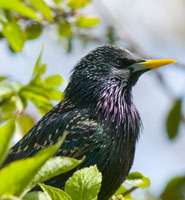
April 30th, 2008 A starling

A starling (Sturnus vulgaris) Photo by Theo Webb

In humans, the eyes are said to be the ‘window to the soul’, conveying much about a person’s emotions and intentions. New research demonstrates for the first time that birds also respond to a human’s gaze.

Predators tend to look at their prey when they attack, so direct eye-gaze can predict imminent danger. Julia Carter, a PhD student at the University of Bristol, and her colleagues, set up experiments that showed starlings will keep away from their food dish if a human is looking at it. However, if the person is just as close, but their eyes are turned away, the birds resumed feeding earlier and consumed more food overall.

Carter said “This is a great example of how animals can pick up on very subtle signals and use them to their own advantage”. Her results are published online today (30 April) in Proceedings of the Royal Society B.

Wild starlings are highly social and will quickly join others at a productive foraging patch. This leads to foraging situations that are highly competitive. An individual starling that assesses a relatively low predation risk, and responds by returning more quickly to a foraging patch (as in the study), will gain valuable feeding time before others join the patch.

Responses to obvious indicators of risk – a predator looming overhead or the fleeing of other animals – are well documented, but Carter argued that a predator’s head orientation and eye-gaze direction are more subtle indicators of risk, and useful since many predators orient their head and eyes towards their prey as they attack.

This research describes the first explicit demonstration of a bird responding to a live predator’s eye-gaze direction. Carter added: “By responding to these subtle eye-gaze cues, starlings would gain a competitive advantage over individuals that are not so observant. This work highlights the importance of considering even very subtle signals that might be used in an animal’s decision-making process.”

Do these birds understand that a human is looking at them, and that they might pose some risk? As yet, this question has not been answered. But whether or not the responses involve some sort of theory of mind, and whether or not they are innate or acquired, the result is that starlings are able to discriminate the very subtle eye-gaze cues of a nearby live predator and adjust their anti-predator responses in a beneficial manner.

Source: University of Bristol


print this article email this article download pdf blog this article bookmark this article     Digg this Stumble it share on Facebook share on Reddit add to delicious save to Yahoo! bookmarks
4.4/5 after 29 votes

Rank Filter

Move the slider to adjust rank threshold, so that you can hide some of the comments.


Display comments: newest first

  • Arthur_Dent - Apr 30, 2008
    • Rank: not rated yet
    "Do these birds understand that a human is looking at them, and that they might pose some risk?"

    No, they understand that *something* or *other-kind one* is looking at them:
    they've no concept of "human".

    Geepers..

April 30th, 2008 all stories
Biology /

Comments: 1
Rank: 4.4/5 after 29 votes

  • Stumble this up

  • Digg this

  • Share it:
  • share on Facebook
  • share on MySpace
  • share on Slashdot
  • rss-newsfeed
  • share on Google
  • share on Reddit
  • add to delicious
  • save to Yahoo! bookmarks
  • share on Windows Live
  • Add to Mixx!
Rating: 4.4/5 after 29 votes

Tags


  • Physicists Demonstrate Quantum Memory with Matter Qubits
    Physicists Demonstrate Quantum Memory with Matter Qubits
    Physics / General Physics
    created Jul 03, 2009 | popularity 4.4 / 5 (13) | comments 1
  • 'Holey' Nanosheets for Wastewater Dye Removal
    Nanotechnology / Nanomaterials
    created Jul 01, 2009 | popularity 5 / 5 (5) | comments 1
  • Jellyfish Robot Swims Like its Biological Counterpart
    Jellyfish Robot Swims Like its Biological Counterpart
    Electronics / Robotics
    created Jun 26, 2009 | popularity 4.4 / 5 (7) | comments 1
  • Could Maxwell's Demon Exist in Nanoscale Systems?
    Could Maxwell's Demon Exist in Nanoscale Systems?
    Physics / General Physics
    created Jun 24, 2009 | popularity 4.4 / 5 (18) | comments 29
  • Living Safely with Robots, Beyond Asimov's Laws
    Living Safely with Robots, Beyond Asimov's Laws
    Electronics / Robotics
    created Jun 22, 2009 | popularity 4.6 / 5 (51) | comments 39
  • Other News

    The calf (bottom centre), yet to be named, was born at the harbourside Taronga Zoo just after 3am

    Australia welcomes its first new-born elephant

    Biology / Plants & Animals

    created 8 hours ago | popularity not rated yet | comments 0

    Australia has welcomed the first elephant ever born in the country with the arrival of a 100-kilogram (220.4-pound) male calf at a Sydney zoo, according to keepers.


    Early detection sought for aquatic invasive weed Eurasian Watermilfoil

    Biology / Ecology

    created 23 hours ago | popularity not rated yet | comments 0

    (PhysOrg.com) -- Battling invasive plants is nothing new to Montanans, but a newcomer on the scene dwells in the water. This aquatic invader is called Eurasian watermilfoil. Fortunately, Montanans can take preventive action ...


    Cells use import machinery to export their goods as well

    Biology / Microbiology

    created 23 hours ago | popularity 3.5 / 5 (2) | comments 0

    (PhysOrg.com) -- In the bustling economy of the cell, little bubbles called vesicles serve as container ships, ferrying cargo to and from the port — the cell membrane. Some of these vesicles, called post-Golgi vesicles, export ...


    Scientists 'rebuild' giant moa using ancient DNA

    Biology / Plants & Animals

    created Jul 01, 2009 | popularity 5 / 5 (9) | comments 12

    (PhysOrg.com) -- Scientists have performed the first DNA-based reconstruction of the giant extinct moa bird, using prehistoric feathers recovered from caves and rock shelters in New Zealand.


    Pacific Giant Salamander (Dicamptodon tenebrosus)

    Salamanders, regenerative wonders, heal like mammals, people

    Biology / Microbiology

    created Jul 01, 2009 | popularity 4.9 / 5 (18) | comments 10

    The salamander is a superhero of regeneration, able to replace lost limbs, damaged lungs, sliced spinal cord -- even bits of lopped-off brain. But it turns out that remarkable ability isn't so mysterious after ...