Physicists Build a Quantum Gambling Machine
April 30, 2008 By Lisa Zyga Physicists Build a Quantum Gambling Machine

Enlarge

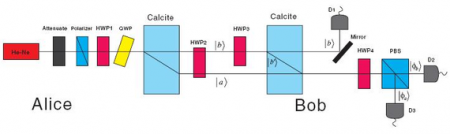
Physicists have realized a quantum gambling machine using optical elements. From a helium-neon laser, a polarizer generates a single photon in a definite polarization state (horizontal or vertical). Then, Alice uses half wave plate 1 to transfer the definite state into a superposition state to alter the probability of the photon’s destination. The beam is split in the calcite beam splitter into beams A and B. Then Bob splits beam B with half wave plate 3 to influence the photon’s destination, and the second calcite beam splitter superposes beams B’ and A. Finally, three detectors labeled D1, D2, and D3 detect the photon in state B, B’, or A, respectively. Credit: Zhang, et al.

Quantum gambling machines may not be popping up at futuristic casinos any time soon, but the devices could have other uses – such as enabling physicists to study game theory in situations where cheating is impossible.

That’s because, in the quantum domain, opponents can always figure out what choice the other made when the game is over, thanks to superpositions of their actions. In the classical version of the “Pick the Winning Box” game, for example, a casino operator hides a ball in either box A or box B, and a player guesses the box that contains the ball in order to win. If the game were played remotely, the casino operator could easily lie about which box the ball was in if the player chose the winning box. Or, if the boxes were with the player, he could cheat by claiming that he found the ball when he did not.
Physicists Build a Quantum Gambling Machine

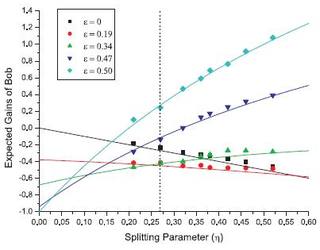
This graph shows that Bob’s optimal splitting parameter has the value 0.27. This choice maximizes his gains over the possible choices that Alice could make for her superposition state (with the black square representing an equal superposition state and the light blue diamond representing a highly biased superposition state). Credit: Zhang, et al.

But in quantum gambling, this kind of cheating is impossible, opening up the possibility for remote gambling. Researchers Yong-Sheng Zhang and colleagues from the University of Science and Technology of China have built such a quantum gambling machine using optical elements, which they describe in a recent issue of Europhysics Letters.

“As far as I know, this is the first demonstration of a quantum gambling machine since L. Goldenberg et al. presented it in 1999,” Zhang told PhysOrg.com. “It is a toy model of applications of quantum mechanics, and it may be used in real gambling.”

First, the machine generates a photon, which has a definite polarization state of either vertical or horizontal. Then, to represent Alice the casino operator, a half wave plate transfers the photon into a superposition of horizontal and vertical states. In an equally distributed state, the photon would be half vertically polarized and half horizontally polarized. Then, a beam splitter splits the photon beam into beam A and beam B. At the end of the machine, there will be a 50-50 chance of the photon ending up in the player Bob’s “box” (his detector, B) or Alice’s detector, A.

But the game offers other variables. To alter that 50-50 probability, for instance, Alice has the option of preparing a biased superposition state – for example, one that is more vertically polarized than horizontally polarized, or vice versa. Then, there would be a smaller chance that the photon would end up in Bob’s detector than in Alice’s detector.

However, Bob has another option besides passively waiting to see if his detector gets the photon. Like Alice, Bob also has a half wave plate, and he can use it to split his beam B into two parts according to a splitting parameter of his choice. Then, one path of his split beam, B’, is superposed back with beam A. He would probably choose a higher splitting parameter if he thought that Alice had chosen a superposition state that was highly biased against putting the photon in his beam. In a sense, splitting his beam B gives Bob a second chance of winning, and – depending on the bet – winning a greater amount.

If Bob’s detector doesn’t get the photon, then it will go to either Alice’s detector A or a third detector, B’. If Bob bet on the photon landing in detector A, and it does, then Bob wins a previously agreed sum, while a photon in detector B means Bob loses that sum (i.e. he chose the wrong box, in the classical analogy). Similarly, if he had bet on detector B, and the photon was detected there, he would win that bet, too. But he cannot bet on detector B’.

So Bob and Alice both have sway over where the photon ends up. If Bob chooses a high splitting parameter and Alice had chosen a greatly biased superposition state (so that she increased the chance of having the photon in beam A), the photon would be more likely to go to detector A than B’, and Bob would win. But if Alice had chosen a more equal superposition state (so that beam B was just as likely to have the photon), the photon would be more likely to go to detector B’ than detector A, and Bob would lose. In this case, Bob would have been better off choosing a lower splitting parameter, or not splitting his beam at all.

In a sense, Bob’s choice of his splitting parameter depends on how equally he thinks Alice prepared the original photon. The researchers figured out the optimal splitting parameter for Bob that would make him the most money for any superposition state that Alice chooses, for a game when Bob’s winnings would be 5 for detector A and 1 for detector B (and losing the same amount if his bet is wrong). They also found that Bob has a greater chance of losing than winning.

As the researchers explain, this demonstration of a quantum gambling machine shows that quantum mechanics could have interesting implications in traditional game theory. For instance, quantum gambling might reveal insights into the foundations of game theory, survival games, and quantum communication. And quantum mechanics could also ensure fairness in remote gambling.

“It is not clear how this gambling machine can affect people’s lives,” Zhang said. “However, with more and more things being used in gambling and trade [Super Tuesday: Markets Predict Outcome Better Than Polls, Scientific American, Feb. 2008], it can be conjectured that a quantum gambling machine whose security is guaranteed by the laws of physics may have some role in the future.”

More information: Zhang, P.; Zhang, Y.-S.; Huang, Y.-F.; Peng, L.; Li, C.-F., and Guo, G.-C. “Optical realization of quantum gambling machine.” Europhysics Letters, 82, (2008) 30002.

Copyright 2008 PhysOrg.com.
All rights reserved. This material may not be published, broadcast, rewritten or redistributed in whole or part without the express written permission of PhysOrg.com.


print this article email this article download pdf blog this article bookmark this article     Stumble it Digg this share on Facebook retweet share on Reddit add to delicious
Rate this story - 4 /5 (34 votes)

Rank Filter

Move the slider to adjust rank threshold, so that you can hide some of the comments.


Display comments: newest first

  • quantum_flux - May 03, 2008
    • Rank: not rated yet
    Quantum gambling is interesting to think about :)

    QF's blog: http://irrational...pot.com/
  • superhuman - May 04, 2008
    • Rank: 5 / 5 (1)
    >Quantum gambling machines may not be popping up at futuristic casinos any time soon, but the devices could have other uses %u2013 such as enabling physicists to study game theory in situations where cheating is impossible.
    >But in quantum gambling, this kind of cheating is impossible, opening up the possibility for remote gambling.

    Seriously those have to be two of the most silly and far fetched claims on physorg!

    All it takes to make cheating impossible in such games is asking subjects to write down the answer before the game result is revealed!

    And although the cheating at the machine may be theoretically impossible operator could still lie about results so players would have to be connected directly to the machine using quantum communication channels which is completely unfeasible.
  • mummy - May 08, 2008
    • Rank: not rated yet
    Right on superman, you got the point alright - writing down the answer before the outcome is obviously the real issue. It's called precognition and is why roulette is the one game in Vegas which the house allows one to collect all the data they want. But it is also the one test of state vector reduction that can show quantum superposition is but one side of a much bigger non-local picture than an unpredictable multi-verse. If it wasn't, the human mind would be quickly replaced by a more functional quantum computer, which is basically only being developed to secure financial data falling into the hands of would-be hackers. And physicists are supposed to be impressed by a simple silly advanced machine - bravo superman I think you hit the nail on the head.

April 30, 2008 all stories

Comments: 3

4 /5 (34 votes)
  • Stumble this up

  • Digg this

  • share this

  • hide
  • Related Stories

  • Researchers Set New Distance Record for Quantum Key Distribution
    created Jul 21, 2009 | popularity not rated yet | comments 0
  • Two for One: New Design Enables More Cost-Effective Quantum Key Distribution
    created May 29, 2008 | popularity not rated yet | comments 0
  • 'Dead time' limits quantum cryptography speeds
    created Sep 28, 2007 | popularity not rated yet | comments 0
  • INL, ISU team on nanoparticle production breakthrough
    created Oct 19, 2009 | popularity not rated yet | comments 0
  • 3D CMOS camera for your mobile?
    created Oct 14, 2009 | popularity not rated yet | comments 0


  • hide
  • Relevant PhysicsForums posts

  • Work
    created 1hour ago
  • I need some help with this project (optics and lens design)
    created 2 hours ago
  • black hole gravity
    created 3 hours ago
  • Photoelectric effect
    created 5 hours ago
  • Ranges of coherence lengths for......
    created 8 hours ago
  • Has einsteins experient with time been proven, why hasn't it been applied or used
    created 9 hours ago
  • More from Physics Forums - General Physics

Other News

The LHC tunnel

Peckish bird briefly downs big atom smasher

Physics / General Physics

created 1hour ago | popularity 5 / 5 (2) | comments 1

A peckish bird briefly knocked out part of the world's biggest atom smasher by causing a chain reaction with a piece of bread, the European Organisation for Nuclear Research (CERN) said Monday.


Russian physicist Ginzburg dead at 93: academy

Physics / General Physics

created 3 hours ago | popularity 5 / 5 (1) | comments 0

Nobel Physics prize winner Vitaly Ginzburg, who helped develop the Soviet hydrogen bomb, has died at the age of 93, the Russian Academy of Sciences said Monday.


Stars Fueled by Dark Matter Could Hold Secrets to the Universe

Stars Fueled by Dark Matter Could Hold Secrets to the Universe

Physics / General Physics

created Nov 03, 2009 | popularity 4.5 / 5 (51) | comments 41

(PhysOrg.com) -- The first stars in the universe may have been very different from the stars we see today, yet they may hold clues to understanding some of the mysterious features of the universe. These "dark ...


Second Law of Thermodynamics May Explain Economic Evolution

Second Law of Thermodynamics May Explain Economic Evolution

Physics / General Physics

created Nov 02, 2009 | popularity 4.3 / 5 (31) | comments 28

(PhysOrg.com) -- Terms such as the "invisible hand," laissez-faire policy, and free-market principles suggest that economic growth and decline in capitalist societies seem to be somehow self-regulated. Now, ...


High-performance plasmas may make reliable, efficient fusion power a reality

High-performance plasmas may make reliable, efficient fusion power a reality

Physics / Plasma Physics

created Nov 02, 2009 | popularity 4.7 / 5 (40) | comments 34

In the quest to produce nuclear fusion energy, researchers from the DIII-D National Fusion Facility have recently confirmed long-standing theoretical predictions that performance, efficiency and reliability ...