Graphene-based gadgets may be just years away
Researchers at The University of Manchester have produced tiny liquid crystal devices with electrodes made from graphene – an exciting development that could lead to computer and TV displays based on this technology.
Writing in the American Chemical Society’s journal Nano Letters, Dr Kostya Novoselov and colleagues from The School of Physics and Astronomy and The School of Computer Science, report on the use of graphene as a transparent conductive coating for electro-optical devices – and show that its high transparency and low resistivity make it ideal for electrodes in liquid crystal devices.
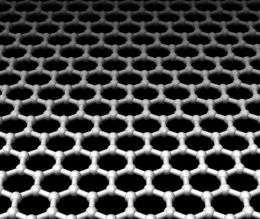
Graphene was discovered at The University of Manchester back in 2004, by Professor Andre Geim FRS and Royal Society Research Fellow Dr Kostya Novoselov. This incredible one-atom-thick gauze of carbon atoms, which resembles chicken wire, has quickly become one of the hottest topics in physics and materials science.
“Graphene is only one atom thick, optically transparent, chemically inert, and an excellent conductor,” says Dr Novoselov, from the Manchester research team.
“These properties seem to make this material an excellent candidate for applications in various electro-optical devices that require conducting but transparent thin films. We believe graphene should improve the durability and simplify the technology of potential electronic devices that interact with light.”
Prof Geim said: “Transparent conducting films are an essential part of many gadgets including common liquid crystal displays (LCDs) for computers, TVs and mobile phones.
“The underlying technology uses thin metal-oxide films based on indium. But indium is becoming an increasingly expensive commodity and, moreover, its supply is expected to be exhausted within just 10 years.
“Forget about oil – our civilisation will first run out of indium. Scientists have an urgent task on their hands to find new types of conductive transparent films.”
The Manchester research team has now demonstrated highly transparent and highly conductive ultra-thin films that can be produced cheaply by ‘dissolving’ chunks of graphite – an abundant natural resource – into graphene and then spraying the suspension onto a glass surface.
The resulting graphene-based films can be used in LCDs and, to prove the concept, the research team have demonstrated the first liquid crystal devices with graphene electrodes.
Dr Novoselov believes that there are only a few small, incremental steps remain for this technology to reach a mass production stage. “Graphene-based LCD products could appear in shops as soon as in a few years”, he adds.
A research team from the Max Planck Institute for Polymer Research in Germany recently reported in Nano Letters how they had used graphene-based films to create transparent electrodes for solar cells [Wang, X.; Zhi, L.; Mullen, K. Nano Lett. 2008, 8, 323.].
But the German team used a different technology for obtaining graphene films, which involved several extra steps.
The Manchester team says the films they have developed are much simpler to produce, and they can be used not only in LCDs but also in solar cells.
Source: University of Manchester


