CU-Boulder researchers forecast 3-in-5 chance of record low Arctic sea ice in 2008
April 30, 2008
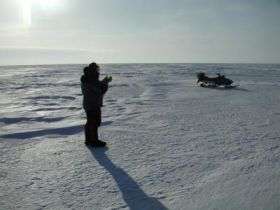
CU-Boulder researchers are forecasting a 59 percent chance of a record low minimum extent of Arctic sea ice in 2008. Credit: James Maslanik, University of Colorado at Boulder
New University of Colorado at Boulder calculations indicate the record low minimum extent of sea ice across the Arctic last September has a three-in-five chance of being shattered again in 2008 because of continued warming temperatures and a preponderance of younger, thinner ice.
The forecast by researchers at CU-Boulder's Colorado Center for Astrodynamics Research is based on satellite data and temperature records and indicates there is a 59 percent chance the annual minimum sea ice record will be broken this fall for the third time in five years. Arctic sea ice declined by roughly 10 percent in the past decade, culminating in a record 2007 minimum ice cover of 1.59 million square miles. That broke the 2005 record by 460,000 miles -- an area the size of Texas and California combined.
"The current Arctic ice cover is thinner and younger than at any previous time in our recorded history, and this sets the stage for rapid melt and a new record low," said Research Associate Sheldon Drobot, who leads CCAR's Arctic Regional Ice Forecasting System group in CU-Boulder's aerospace engineering sciences department. Overall, 63 percent of the Arctic ice cover is younger than average, and only 2 percent is older than average, according to Drobot.
Changes in Arctic sea ice -- defined as the area of an ocean covered by at least 15 percent ice -- is "one of the more compelling and obvious signs of climate change," said Drobot. Continued Arctic sea ice declines likely will have negative effects on various types of wildlife, including polar bears, walruses and seals, he said.
For humans, larger ice-free zones in the Arctic region for longer periods offer potential for cheaper and faster merchant shipping between North America and Europe, he said. The declining ice may well open up the Northwest Passage, for example, which runs through the Bering Strait, the Chukchi Sea, the Beaufort Sea and through the Canadian Archipelago to the Atlantic Ocean.
"Based on the current sea ice conditions, aerospace engineering Research Professor Jim Maslanik said the Northern Sea Route -- the shipping lane from the Atlantic Ocean to the Pacific Ocean along the Russian coastline -- might also open up this summer. "It also is quite possible that extensive ice-free conditions could develop at or near the North Pole," said Maslanik.
CU-Boulder's Arctic Regional Ice Forecasting System group -- the only research group in the world currently making seasonal Arctic sea ice forecasts based on probability -- receives funding from the National Science Foundation, the National Oceanic and Atmospheric Administration and NASA.
In January 2008, a team led by Maslanik and involving CCAR's Drobot, Charles Fowler and William Emery, as well as Julienne Stroeve of CU-Boulder's Cooperative Institute for Research in Environmental Sciences and NASA's Jay Zwally and Donghui Yi, concluded there had been a nearly complete loss of the oldest, thickest Arctic sea ice. The team calculated that 58 percent of the remaining Arctic sea ice was thin and only two to three years old.
The researchers used passive microwave, visible infrared radar and laser altimeter satellite data from NOAA, NASA and the U.S. Department of Defense, as well as ocean buoys to measure and track sections of sea ice. They developed "signatures" of individual ice sections roughly 15 miles square using their thickness, roughness, snow depth and ridge characteristics, tracking them over the seasons and years as they moved around the Arctic.
Last summer the CCAR Arctic Regional Ice Forecasting System group, which has been making Arctic sea ice forecasts for the past six years, correctly forecast the 2007 record minimum. Updated forecasts will be provided throughout the spring and summer. For more information visit the Web at http://ccar.colora … do.edu/arifs.
Source: University of Colorado at Boulder
-
Study shows global glaciers, ice caps, shedding billions of tons of mass annually
Feb 08, 2012 |
4.5 / 5 (10) |
14
-
In scientific coup, Russians reach Antarctic lake
Feb 08, 2012 |
4.3 / 5 (7) |
6
-
New study shows correlation between summer Arctic sea ice cover and winter weather in Central Europe
Feb 01, 2012 |
4.8 / 5 (5) |
0
-
CU-Boulder-led team to assess decline of Arctic sea ice in Alaska's Beaufort Sea
Jan 26, 2012 |
5 / 5 (1) |
2
-
Predicting Arctic sea ice loss
Jan 17, 2012 |
3.8 / 5 (10) |
0
-
Engineers build first sub-10-nm carbon nanotube transistor
Feb 01, 2012 |
4.9 / 5 (33) |
30
-
Something old, something new: Evolution and the structural divergence of duplicate genes
Jan 31, 2012 |
4.6 / 5 (7) |
1
-
The hidden nanoworld of ice crystals: Revealing the dynamic behavior of quasi-liquid layers
Jan 30, 2012 |
5 / 5 (4) |
1
-
Stock market network reveals investor clustering
Jan 27, 2012 |
3.9 / 5 (23) |
8
-
Of microchemistry and molecules: Electronic microfluidic device synthesizes biocompatible probes
Jan 26, 2012 |
5 / 5 (2) |
0
-
Do some geologists actually act a lot like Randy Marsh?
Feb 11, 2012
-
Discrepancy between oxygen and carbon-dioxide levels
Feb 09, 2012
-
where gems are found in the world
Feb 09, 2012
-
Wind Waves in Reservoir ~ Wind run-up and Wind set-up
Feb 08, 2012
-
Balance of oxygen in the atmosphere
Feb 01, 2012
-
The case for a methanol-based economy
Jan 30, 2012
- More from Physics Forums - Earth
More news stories
Salvage workers begin pumping fuel from Italian shipwreck
Salvage workers Sunday began pumping fuel from the shipwrecked Italian cruise liner Costa Concordia, a day ahead of schedule, officials said.
7 hours ago |
5 / 5 (1) |
0
Latin America mining boom clashes with conservation
Latin America is experiencing a mining boom as prices rise fuelled by a hike in global demand, but the region is also being hit by a wave of violent protests, strikes and rallies by environmentalists.
15 hours ago |
5 / 5 (1) |
1
Political leaders play key role in how worried Americans are by climate change: study
More than extreme weather events and the work of scientists, it is national political leaders who influence how much Americans worry about the threat of climate change, new research finds.
Feb 06, 2012 |
5 / 5 (7) |
73
NASA budget will axe Mars deal with Europe: scientists
US President Barack Obama's budget proposal to be submitted next week for 2013 will cut NASA's budget by 20 percent and eliminate a major partnership with Europe on Mars exploration, scientists said Thursday.
Space & Earth / Space Exploration
Feb 10, 2012 |
5 / 5 (3) |
58
Humans may have helped the decline of African rainforests 3000 years ago
(PhysOrg.com) -- Large areas of rainforests in Central Africa mysteriously disappeared over three thousand years ago, to be replaced by savannas. The prevailing theory has been that the cause was a change ...
Scientists discover molecular secrets of 2,000-year-old Chinese herbal remedy
For roughly two thousand years, Chinese herbalists have treated Malaria using a root extract, commonly known as Chang Shan, from a type of hydrangea that grows in Tibet and Nepal. More recent studies suggest that halofuginone, ...
New method to examine batteries -- MRI from the inside
There is an ever-increasing need for advanced batteries for portable electronics, such as phones, cameras, and music players, but also to power electric vehicles and to facilitate the distribution and storage of energy derived ...
A mitosis mystery solved: How chromosomes align perfectly in a dividing cell
Although the process of mitotic cell division has been studied intensely for more than 50 years, Whitehead Institute researchers have only now solved the mystery of how cells correctly align their chromosomes during symmetric ...
Google might launch Drive for cloud storage soon
(PhysOrg.com) -- Google's next big move, according to the Wall Street Journal, is a cloud storage service called Drive. Hardly first to the plate, Google is simply catching up to introducing its cloud reposi ...
Lab study raises questions over nano-particle impact
Tests involving chickens have raised questions about the impact on health from engineered nano-particles, the ultra-fine grains commonly used in drugs and processed foods, scientists said on Sunday.
Overeating may double risk of memory loss
New research suggests that consuming between 2,100 and 6,000 calories per day may double the risk of memory loss, or mild cognitive impairment (MCI), among people age 70 and older. The study was released today and will be ...
Apr 30, 2008
Rank: 2 / 5 (4)
Funny I didn't know the ancient Egyptians kept records of arctic sea ice.
May 02, 2008
Rank: 2.3 / 5 (3)