GIOVE-B spacecraft in good health
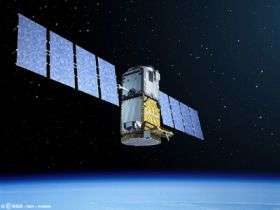
A second test satellite for Galileo, Europe's rival to the US Global Positioning System, is "in good health" despite a hiccup that emerged after it was placed in orbit last Sunday, the European Space Agency said on Wednesday.
After its successful launch by a Soyuz Rocket from Baiknour on 27 April and accurate insertion into its target orbit by the Fregat autonomous upper stage, GIOVE-B is now completing its Launch and Early Operations Phase (LEOP), which will shortly give way to the platform commissioning phase.
Platform commissioning includes the on-board verification of all primary and redundant platform subsystems, namely telemetry and telecommand, propulsion, power, thermal control, and attitude and orbit control. GIOVE-B operations are being carried out from Telespazio's Fucino Space Centre in Italy.
Once the spacecraft platform has been commissioned, switch-on of the various payload elements can begin. First signal transmission is anticipated in the coming days.
Charging the batteries
Since the spacecraft had been running on battery power from just before liftoff - throughout the lengthy series of manoeuvres performed by Fregat to reach the intended orbit - the first tasks after separation from Fregat were to deploy the solar arrays and achieve Sun-pointing, so that battery charging could begin.
The first-choice method to turn the spacecraft for Sun-pointing is to use the reaction wheels. GIOVE-B is equipped with four gyroscope-like wheels driven by brushless electric motors. Altering the speed of rotation of these wheels allows the satellite to be rotated in space.
Use of the reaction wheels for initial pointing is the first choice because, once they are operational, the supply of electricity from the solar arrays is essentially unlimited. However, due to the battery discharge that occurred during pre-orbital flight, the spacecraft operations manual only allows a restricted time for these manoeuvres to be accomplished.
Attitude and orbit control
GIOVE-B's reaction wheels were slow to respond and stable Sun-pointing was not achieved within the specified time period. As a consequence, around five hours after launch it was decided to put the satellite into safe mode, and Sun-pointing was achieved using small engines known as thrusters.
The initial underperformance of the reaction wheels was found to have occurred due to a mismatch between the on-board avionics software and the reaction wheel calibration data. This has now been corrected by the uploading of a software patch to the spacecraft, leading to nominal performance.
Use of the thrusters is the second-choice method because one of the factors determining the operational life of GIOVE-B is the amount of propellant that the spacecraft carries. The thrusters are used for orbital station-keeping and conservation of propellant is important to maximise the lifetime of the spacecraft. Once the propellant is nearly exhausted, the thrusters' final task is to lift the spacecraft into a 'graveyard' orbit at the end of its mission - to free the orbit for the operational Galileo constellation.
Payload switch-on
Once the GIOVE-B spacecraft platform is fully commissioned, the navigation payload can be switched on. The rubidium and passive hydrogen maser clocks will be started first, followed by the navigation signal generator.
The final units to be turned on will be the transmit chain consisting of L-band solid-state power amplifiers that broadcast the Galileo signals to the Earth. First signal transmission is anticipated in the coming days and will be received and calibrated by In-Orbit Test (IOT) facilities deployed at ESA's ground station in Redu (Belgium) and at Chilbolton Observatory in the UK.
Source: ESA


