Scientists find rings of Jupiter are shaped in shadow
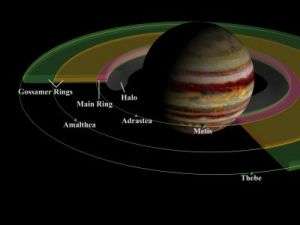
April 30, 2008 Jupiter's Rings

Jupiter's rings consist of bands of widely scattered dust particles generated by the impact of space debris into the planet's small inner moons, Adrastea, Metis, Amalthea and Thebe. This dust is organized into a main ring, an inner halo, and two fainter and more distant gossamer rings. The rings largely are bounded by the orbits of these four moons. However, a faint outward protrusion of dust (not show here) extends beyond the orbit of Thebe.Courtesy NASA

Scientists from the University of Maryland and the Max-Planck Institute for Solar System Research in Germany appear to have solved a long-standing mystery about the cause of anomalies in Jupiter's gossamer rings.

In a new study published in the May 1 issue of Nature, they report that a faint extension of the outermost ring beyond the orbit of Jupiter's moon Thebe, and other observed deviations from an accepted model of ring formation, result from the interplay of shadow and sunlight on dust particles that make up the rings.

"It turns out that the outer ring's extended boundary and other oddities in Jupiter's rings really are 'made in the shade,'" said Douglas Hamilton, a professor of astronomy at the University of Maryland. "As they orbit about the planet, dust grains in the rings alternately discharge and charge when they pass through the planet's shadow. These systematic variations in dust particle electric charges interact with the planet's powerful magnetic field. As a result small dust particles are pushed beyond the expected ring outer boundary, and very small grains even change their inclination, or orbital orientation, to the planet."

Hamilton and German co-author Harald Krüger studied for the first time new impact data on dust grain sizes, speeds, and orbital orientations taken by the spacecraft Galileo during its traversal of Jupiter's rings in 2002-2003, as part of its deliberate maneuvering for a death plunge into the planet. Krüger analyzed the new data set and Hamilton created elaborate computer models that matched dust and imaging data on Jupiter's rings and explained the observed eccentricities.

"Within our model we can explain all essential structures of the dust ring we observed," said Krüger.

According to Hamilton, the mechanisms identified in this paper effect the rings of any planet in any solar system, but the effects may not be as evident as it is at Jupiter. "The icy particles in Saturn's famous rings are too large and heavy to be significantly shaped by this process, which is why similar anomalies are not seen there," he said. "Our findings on the effects of shadow may also shed some light on aspects of planetary formation because electrically charged dust particles must somehow combine into larger bodies from which planets and moons are ultimately formed."

Jupiter, the fifth planet from the Sun, has 63 known moons. The dust forming Jupiter's faint rings is produced when bits of space debris smashes into the small inner moons Adrastea, Metis, Amalthea and Thebe (listed closest to farthest). This dust is organized into a main ring, an inner halo, and two fainter and more distant gossamer rings. The rings largely are bounded by the orbits of these four moons, but a faint outward protrusion of dust extending beyond the orbit of Thebe (pronounced The-be) has, until now, mystified scientists.

Italian scientist Galileo Galilei was the first to discover that Jupiter had moons. Galileo first observed the planet's four largest moons in 1610.

On December 7, 1995 NASA's Galileo spacecraft reached Jupiter and began the first of 35 orbits around the planet. Over seven years the spacecraft took some 14, 000 images of Jupiter, its moons and rings. On September 21, 2003 the Galileo spacecraft was put into a controlled dive to end its mission, by plummeting through Jupiter's atmosphere. In addition to its imaging instruments, the spacecraft carried a supersensitive dust detector, which registered thousands of impacts from dust particles on its way through Jupiter's ring system in 2002 and 2003. The Thebe extension was one of the many new discoveries made by the Galileo spacecraft.

Source: University of Maryland


print this article email this article download pdf blog this article bookmark this article     Stumble it Digg this share on Facebook retweet share on Reddit add to delicious
Rate this story - 4.3 /5 (11 votes)

Rank Filter

Move the slider to adjust rank threshold, so that you can hide some of the comments.


Display comments: newest first

  • brant - Apr 30, 2008
    • Rank: 1 / 5 (2)
    "Our findings on the effects of shadow may also shed some light on aspects of planetary formation because electrically charged dust particles must somehow combine into larger bodies from which planets and moons are ultimately formed."

    You mean there are electrical interactions???

    See the Electric Universe for the model on star/planet formation with charged dust grains.

April 30, 2008 all stories

Comments: 1

4.3 /5 (11 votes)
  • Stumble this up

  • Digg this

  • share this

  • hide
  • Related Stories

  • STAR TRAK for November: Mars is prominent again
    created Nov 02, 2009 | popularity not rated yet | comments 0
  • Galileo's Jupiter Journey Began Two Decades Ago
    created Oct 19, 2009 | popularity not rated yet | comments 0
  • Saturn to Pull Celestial Houdini on August 11
    created Aug 10, 2009 | popularity not rated yet | comments 0
  • Guide to galaxy for Earth Hour's starry, starry night
    created Mar 18, 2009 | popularity not rated yet | comments 0
  • STAR TRAK for November
    created Nov 03, 2008 | popularity not rated yet | comments 0


  • hide
  • Relevant PhysicsForums posts

  • The shape of our solar system's orbits.
    created Nov 07, 2009
  • Above or Below the Line of Nodes
    created Nov 07, 2009
  • Supernova vs. Nova?
    created Nov 07, 2009
  • Supernova's Gamma Rays and Comets
    created Nov 06, 2009
  • More from Physics Forums - General Astronomy

Other News

Deep creep means milder, more frequent earthquakes along Southern California's San Jacinto fault

Deep creep means milder, more frequent earthquakes along Southern California's San Jacinto fault

Space & Earth / Earth Sciences

created 9 hours ago | popularity 4.7 / 5 (3) | comments 0

With an average of four mini-earthquakes per day, Southern California's San Jacinto fault constantly adjusts to make it a less likely candidate for a major earthquake than its quiet neighbor to the east, the ...


Success in 'space elevator' competition (AP)

Success in 'space elevator' competition (Update 3)

Space & Earth / Space Exploration

created Nov 05, 2009 | popularity 4.3 / 5 (33) | comments 50

(AP) -- A robot powered by a ground-based laser beam climbed a long cable dangling from a helicopter on Wednesday to qualify for prize money in a $2 million competition to test the potential reality of the ...


In a Galaxy Far, Far Away...

In a Galaxy Far, Far Away...

Space & Earth / Astronomy

created Nov 06, 2009 | popularity 4.8 / 5 (5) | comments 15

(PhysOrg.com) -- Astronomers have published the discovery of the farthest known object in the cosmos: a star that exploded when the universe was only 630 million years old -- only 4.6% of its current age. ...


'Dropouts' pinpoint earliest galaxies

'Dropouts' pinpoint earliest galaxies

Space & Earth / Astronomy

created Nov 06, 2009 | popularity 4.2 / 5 (10) | comments 13

Astronomers, conducting the broadest survey to date of galaxies from about 800 million years after the Big Bang, have found 22 early galaxies and confirmed the age of one by its characteristic hydrogen signature ...


Space hotel taking bookings for 2012 opening

Space hotel taking bookings for 2012 opening

Space & Earth / Space Exploration

created Nov 05, 2009 | popularity 4.4 / 5 (20) | comments 11

(PhysOrg.com) -- The first orbiting space hotel is on track to open for its first customers in 2012, but hurry, as bookings are filling fast.