Black hole expelled from its parent galaxy
April 30, 2008 Black hole expelled from its parent galaxy

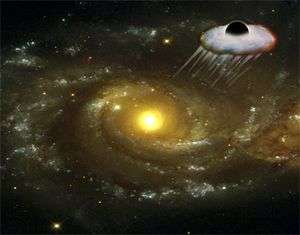
Ejection from the nucleus: for the first time in nature, astronomers have observed a supermassive black, which - propelled by gravitational waves - leaves its parent galaxy. The illustration depicts this scenario. Image: MPE/HST-Archive

By an enormous burst of gravitational waves that accompanies the merger of two black holes the newly formed black hole was ejected from its galaxy. This extreme ejection event, which had been predicted by theorists, has now been observed in nature for the first time. The team led by Stefanie Komossa from the Max Planck Institute for extraterrestrial Physics (MPE) have thereby opened a new window into observational astrophysics.

The discovery will have far-reaching consequences for our understanding of galaxy formation and evolution in the early Universe, and also provides observational confirmation of a key prediction from the General Theory of Relativity (Astrophysical Journal Letters, May 10, 2008).

When two black holes merge, waves of gravitational radiation ripple outward through the galaxy at the speed of light. Because the waves are emitted mainly in one direction, the black hole itself is pushed in the opposite direction, much like the recoil that accompanies the firing of a rifle or the launching of a rocket. The black hole is booted from its normal location in the nucleus of the galaxy. If the kick velocity is high enough, the black hole can escape the galaxy completely.

The MPE team’s discovery verifies, for the first time, that these extreme events actually occur; up to now they had only been simulated in supercomputers. The recoiling black hole caught the astrophysicists’ attention by its high speed - 2650 km/s - which was measured via the broad emission lines of gas around the black hole. At this speed, one could travel from New York to Los Angeles in just under two seconds. Because of the tremendous power of the recoil the black hole, which has a mass of several 100 millions solar masses, it was catapulted from the core of its parent galaxy.

In addition to the emission lines from gas bound to the recoiling black hole, the astronomers were also struck by a remarkably narrow set of emission lines originating from gas left behind in the galaxy. This gas has been excited by radiation from the recoiling black hole.

Gas that moves with the black hole - the so-called accretion disk gas - continues to "feed" the recoiling black hole for millions of years. In the process of being accreted, this gas shines in X-ray wavelengths. In fact the team around Komossa also detected this X-ray emission from the disk around the black hole at a distance of 10 billion light years: by chance the region was scanned by the satellite ROSAT, and at the extreme end of the visual field an X-ray source, the position corresponding with the distant galaxy.

Large kicks for mergers

The new discovery is also important because it indirectly proves that black holes do in fact merge and that the mergers are sometimes accompanied by large kicks. This process had been postulated in theory, but never before confirmed via direct observation. Another implication of the discovery is that there must be galaxies without black holes in their nuclei - as well as black holes which float forever in space between the galaxies.

This raises new questions for the scientists: Did galaxies and black holes form and evolve jointly in the early Universe? Or was there a population of galaxies which had been deprived of their central black holes? And if so, how was the evolution of these galaxies different from that of galaxies that retained their black holes?

In a close interplay between theory and observation, the astrophysicists prepare to answer these questions. Various detectors on earth and in space, for example the space interferometer LISA, are set to track gravitational waves. The MPE team`s discovery will provide new impetus for theorists to develop more detailed models of the superkicks and their consequences for the evolution of black holes and galaxies.

Citation: Komossa, S., Zhou, H., Lu, H. A recoiling supermassive black hole in the quasar SDSSJ092712.65+294344.0? Astrophysical Journal Letters, Vol. 678, L81, 2008 (May 10, 2008)

Source: Max-Planck-Institute for Extraterrestrial Physics


print this article email this article download pdf blog this article bookmark this article     Stumble it Digg this share on Facebook retweet share on Reddit add to delicious
Rate this story - 4.5 /5 (60 votes)

Rank Filter

Move the slider to adjust rank threshold, so that you can hide some of the comments.


Display comments: newest first

  • David6502 - Apr 30, 2008
    • Rank: 4 / 5 (1)
    So have gravitational waves actually been observed yet?
  • Mercury_01 - Apr 30, 2008
    • Rank: 3.5 / 5 (2)
    Wow.
  • thales - Apr 30, 2008
    • Rank: 5 / 5 (1)
    No, if the waves themselves had been observed it would be a major story. Pretty amazing all the same.
  • brant - Apr 30, 2008
    • Rank: not rated yet
    Is that a flying saucer leaving that galaxy????
  • earls - Apr 30, 2008
    • Rank: not rated yet
    lol brant my thoughts exactly
  • _Scott_ - May 01, 2008
    • Rank: not rated yet
    "astronomers have observed a supermassive black"
  • superhuman - May 03, 2008
    • Rank: not rated yet
    So there may be many stray supermassive black holes lurking in the void, waiting for an opportunity to meet intelligent life...

April 30, 2008 all stories

Comments: 7

4.5 /5 (60 votes)
  • Stumble this up

  • Digg this

  • share this

  • hide
  • Related Stories

  • Mysterious X-rays from a Nearby Galaxy
    created Nov 13, 2009 | popularity not rated yet | comments 0
  • NASA's Great Observatories Celebrate International Year of Astronomy
    created Nov 10, 2009 | popularity not rated yet | comments 0
  • Swift, XMM-Newton satellites tune into a middleweight black hole
    created Nov 10, 2009 | popularity not rated yet | comments 0
  • X-Ray Jets from Galaxies
    created Oct 19, 2009 | popularity not rated yet | comments 0
  • Chinese scientists create metamaterial black hole
    created Oct 16, 2009 | popularity not rated yet | comments 0


  • hide
  • Relevant PhysicsForums posts

  • avoidance of admitting that we dont know somethin
    created 5 hours ago
  • Speed of light : missing energy
    created 8 hours ago
  • Can light produce darkness and can noise procude quiteness 4
    created 11 hours ago
  • Magnetic Oscillation Equations
    created 17 hours ago
  • More from Physics Forums - General Physics

Other News

Restored machine to explore mysteries of Big Bang (AP)

Restored machine to explore mysteries of Big Bang

Physics / General Physics

created 9 hours ago | popularity 4.4 / 5 (12) | comments 6

(AP) -- Scientists are preparing the world's largest atom smasher to explore the depths of matter after successfully restarting the $10 billion machine following more than a year of repairs.


nuclear power plant

Doubts raised on nuclear industry viability

Physics / General Physics

created Nov 19, 2009 | popularity 3.2 / 5 (19) | comments 18

(PhysOrg.com) -- The investment in nuclear power has been growing around the world over the last few years, being viewed as a means for countries to control their energy security, avoid the price fluctuations ...


Researchers Find Innate Correlations Among Different Power Law Phenomena

Researchers Find Innate Correlations Among Different Power Law Phenomena

Physics / General Physics

created Nov 17, 2009 | popularity 4.3 / 5 (15) | comments 12

(PhysOrg.com) -- Studying the patterns that emerge in natural and social phenomena is a popular area of research, although usually individual phenomena are studied separately from each other. In a recent study, ...


Scientists demonstrate 'universal' programmable quantum processor

Scientists demonstrate 'universal' programmable quantum processor

Physics / Quantum Physics

created Nov 15, 2009 | popularity 4.6 / 5 (21) | comments 11

Physicists at the National Institute of Standards and Technology have demonstrated the first "universal" programmable quantum information processor able to run any program allowed by quantum mechanics -- th ...


Proton's party pals may alter its internal structure

Proton's party pals may alter its internal structure

Physics / General Physics

created Nov 18, 2009 | popularity 4.6 / 5 (18) | comments 9

A recent experiment at the DOE's Thomas Jefferson National Accelerator Facility has found that a proton's nearest neighbors in the nucleus of the atom may modify the proton's internal structure.