Climate modelers see modern echo in '30s Dust Bowl
Climate scientists using computer models to simulate the 1930s Dust Bowl on the U.S Great Plains have found that dust raised by farmers probably amplified and spread a natural drop in rainfall, turning an ordinary drying cycle into an agricultural collapse. The researcher say the study raises concern that current pressures on farmland from population growth and climate change could worsen current food crises by leading to similar events in other regions.
Recent studies indicate that periodic droughts in the western United States are controlled by naturally occurring periods of cool sea-surface water temperatures over the eastern tropical Pacific—so-called La Niña phases. Via long-distance winds, these phases indirectly affect faraway rain patterns. In addition to the 1930s, such patterns have occurred in the 1850-60s, 1870s, 1890s, 1950s, and 1999 to present.
What made the 1930s different was the arrival of farmers onto the Great Plains, where they replaced drought-resistant wild prairie grasses with fragile wheat, neglected to plant cover crops in unused fields, and allowed livestock to overgraze pastures.
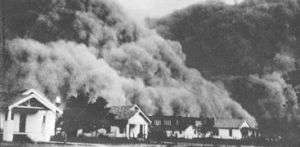
When the 1932-1939 drought struck, plants shriveled and ever more bare soil was exposed. The land was quickly eroded by gigantic dust storms, and farming collapsed. Skies were chronically darkened on and off; in some years, an estimated 770 million metric tons of topsoil were lost, and over the whole time, 3.5 million people were displaced--one of the 20th century’s worst environmental disasters. The new study finds that farm dust probably fed the disaster, doubling the drop in rainfall, and moving the drought itself northward into major farming regions.
The researchers, based at Lamont-Doherty Earth Observatory and NASA Goddard Institute for Space Studies (both affiliates of Columbia University’s Earth Institute) used a computer model to simulate a 1930s drought driven only by the change in sea-surface temperature. This showed a 5% drop in rainfall, centered over northern Mexico and the U.S. southwest, where little agriculture then took place. This would have affected the Great Plains too, but probably would have not brought disaster. Then the modelers added in the effects of dust, using data from the ‘30s that indicated dust sources, and allowing the computer to create dust storms. This yielded a simulated event eerily like the real one, with a full 10% drop in rain—to just 18 inches a year--and centered over the prairie farm regions of north Texas, Oklahoma, Missouri, Kansas, Nebraska and Iowa.
Lead author Benjamin Cook, a National Oceanic and Atmospheric Administration postdoctoral researcher affiliated with both Lamont and Goddard, said the effect occurred because dust particles suspended in air reflect solar radiation. Studies by researchers in other parts of the world show that this causes a drop in temperatures at or near the soil surface, lessening evaporation of moisture into the air, and thus decreasing precipitation even further. Dust on the Great Plains helped draw the drought northward like a siphon, said Cook. “This is what made the Dust Bowl the Dust Bowl,” he said. “It was a process that fed on itself.”
The U.S. southwest is currently suffering a serious long-term drought that threatens agriculture and population growth there. Cook said it is unlikely that this by itself will cause another Dust Bowl in the United States. Among other things, the U.S. Natural Resources Conservation Service, founded in response to the ‘30s crisis, has shifted farmers into more sustainable practices. On the other hand, Cook points out that many scientists believe hard-pressed farmers and herders in China and Africa’s Sahel region may be repeating the experience, ruining marginal lands in order to feed themselves in the short term.
“This highlights the fact that humans can alter natural events and make them worse,” said coauthor Richard Seager, a modeler at Lamont. Seager says that scientists studying global climate change predict many subtropical regions will dry in coming years. “That, in combination with the pressure from rising population and demand for food, could lead to a similar cycle of drought, dust storms and more drought,” he said. “The lesson of the Dust Bowl is there to be learned.”
Citation: “Dust and sea surface temperature forcing of the 1930s ‘Dust Bowl’ drought” appears in the current online edition of Geophysical Research Letters: www.agu.org/journals/gl/gl0808/2008GL033486/ .
Source: Columbia University


